
An Anafiotika Couple Photoshoot Beneath the Acropolis
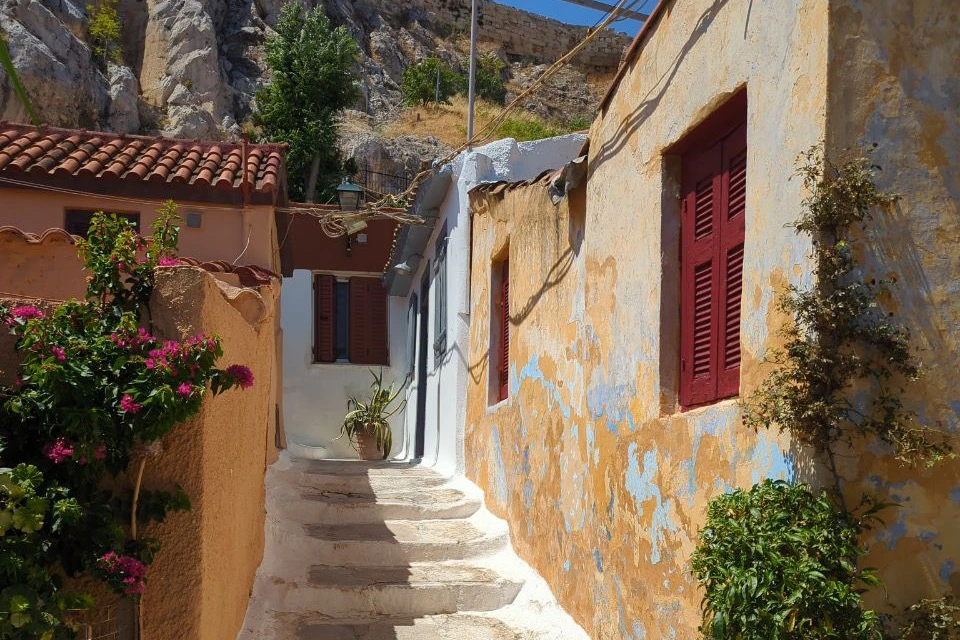
Turn uphill from Plaka and Athens suddenly gets very small. The lanes narrow, pale walls throw light back at you, red shutters appear above flowering pots and the Acropolis rock seems to lean over the roofs. For a few minutes, the city has the scale and colours of a Cycladic village.
That is the magic of an Anafiotika couple photoshoot. It isn't a collection of grand monuments. It's the two of you in a rising lane, a hand offered on the steps, a flash of pink flowers and, higher up, a quiet view across Athens. The setting doesn't need much added to it. In fact, the less the session asks of the neighbourhood, the better it tends to feel.
Updated

Table of Contents
First decide whether Anafiotika is your kind of Athens
The Acropolis is present, but not always in the way first-time visitors imagine. Rock and lower walls can appear above the roofs, while an upper opening looks out towards the white city and Mount Lycabettus. The famous Parthenon panorama isn't the neighbourhood's main photographic job.
That is useful to know before you fall in love with the words “island village beneath the Acropolis”. If a large, instantly recognisable landmark matters more than texture, choose an Acropolis viewpoint. If you want cafés, flags and colourful neoclassical façades, Plaka gives you a broader street story. Anafiotika is for couples who would happily trade scale for closeness.
It's also wonderfully simple when one of you feels awkward around a camera. The lane gives you something to do. You walk, negotiate the steps, make space for each other and occasionally discover that two adults can't climb in matching rhythm. That small bit of reality is much more useful than a perfect pose.
The white walls belong to a lived-in neighbourhood
People still live here. That one fact should guide the whole session.
A public lane is a place you can pass through. It doesn't make the window beside it public, turn a doorstep into seating or invite anyone into a courtyard or onto a roof. A pot of flowers may be exactly the colour the frame needs, but it stays where its owner put it. Shutters, chairs and washing lines aren't props.
This isn't a gloomy list of restrictions. It's the reason a small session works so well. One photographer, handheld equipment and two people who can move when the lane needs them create almost no friction. The neighbourhood carries on around you, and the photographs keep the feeling that drew you there.
Make a complete gallery from five small moments
Open with the rising lane. This is the establishing photograph: walls on both sides, steps leading the eye and the Acropolis rock or roofline above. You're part of a place, not dropped in front of a blank background.
Let the steps create movement. Walk a short section, pause on different levels and reach back for a hand. The photographer gets shape, height and interaction without asking you to perform.
Come close beside a pale wall. Once the wide scene has done its work, a simple wall lets expressions and touch take over. This is where a quiet portrait, a laugh or the way you look at each other becomes the whole frame.
Use one colour detail. A red shutter, blue door or flowering plant stops the whitewashed story becoming visually repetitive. You don't need to touch it or stand on its threshold. A careful angle from the public lane is enough.
Finish with the city reveal. An upper opening towards Mount Lycabettus changes the scale for one photograph. The close lanes fall away, Athens appears below and the gallery gets a sense of arrival.
Five jobs, one small footprint. That is more coherent than repeating the same embrace against six similar walls, and much kinder than turning the neighbourhood into a scavenger hunt.
Begin on a rising lane and let the steps set the pace
Start with a slow walk. You don't have to look at the camera or at each other on command. Notice where the step changes height, offer a hand and let the photographer work a little farther back. Then pause once, perhaps with one of you a step higher, and let the frame become closer.
Short loops are better than repeated climbs. Walking the same ten metres over and over looks less spontaneous with every pass and turns a public lane into a set. One walk up, one turn and one close frame are usually plenty. The photographer can change position while you keep your energy for the rest of the morning.
If a resident appears or someone needs the passage, clear it fully. Don't press yourselves flat against a doorway and hope that counts. Step to a genuine open patch, smile, wait and begin again when the lane is free. The interruption is rarely more than a minute, and nobody's morning has to become your production problem.
Let pale walls simplify the close portraits
That simplicity also helps when you don't want to spend a session posing. Stand close, breathe and talk quietly. Your photographer can make a frame while one of you fixes the other's collar, brushes away a loose strand of hair or tries not to laugh. Nothing dramatic needs to happen.
The light matters. A pale wall in hard sun can be almost painfully bright, with deep shadow beside it. A photographer may choose the shaded side of the lane, use reflected light from the opposite wall or wait for the sun to move off a small patch. Taking three steps to a softer surface can do more than any amount of editing later.
Don't worry if every wall isn't brilliant white. Sun-worn ochre, patches of old blue paint and textured plaster tell a more truthful story of the neighbourhood. A gallery gains depth when it includes both the familiar island-like palette and the lived layers underneath it.
Treat the steps as part of the plan, not a surprise
Wear broken-in shoes with useful grip for the approach and the moving photographs. If a smarter pair matters to the look, carry it in a small bag and change on a level patch for a few frames. Nobody receives a prize for reaching an upper lane in shoes that have declared war on their feet.
Share mobility concerns before the day. A local photographer can plan a lower, shorter sequence, reduce repeated climbing or recommend a different Athens setting if steps make the experience more stressful than enjoyable. That conversation is part of good photography, not an awkward extra.
Keep what you carry equally practical. Water, sunglasses between frames and one small touch-up item are useful. A full outfit change, large props and several bags aren't. There's little spare room to set things down without blocking a passage or borrowing somebody's threshold.
Keep the city view as a quiet reveal
The view works best as a breath, not as proof that you reached a secret platform. Use the public stopping point, respect any barrier and make one wide frame before coming closer. The Acropolis isn't the star from this angle. The contrast is between the tiny world you've just walked through and the enormous city outside it.
Bright midday light can flatten the distant buildings and turn the pale foreground into glare. Softer morning light gives the layers more shape. Later in the day, the view can be lovely too, but the upper passages may be busier and the light direction will depend on the season.
If the opening is occupied, skip it. A city view is a useful final chapter, not a reason to hover behind other visitors or squeeze past a barrier. The gallery already has a beginning, movement, closeness and colour. It can survive without the last wide frame.
Choose the time for light and comfort, not a promise of emptiness
No time guarantees empty lanes. Residents come and go, visitors arrive early, maintenance happens and a delivery can appear exactly when the composition looks perfect. Plan for calm, not control.
Late afternoon can work when the sun has dropped and the walls are no longer blazing. It suits couples who dislike dawn and can accept more movement around them. A photographer should scout the light rather than assume that every picturesque wall faces the sunset.
Midday is the difficult option, especially in July and August. High sun creates hard contrast, pale walls bounce brightness into faces and the climb feels less charming when both of you are overheating. If midday is unavoidable, keep the session shorter, use shade, carry water and let the brightest exposed lanes go.
Spring and autumn often give the easiest balance of temperature and light. Winter can be quieter and moodier. The best weather fallback is simple: if rain makes smooth steps unsafe, move the date or use a more sheltered Athens setting. A wet-stone adventure isn't a romantic requirement.
Wear colours that belong beside white, ochre and red
If one person wears the stronger colour, let the other use a quieter tone. That keeps the pair connected without making you look as though you were issued a uniform for the morning.
Choose fabric that moves and breathes. A loose shirt, soft skirt or unstructured jacket gives the walking photographs life, while heavy formal clothes can feel out of place in a steep lane. Skip large logos and very fine high-contrast patterns, which compete with shutters, plants and textured plaster.
Most importantly, dress for the route you're actually doing. A beautiful outfit that makes you watch every step will show in your shoulders and face. Comfort isn't separate from the look. It's what allows the two of you to forget the camera for a minute.
Keep the camera footprint smaller than the lane
Stands, lights, tripods, large reflectors, a crew, bulky props or any attempt to reserve space turn the session into something else. Check the current requirements with the City of Athens, relevant property owners and, when heritage space is involved, the appropriate cultural authority. Requirements can change, so a blog shouldn't make the final ruling for a future date.
The same principle applies even when formal permission isn't the issue. If the equipment can't be lifted away in seconds, it's probably too large for this plan. Anafiotika rewards attention, not production weight.
A local photographer should also have a replaceable-scene rule. If one wall or lane is busy, identify the job it was meant to do and solve that job nearby. Find another shaded pale wall, another safe step sequence or another touch of colour. Never defend one exact doorstep as though the entire gallery depends on it.
Add Plaka only when the colour contrast earns its place
Plaka is useful when you want a clear second chapter. Its yellow and peach façades, flags, café streets and neoclassical details can turn the gallery from quiet and pale to warm and lively. It also gives you an easy place to finish with coffee after the climb.
Keep the contrast clear. Make Anafiotika the restrained whitewashed chapter, then use one Plaka street for colour. Don't drift through five extra lanes until the original idea disappears. If your session starts to sound like a complete Athens sightseeing route, it has crossed into a different plan.
And if you discover that you really want the Acropolis large in the frame, choose that honestly. The right location isn't the one with the most romantic description. It's the one that gives you the photographs you'll actually want to live with.
Plan your Anafiotika couple photoshoot
Tell your photographer what draws you here: the island-like texture, the steps and movement, quiet close portraits or the upper city view. Share how much climbing feels comfortable and whether a short Plaka colour finish would add something real.
You can plan the session with a photographer in Athens who can scout the light, keep the route small and change a scene without turning the neighbourhood upside down. Leave room for a coffee afterwards. You will have earned it, and your feet may wish to file a formal request.
Anafiotika couple photoshoot FAQs
Practical answers for a quiet, respectful Anafiotika session
Early morning is usually the strongest all-round choice for softer light, lower heat and better odds of calm lanes. It never guarantees emptiness. Late afternoon can also work when the sun has softened, although visitor movement may be heavier.
Parts of the rock and lower walls can appear above the lanes, but Anafiotika isn't the classic Parthenon panorama. Its main strengths are whitewashed texture, steps, shutters, flowers and close portraits. An upper opening can add a view across Athens towards Mount Lycabettus.
Expect an uphill approach, uneven stone and steep or narrow steps. Tell your photographer about mobility, balance or footwear concerns before the plan is agreed. A shorter lower route may be possible, but Anafiotika isn't a step-free setting.
Choose breathable clothes that move, coordinated colours and broken-in shoes with grip. Cream, blue, olive, terracotta and muted red work well with the pale walls and greenery. Carry dressier shoes only if you can change on level ground.
No. Doorsteps, windows, courtyards, roofs, chairs, shutters and pots belong to residents even when they sit beside a public lane. Use camera angle and distance instead of rearranging somebody's home.
A small handheld couple session is different from a production that occupies public space. If you plan to use stands, lights, a tripod, a crew, large props or controlled access, check the current requirements with the City of Athens and any relevant heritage or property authority before the day.
Only if you want a clear colour contrast. Anafiotika can provide a complete intimate gallery on its own. Plaka adds warmer façades, flags and café life, but it should be one purposeful second chapter rather than the beginning of a long location list.
Your photographer should replace the visual job, not wait indefinitely for one exact pin. Another shaded wall can make the close portrait, another safe step sequence can create movement and another coloured shutter can provide the detail. Flexibility protects both the experience and the neighbourhood.


Our Athens Shoots:
Book your Athens couple Photographer!
Start Booking
A Plaka Couple Photoshoot Through Athens' Loveliest Streets

An Athens Rooftop Couple Photoshoot with Acropolis Views
Turn Your Athens Couple Photoshoot Into a Brilliant Date
How to Make Your Athens Honeymoon or Anniversary Photoshoot Personal

Athens Engagement Photos: Romantic Ideas That Feel Like You
Natural Athens Couple Photos Without Awkward Posing
ENJOY $20 OFF
Your first photoshoot when you become an email subscriber.
Related Articles

A Plaka Couple Photoshoot Through Athens' Loveliest Streets
Choose the loveliest Plaka streets for your couple photoshoot, with an easy flower, shutters, steps and colour route that respects the neighbourhood.

An Athens Rooftop Couple Photoshoot with Acropolis Views
Plan an Athens rooftop couple photoshoot with clear property permission, the right Acropolis view, well-timed light, wind-ready clothes and a safe fallback.
Turn Your Athens Couple Photoshoot Into a Brilliant Date
Turn an Athens couple photoshoot into a relaxed date with an easy walk, one meaningful activity, thoughtful coffee timing and a lovely plan for afterwards.