
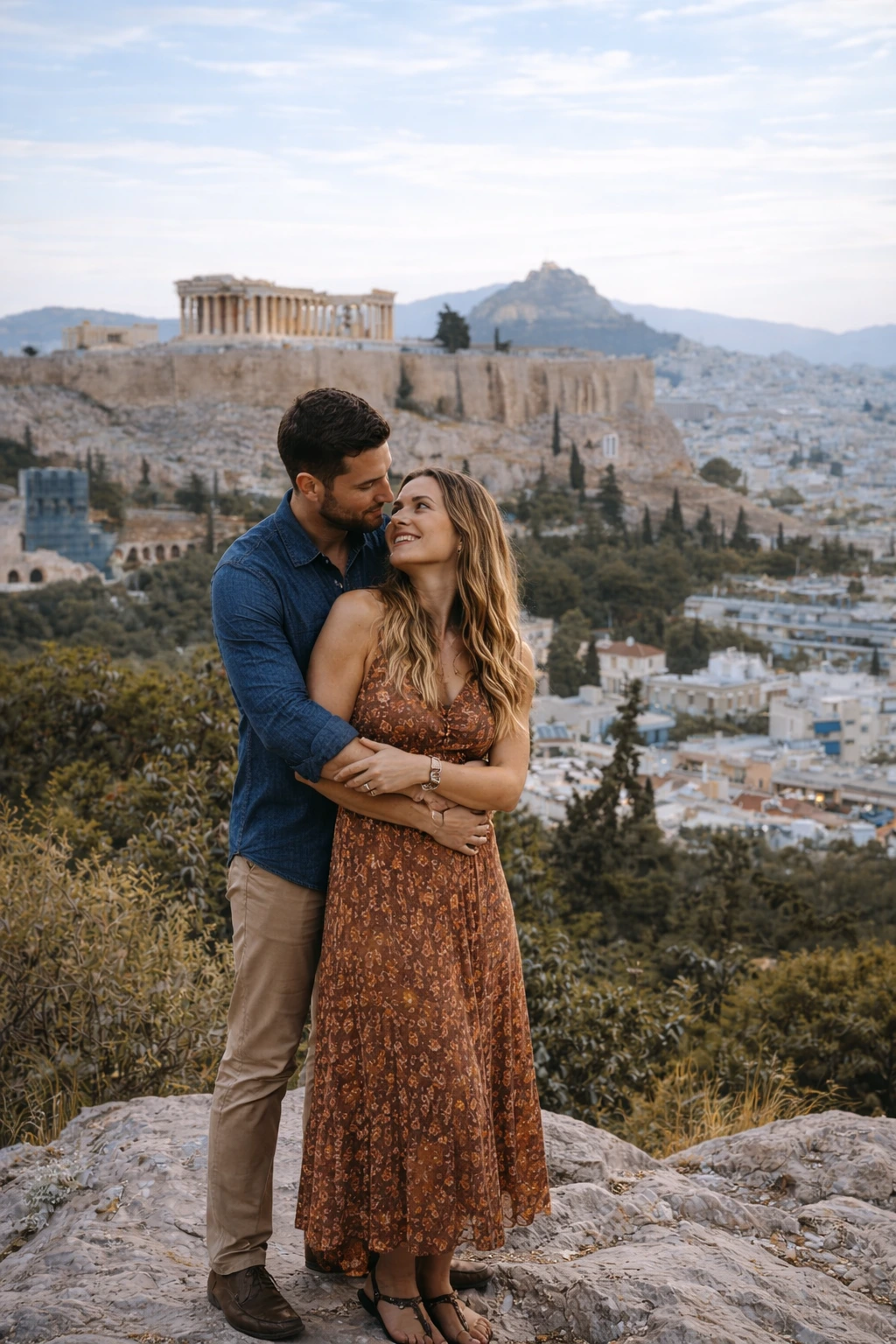
Athens After Sunset: Couple Photos with the Illuminated Acropolis
Athens changes character when the sun slips away. The pale stone cools, the sky deepens and the Acropolis begins to glow above the city. For a couple, that transition can become the story of the whole photoshoot: a few relaxed portraits in the last daylight, a walk as blue hour arrives, then close, cinematic frames with the illuminated hill behind you.
The best evening plan isn't to begin in full darkness. It is to start early enough to move comfortably, let your photographer capture the changing light and finish somewhere lower, lit and easy to leave. This guide shows you how to build that progression without turning the evening into a race between distant viewpoints.
Updated

Table of Contents
Why night-time couple photos in Athens feel completely different
That change gives one short session several visual moods without an outfit change or a journey across town. You can begin with wide portraits that place you in the city, move into walking photographs as lights appear, then finish with tighter frames where expressions and the illuminated Acropolis carry the picture.
Night photographs also reward stillness. You don't need a complicated performance. A slow walk, a hand on an arm, a pause to look at the view or a quiet conversation gives the photographer enough real movement to work with. The city supplies the drama, so the two of you can remain recognisably yourselves.
There is one useful expectation to set: darkness does not turn every public corner into a perfect backdrop. Light direction, passing people, temporary closures and the way a monument is illuminated can all change. So give yourselves a clear order and one easy backup for the final frames. That feels far better than chasing one exact mark on the pavement.
Start before sunset and let the city change around you
Beginning before sunset solves several problems at once. You can greet your Athens photographer and settle in while you can still see the ground clearly. There is time for natural walking portraits before the camera settings become more demanding. Most importantly, the collection records the transition instead of jumping from bright afternoon to black sky.
Ask your photographer to work backwards from the final illuminated view. The plan might allow 15 minutes to meet and warm up, 20 minutes for late-day portraits, 15 minutes for blue-hour movement and the remaining time for the lit Acropolis frames. Use that as a loose rhythm, then follow the best light. If the sky becomes beautiful earlier, or a quieter corner appears, the order can breathe.
Check the sunset time again close to the shoot. Cloud, haze and surrounding buildings affect when a particular street actually loses light. Your photographer may also move the meeting time by a few minutes after scouting the route. A tiny timing tweak can be exactly what the evening needs.
To compare an evening session with other times of day, see our Athens photoshoot timing guide.
Choose a lower, lit Acropolis backdrop
The lower walk picked up a softer evening glow in October 2026, when Athens refreshed the lighting along Dionysiou Areopagitou and Apostolou Pavlou and brought warm light to more side paths and nearby archaeological remains. It is still worth checking current conditions before your date, as maintenance, events and special switch-offs can affect what you find.
Look for a position where the Acropolis is visible but not directly above your heads. A little distance lets the monument read clearly and gives the photographer room to balance you with the skyline. Side light from the promenade can also be more flattering than standing directly beneath a bright lamp.
Public space remains public space. People may pass through, and no photographer can reserve a clear background. A patient minute, a small angle change or a tighter composition is usually more helpful than trying to remove the city from the photograph. Keep bags compact and close, leave the route open and choose a final meeting or pickup point before the session begins.
Use the hills for sunset, then walk down before dark
If a hill belongs in your plan, arrive while there is plenty of light and use it for the wide scene. Wear stable shoes for the climb, keep the shoes you want in the portraits in a small bag if necessary and begin descending before the remaining daylight disappears. The final illuminated portraits can then happen on a lower, lit route.
It creates a gorgeous change within one walk: open sky and a huge Athens view first, then closer street-level moments as the lights come on. It also avoids asking you to hurry downhill while carrying coats, phones or a change of shoes. You may see the western hills listed as open around the clock. Treat that as useful access information, not a reason to squeeze in a dark path. A quick current check keeps the walk feeling easy.
Lycabettus can also show the city moving from sunset into lights, but it creates a separate transport and timing decision. Unless that elevated panorama is the whole point of your session, combining it with the Acropolis promenade can spend too much of a short evening in transit. Choose one elevated viewpoint and one lower finish.
Let the camera work harder while you do less
What helps is holding a comfortable position for a moment longer. Instead of walking quickly towards the camera, take two slow steps and pause. If the photographer asks you to look at each other, give the expression time to happen rather than snapping straight back towards the lens. Small movements photograph beautifully when the background is glowing.
A little grain, movement or shadow can be part of the atmosphere. Evening portraits do not need to look like noon. You should still recognise your skin tones and expressions, while Athens gets enough room to sparkle around you. Tell your photographer if you prefer crisp, polished portraits, a softer cinematic feeling or a mixture of both.
Flash is not automatically necessary for every frame. Available light may be enough in some positions, while a discreet light can help in others. If a small light does come out, it should stay out of everyone else's way. A photographer who knows the route can choose the simplest setup for the spot.
What to wear when Athens turns blue
Coordinate rather than matching exactly. One person might wear a deeper colour while the other brings a lighter tone near the face. If both outfits are entirely black, ask whether there will be enough separation from the evening background. The answer may depend on the photographer's lighting style.
Bring a light layer even after a warm day, especially if you will wait at an exposed viewpoint. Comfortable, stable shoes are the priority for any hill section and polished stone. If dressier shoes matter to the photographs, carry them and change only on level ground.
Keep accessories simple. Reflective glasses, a watch face or glossy fabric can catch small lights strongly. That can look wonderful when deliberate, but it is worth mentioning anything especially reflective during the planning call. A compact bag is easier to keep close than several loose items.
Your Athens evening photo plan, step by step
Set a meeting time from sunset, not dinner. Start around 45 to 60 minutes before sunset as a working point, then let the photographer adjust it for the date and route. Book dinner with enough margin afterwards so a lovely sky does not become a reason to check the time every two minutes.
Use one upper setting at most. If you want a hill view, make it the opening. Choose it for the picture and experience you genuinely want, not because every Athens list includes it. Leave while there is still enough light for a calm descent.
Finish on a connected lower route. A lit pedestrian area around the Acropolis can provide the final wide view, walking portraits and close frames without another transfer. Confirm the exact meeting and finishing points so you are not searching for each other in the dark.
Carry only what you can move with easily. Water, a layer, stable shoes and one compact bag are usually more useful than multiple outfits or props. Keep phones and valuables secured and bags attended, as you would in any busy city centre.
Leave room for the city to surprise you. A quick look at the weather, access and nearby events on the day helps your photographer keep the lovely parts of the plan and swap anything that no longer fits. Thinking about going inside an archaeological site or onto a private rooftop? Ask about permission separately rather than assuming that entry, a room or a table booking includes a photoshoot.
Keep one simple fallback. If wind, a closure or an event changes the first setting, keep the sunset-to-lights story on the lower route. When a location isn't playing along, swap it and enjoy the lovely light instead. The photographs will be better for it.
Ready to plan your Athens evening?
Share your dates, the illuminated view you love and how comfortable you are with hills and evening walking. Travaya's local photographer can turn those details into a connected route, a realistic meeting time and photographs that move naturally from the last warm light into the glow of the Acropolis.
FAQs about couple photos in Athens after dark
Yes. Several public viewpoints and external routes can place the illuminated Acropolis in the background without entering the site. Pick the exact spot with your photographer, then let them check the current conditions and any rules that apply to the planned shoot.
About 45 to 60 minutes before sunset is a useful planning point for many routes. The final time should be adjusted for your date, weather, walking pace and first location, especially when a hill is involved.
It is commonly illuminated, but no article can guarantee the exact lighting conditions for a future date. Maintenance, commemorations, events or special switch-offs may alter the display, so ask your photographer to recheck close to the session.
It is usually more comfortable to use an elevated viewpoint for sunset and descend while useful daylight remains. You can then make the final night portraits on a lower, lit public route. Your photographer should adapt that plan to current access and conditions.
Not for every photograph. Your photographer may use available light, a steadier pose with a slower shutter speed or a small controlled light depending on the position and style. Tell them whether you prefer crisp polished portraits, a cinematic look or a blend.
Choose stable shoes for hills, polished rock and uneven surfaces, plus a light layer for exposed evening positions. Richer colours and simple textures can hold their shape well as the sky deepens. Carry dressier shoes and change only on level ground if needed.
Only with the property's clear permission for the planned photography. A room or table booking does not automatically include professional shoot access. A rooftop session is a different permission-led plan from the public evening route described here.
Around 60 to 90 minutes can hold the transition from late daylight to illuminated backgrounds without rushing, provided the route is compact. A hill start, mobility needs or extra travel may require a different plan.


Our Athens Shoots:
Book your Athens couple Photographer!
Start Booking
A Plaka Couple Photoshoot Through Athens' Loveliest Streets

An Anafiotika Couple Photoshoot Beneath the Acropolis

An Athens Rooftop Couple Photoshoot with Acropolis Views
Turn Your Athens Couple Photoshoot Into a Brilliant Date
How to Make Your Athens Honeymoon or Anniversary Photoshoot Personal

Athens Engagement Photos: Romantic Ideas That Feel Like You
ENJOY $20 OFF
Your first photoshoot when you become an email subscriber.
Related Articles

A Plaka Couple Photoshoot Through Athens' Loveliest Streets
Choose the loveliest Plaka streets for your couple photoshoot, with an easy flower, shutters, steps and colour route that respects the neighbourhood.

An Anafiotika Couple Photoshoot Beneath the Acropolis
Plan a quiet Anafiotika couple photoshoot with kinder light, sensible shoes, a small gallery footprint and respectful use of the residential lanes.

An Athens Rooftop Couple Photoshoot with Acropolis Views
Plan an Athens rooftop couple photoshoot with clear property permission, the right Acropolis view, well-timed light, wind-ready clothes and a safe fallback.