
October 9, 2026
Best Places to Propose in Paris: Eiffel Tower Views, Gardens and Romantic Streets
Paris gives you a lovely problem: there isn't one perfect proposal setting. There are several, and they create completely different memories. You could ask the question with the Eiffel Tower filling the skyline, beside a shaded fountain, under the columns of a bridge or on a boat as the city moves past. The right place is the one that feels like the two of you, works on the day and gives the surprise room to breathe.
This guide helps you choose the setting, not collect the longest list of pins. You'll see what each place feels like, where your Paris photographer can wait, how to arrive without making the plan obvious and where to wander once you've heard that very important yes.
Updated

Table of Contents
Choose the memory before you choose the pin
Then think about the experience around the question. Trocadéro is a grand reveal with steps and broad views. Bir-Hakeim feels graphic and cinematic. The Louvre gives you scale and symmetry. Montmartre feels like a walk through a neighbourhood. Luxembourg Garden puts trees, chairs and palace architecture around you. A boat makes movement part of the surprise.
Public does not mean unsuitable, and booked does not automatically mean better. A public place can feel wonderfully spontaneous when your meeting point, cue and photographer position are precise. A booked place gives you more control, but only the agreement with that venue tells you what space, access, decoration and photography are actually included.
One more useful choice is how much walking feels fun. Montmartre brings slopes, cobbles and stairs. Trocadéro has several levels. A Seine quay may involve steps down to the water. Palais-Royal and a compact garden route can be gentler. The proposal should feel like a date with an extraordinary ending, not a fitness test wearing suspiciously smart shoes.
The best places to propose in Paris with the Eiffel Tower behind you
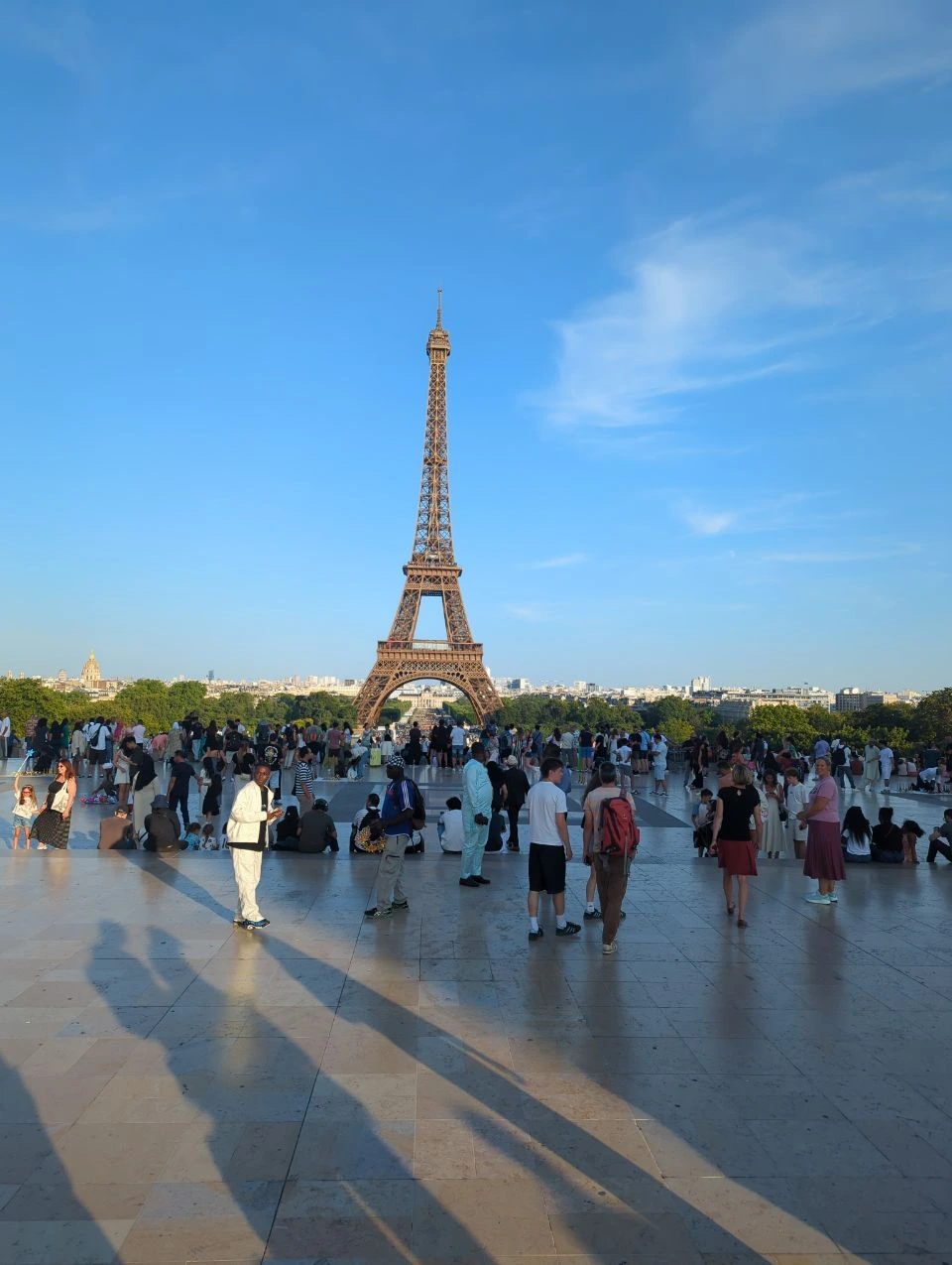
Trocadéro: the biggest, clearest tower reveal. The upper esplanade gives you the famous straight-on view between the wings of Palais de Chaillot. The stairs add height and movement, while the lower garden side brings paths, statues and the Warsaw Fountains into the scene. Our July 2026 observations found the evening extremely busy and the morning variable rather than empty. There were short gaps between groups, which is why a flexible exact position matters more than a promise of privacy.
For the proposal, walk towards a pre-agreed mark as though you're stopping for the view. Your photographer can wait at an angle that keeps the tower behind you without staring straight at you. Ask the question, take a breath, then move down through the gardens for a short celebratory walk. If one terrace is crowded or temporarily altered, the stairs or lower paths can preserve the same Eiffel chapter.
Avenue de Camoëns: a street-sized version of the Eiffel moment. At the top of the steps, the balustrade, lamps and nearby buildings frame the tower in a narrower scene. It feels more like a Paris street than an open viewing platform. The space is limited and popular with other shoots, so it's better to plan one clear standing point and wait calmly for your turn than to expect the whole balustrade.
Your photographer can blend into the small flow near the stairs while you pause at the railing. From there, walk through Passy or head towards the Seine. Choose Camoëns when the romantic street setting matters as much as the tower itself.
Pont de Bir-Hakeim: columns, movement and a strong city feel. The repeating columns create depth, and openings on the bridge give you angled Eiffel Tower views. The covered pedestrian level can help during light rain, although the open viewpoints and adjoining quay are not fully sheltered. Pedestrians and cyclists still need a clear route.
A natural plan is to enter the colonnade together, slow down near the agreed opening and turn towards the view. The photographer waits farther along the line of columns and captures the approach before the question. Afterwards, you can continue to the riverside or Allée des Cygnes for portraits with water and greenery. Pick Bir-Hakeim if you like architecture and movement as much as a clean tower silhouette.
Rue de l'Université and Champ de Mars: close, lively and unmistakable. Rue de l'Université gives you a street-end view where Parisian façades frame the lower tower. Champ de Mars puts you beneath the landmark with lawns and paths around you. Both feel physically close to the Eiffel Tower, which can be thrilling, but closeness does not always create the most balanced photograph.
These settings suit a couple who wants the tower to feel huge and immediate. Your photographer can wait at the far end of the street or beside a chosen path, then lead you into a brief walk after the proposal. If cars, visitors or temporary barriers make the exact street composition untidy, move back towards a wider riverside view rather than forcing the closest pin.
Port Debilly and the riverside: water between you and the tower. A quay or opposite-bank viewpoint can make the moment feel calmer because the Seine creates visual space. It's particularly lovely as the city lights appear, although a quiet visit on one date is never a guarantee of seclusion. Stop at the pre-agreed stretch of wall while the photographer works from farther along the path, then carry the celebration towards a bridge.
Trying to combine all these places around one proposal usually weakens the surprise. Choose one main moment and one nearby portrait walk. Paris will still be there tomorrow, happily refusing to fit into a checklist.
Architecture that makes the proposal feel unmistakably Parisian
The Louvre Pyramid and Cour Carrée: grand scale with two distinct moods. The pyramid court feels open, graphic and modern against the palace façades. Cour Carrée feels more enclosed, with lanterns, arches and a stronger sense of symmetry. If you want a bold landmark without an Eiffel Tower view, this is a brilliant choice.
For the cleanest flow, agree whether the proposal happens near the pyramid or in the square courtyard. Your photographer stays against the geometry of the building, not in the middle of your walking line. Afterwards, move beneath the arches or towards the Seine. Courtyard access, events and temporary installations can change, so the exact mark should be checked again close to the date.
Palais-Royal: garden, galleries and courtyard in one compact chapter. The formal garden feels gentle, the galleries create elegant repeating lines and the Buren columns add a playful turn afterwards. Name the part you mean when you plan it. “Palais-Royal” can describe several very different backgrounds within a few minutes' walk.
The garden is the softer proposal point, while an arcade suits a more architectural moment. Approach along the central path as your photographer stays beneath the chosen gallery, ask in the garden and use the courtyard for the first celebratory portraits. That gives you an easy change of mood without a taxi or long walk.
Palais Garnier: a magnificent exterior, not an automatic indoor backup. The façade and steps can provide a dramatic Paris backdrop. For an exterior proposal, agree one side of the steps, let the photographer work from the opposite pavement edge and continue towards the nearby boulevards afterwards. Inside is different. The Opéra's visitor rules don't make an ordinary ticket permission to use the visitor spaces purely as an organised photoshoot location, and professional work is directed to its events team.
Treat the exterior as the public option and the interior as a venue enquiry. If rain arrives, use a genuinely suitable covered public route or a pre-arranged indoor setting rather than assuming you can move a planned shoot into the opera house.
Montmartre for a proposal that feels like a Paris walk
Sacré-Cœur and its levels: a hilltop moment with real city energy. The forecourt offers the basilica and a broad Paris view, while lower stair levels add greenery, lamps and different angles. Our afternoon visit was extremely busy, and morning simply improves your chances rather than creating a private space. Performers, visitors and local activity are part of the setting.
Plan a precise stair level or side path, not “somewhere near Sacré-Cœur”. A position above or below the agreed turn keeps the photographer discreet and your approach natural. Leave the main forecourt for a neighbourhood walk before the celebration turns into crowd navigation.
Rue de l'Abreuvoir and Place Dalida: the softer Montmartre choice. The curved street, planting and glimpse towards Sacré-Cœur create a more intimate scene than the basilica steps. It remains a shared street with pedestrians and occasional vehicles, so it works best with a light footprint and a short, well-timed pause.
Walk uphill together, stop where the curve opens and let your photographer work from farther down the street. Continue towards a café or a quieter connecting lane afterwards. This suits couples who want Parisian street life in the memory, not a perfectly cleared set.
The best Paris proposal spots beside the Seine and on its bridges
Pont Alexandre III: gold details, river views and an elegant evening. The lamps, sculpture and gilded features make the bridge feel celebratory. One side can also line up the Eiffel Tower in the distance. Traffic runs close to the pedestrian space, so the chosen side and exact standing point matter.
Your photographer waits along the pavement or at the nearby quay, never in the traffic flow. You stroll towards the chosen lamp or view, ask the question and then continue beside the river. It's ideal if you want Paris glamour without making the Eiffel Tower the only subject.
Pont des Arts: an open pedestrian crossing with the city around you. The bridge connects the Louvre side with the Institut de France and gives you open river views. Because people are constantly crossing, it feels lively rather than secluded. Choose it for movement and the broad Paris setting, not for a promise of an empty span.
Stop halfway or close to the agreed bank while the photographer covers the moment from that side. Continue into Saint-Germain or back towards the Louvre. If the centre is too busy, a quay below can keep the river chapter while giving the photographer a different angle.
A private boat: let the route become the reveal. A booked boat can turn the approach to the Eiffel Tower into part of the surprise. You can begin with an ordinary cruise, reach the agreed stretch of river and ask the question when the view opens. The photographer's boarding, position, timing and continued coverage must all be part of the booking.
“Private” should describe the confirmed arrangement, not a hopeful interpretation of an advertisement. Check the vessel, boarding point, exact duration, weather policy and whether photography or decoration is included. Afterwards, stay aboard for the first celebration or step onto a nearby quay for portraits on land.
Best gardens in Paris for a marriage proposal
Jardin du Luxembourg and the Médicis Fountain: palace scale or shaded romance. The main garden offers Luxembourg Palace, tree-lined avenues, gravel paths, green chairs, flowers and water. The Médicis Fountain is a separate scene within the same garden, with a long pool and sculpted backdrop under trees. It feels more enclosed, but other visitors may be sitting or waiting nearby.
At the fountain, your photographer can stay beyond the pool while you approach the agreed side and pause. In the main garden, a palace-facing path creates a more open plan. Take a short walk through the avenues afterwards rather than racing to a second district. The Sénat currently requires authorisation for advertising, professional or commercial photography, so arrange the relevant permission before treating this as a confirmed proposal-shoot location.
The Tuileries: formal Paris between the Louvre and the open city. The basins, clipped trees, gravel paths and green chairs offer several looks. Our field notes particularly liked a raised, carefully planted tree-lined section rather than treating the entire park as one interchangeable backdrop. That section may close at a different time from the wider garden, which makes exact access more important than a generic park schedule.
Choose one basin, path or raised lane for the question. Your photographer waits along the perspective line, then follows you towards the Louvre or Place de la Concorde. Seasonal planting and visitor patterns will change the scene, so build the plan around structure and atmosphere rather than a promised bloom.
Jardin Monica Vitti by Hôtel de Sens: small scale with Gothic detail. Box hedges and geometric planting sit beside the turrets and pale stone of Hôtel de Sens. It's a public garden, not an overnight hotel or a bookable private venue. Our visit found it quiet, but that observation belongs to one date. The city also notes that the garden can close during strong winds or bad weather.
Enter the little garden together while the photographer stays towards the historic building. Continue through Le Marais afterwards. Choose it for a compact, different side of Paris, knowing that a small garden gives you fewer alternative positions if it's busy.
Jardin Lazare-Rachline and Hôtel de Sully: intimate Marais alternatives. Jardin Lazare-Rachline is a small formal garden beside Hôtel Donon, with benches, handsome roofs and old stone around it. The Hôtel de Sully garden and courtyard bring clipped greenery and architecture near Place des Vosges. Both are better treated as access-dependent public stops than bookable spaces.
These places suit a small, simple proposal with no elaborate setup. Enter on the agreed path while the photographer stays near the courtyard edge, ask beside the garden's old-stone backdrop and continue to Place des Vosges afterwards. If one gate is closed or the garden is busy, the Marais streets and squares nearby provide a natural alternative without changing the whole day.
Parc Monceau: a polished park with room to move. Curving paths, a bridge and the colonnade give the park a lighter, more playful mood. It works well when you want a green setting without formal palace architecture dominating every frame. Agree one landmark as the proposal point, approach it along a named path while the photographer waits on the agreed side, then stay for a relaxed walk after the yes.
Public viewpoint, hotel terrace or private boat?
A hotel balcony or terrace can give you more control and a direct Eiffel Tower view, but access usually belongs to a specific room, suite, reservation or event agreement. Confirm the exact terrace, view, photographer access, timings, decoration rules, weather alternative and what happens if the room allocation changes. Don't book from a generic “Eiffel view” label and assume it means the photograph you have in mind.
A private boat creates the most cinematic movement. It also brings boarding logistics, a route, weather and a fixed amount of time. It's strongest when the operator agrees the reveal point and the photographer's role in writing.
The easiest decision is to ask what you value most. Choose public for the feeling of Paris happening around you. Choose a confirmed terrace for controlled space and one framed view. Choose a boat when the journey itself should carry the surprise.
How the surprise can unfold without feeling staged
The photographer begins before the question, from far enough away to stay discreet. Once you kneel or say the agreed line, the sequence is already being captured. After the yes, give yourselves a minute. Hug, look at the ring, laugh and take in the fact that Paris has just become part of your family history.
Then the photographer comes closer and the pressure disappears. You take a short walk through the same area, using the stairs, garden, quay or street that made the setting worth choosing. There's no need to sprint across the city. One proposal and one connected celebration route will feel far richer than five rushed landmarks.
Our Paris proposal photographers can help shape that exact arrival, waiting position, cue and portrait walk around the setting you choose.
Our Paris photo-location guide can help you choose the nearby backdrop for that short celebration walk.
Timing, rain and the Paris you actually get
Evening brings the glow on the Seine, the gold of Pont Alexandre III and the excitement of Paris after dark.
Light rain can look wonderful on stone and water. Bir-Hakeim offers partial cover beneath its upper structure, while Palais-Royal's arcades can provide a pause. Neither makes every angle dry. For stronger weather, keep a genuinely agreed indoor or private alternative rather than assuming a museum, hotel or opera house will accept an organised shoot at the door.
What a Paris proposal really costs
Ask for an itemised quote that says what's included, how long each part lasts and what changes in bad weather. Current prices vary too much by date, operator and setup for one unchecked figure to be useful here. The better comparison is public simplicity, terrace control or a moving river experience.
Plan your Paris proposal with Travaya
Tell us your date, the atmosphere you love and whether you're picturing an Eiffel view, a garden, a street, a bridge or a booked setting. Message Travaya on WhatsApp and we'll help turn that idea into one clear proposal point, a discreet photography plan and a lovely route after the yes.
Paris proposal FAQs
Book as soon as your travel date is firm if you want a specific photographer, terrace, boat or permission-dependent garden. Public-location plans can be simpler, but the best exact position still deserves a close-date access check.
Share your date, preferred atmosphere, any mobility needs and a recent photograph of the two of you. A precise meeting point, cue and contact plan can then be agreed without putting the surprise into a long message your partner might see.
Yes, when their waiting place and entrance are planned as carefully as the photographer's. Keep the group small enough for the chosen public or booked space, and agree who gives the cue so everyone moves at the right moment.
Wear something that feels special and still suits the route. Montmartre cobbles, garden gravel and Seine steps are easier in shoes you can walk in, while a terrace or boat can support a dressier plan with less ground to cover.
Confirm the rules for the exact location and setup before bringing anything that takes space, creates sound or needs installation. A simple bouquet is a different plan from a decorated area, musician or equipment setup.
Not automatically. A visitor ticket does not make the visitor spaces available for an organised photoshoot by default, so discuss a planned professional proposal shoot with the venue's events team.


Our Paris Shoots:
Book your Paris proposal Photographer!
Start Booking
Secret Photo Spots in Paris: Hidden Locations Beyond the Usual Landmarks

Best Photo Spots in Paris for a Photoshoot: Choose Your Backdrop

How to Propose in London

Our 12 Favourite Places to Propose on Holiday

What Does a Marriage Proposal Mean, and Why Does It Matter?

Why Do We Propose With a Ring? The Meaning Behind the Tradition
ENJOY $20 OFF
Your first photoshoot when you become an email subscriber.
Related Articles

Secret Photo Spots in Paris: Hidden Locations Beyond the Usual Landmarks
Discover a different side of Paris through botanical gardens, village streets, covered passages, canals and panoramic parks, with practical guidance for choosing a location that works for your photoshoot.

Best Photo Spots in Paris for a Photoshoot: Choose Your Backdrop
Compare Paris photo spots by atmosphere, accessibility and session style, from classic Eiffel Tower views to Montmartre streets, elegant courtyards, gardens and the Seine.

How to Propose in London
Make the surprise feel like you.