
Best Places to Propose in Pienza and Val d'Orcia: Village Views and Cypress Landscapes
Pienza gives you the loveliest kind of dilemma. You can ask the question during a slow walk through honey-coloured streets, with the whole Val d'Orcia opening beyond a stone wall, or make one beautiful drive into the landscape for cypresses, fields and a horizon that seems to go on forever. One feels close and quietly romantic. The other feels wonderfully cinematic.
The best plan isn't to collect every famous viewpoint. It's to choose one place for the proposal, let your photographer wait in exactly the right position, and use the village or countryside for the happy photographs afterwards. This guide compares the real choices, including what belongs to a public walk, what needs permission, and which roadside views are better saved for a quick photograph than the question itself.
Updated

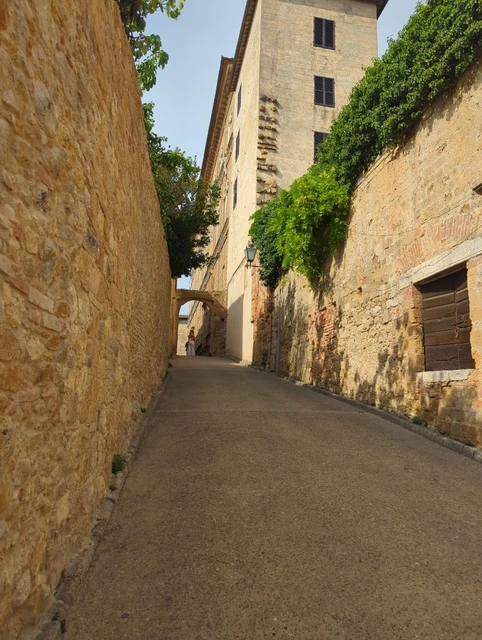
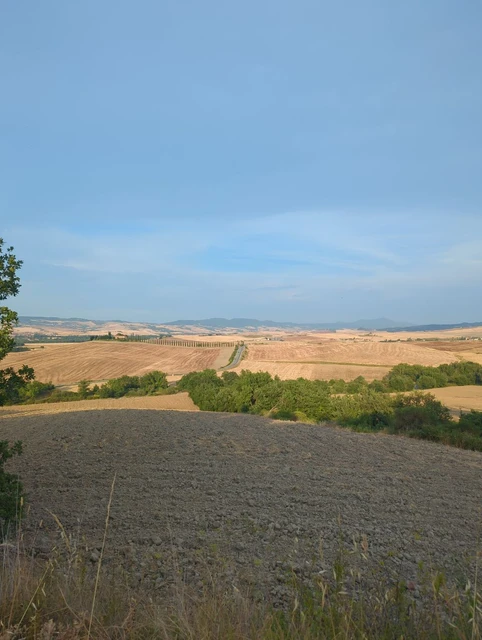
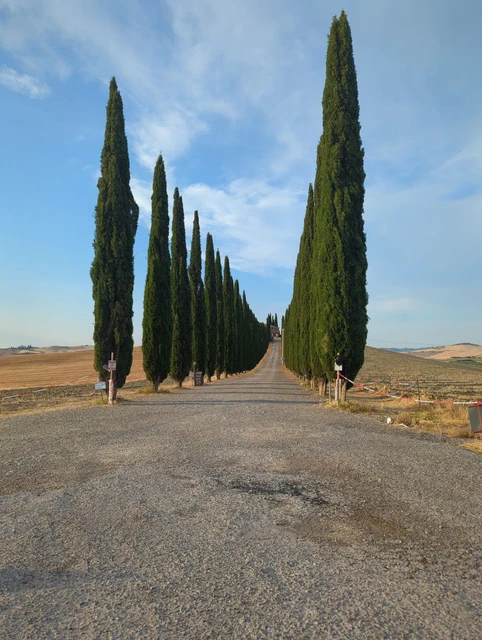
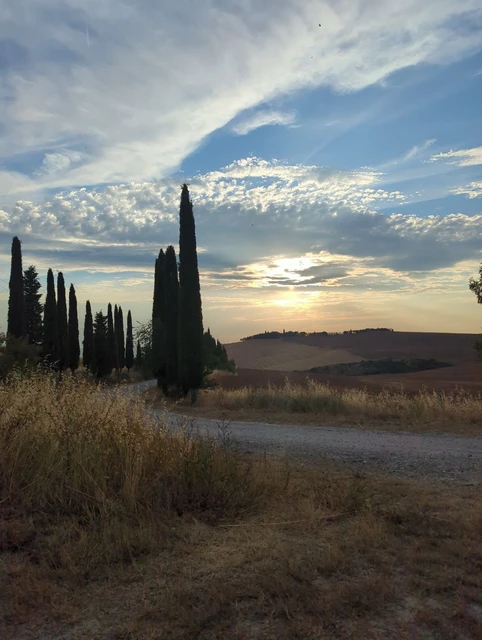
Table of Contents
Best places to propose in Pienza and Val d'Orcia at a glance
A stone gateway or quieter village corner: close, personal and unmistakably Pienza. Choose this when your partner would rather hear every word than feel surrounded by a giant landscape. A photographer can use the arch or wall as a frame, then follow you into the green lanes after the yes. The streets stay public and lived-in, so the plan needs to keep doors and walkways clear.
Palazzo Massaini: a cypress approach followed by portraits in Pienza. Local proposal reportage shows a surprise at Palazzo Massaini followed by portraits in the village. It can create a strong one-place proposal moment, but the estate and approach are not an open film set. Confirm the exact standing point, vehicle plan and photography permission directly before treating it as your location.
Poggio Covili: the famous avenue from a respectful outside view. The long double row of cypresses is instantly recognisable. The agriturismo and its drive are private, which makes this an access-first choice. Use only a confirmed public viewing position or permission from the property. The middle of the avenue is not yours simply because it appears in photographs online.
Best for no car after parking: Pienza. Best for a quiet, close moment: a village gateway or quiet wall. Best for a private-estate feel: Palazzo Massaini with permission. Best for iconic cypress geometry: a confirmed Poggio Covili view.
Pienza's belvedere makes the surprise feel like a walk
That natural approach is Pienza's great advantage. The historic centre is compact, so your cover story can be nothing more complicated than a wander before dinner. Visit Val d'Orcia specifically points to the Belvedere on Via del Casello, Via dell'Amore and Via Santa Caterina for views and photographs. Those names help with planning, but they don't mean every metre of wall works equally well. Your photographer should choose one exact mark where the background is clear and passing walkers still have room.
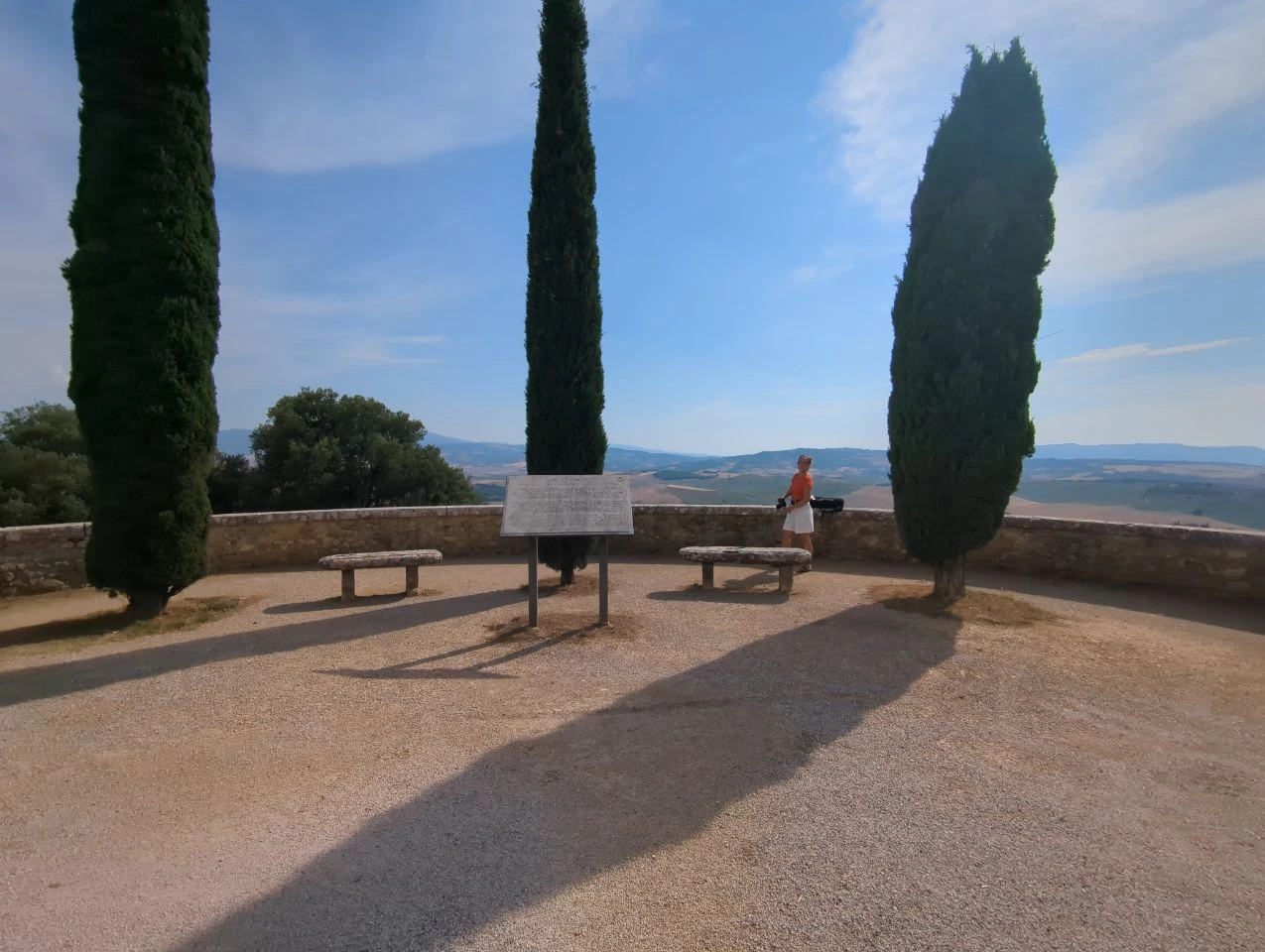
Two useful viewpoints sit close together. One is a semicircular platform with benches and cypresses. The other has a simple stone edge and a very similar sweep of the valley. They don't need to become two proposal candidates. Pick the cleaner one on the day, then use the second only if it adds a genuinely different portrait.
The photographer's position is easy to hide in plain sight. You stand near the wall with the valley behind you. They wait down the promenade or near a bench, far enough away to hold the hills in the frame and close enough to catch your expressions. Agree a cue before the day, such as placing both hands on the wall, asking your partner to look across the valley, or stopping at a named bench. No theatrical signal needed. Pienza is already doing plenty.
After the yes, stay where you are for a few minutes. Let the first hug, the ring and the slightly breathless laughter happen before anyone suggests moving. Then walk back through the village for warm-stone portraits. A celebratory glass or dinner inside the walls feels like the natural ending, with no transfer to manage while your heads are still spinning.
The Pienza viewpoint comparison explains how the open edge, low wall and stone passage change the photographs.
The village gateways turn a big landscape into an intimate frame
The choreography here is beautifully neat. You walk towards the gateway together. Your photographer waits beyond or to one side, depending on pedestrian flow and light. You pause before the opening rather than inside the narrowest part. That leaves the passage clear and gives the camera enough distance to hold both you and the view. Once the ring is on, step through together and let the first walking photographs carry the story onwards.
A church-side corner can work in the same gentle way when the path is clear. Treat it as a portrait alternative your photographer can check on the day, not a guaranteed secret spot. The nearby plant-lined lane is even better as the chapter after the proposal. Vines, warm walls and a slimmer street pull the photographs closer after the huge landscape.
This village plan is for you if the words matter more than the spectacle. You'll still have unmistakable Tuscany behind you, but you won't feel as though you're standing in the middle of a postcard trying to perform. Your photographer can move from a wide gateway frame to close expressions without asking you to recreate anything.
Via dell'Amore deserves its famous name, yet the sign alone isn't the reason to choose it. Choose the exact section because the light, path width and valley angle work for your date. The same goes for Via del Bacio and Via Santa Caterina. Sweet street names are a lovely bonus. A clear proposal mark and respectful flow are what make the photographs sing.
Palazzo Massaini gives you a cypress moment with a village sequel
For the proposal, you need more than the property's name in a map pin. Confirm whether you're allowed to stop, where a vehicle may wait, which side of the approach can be used, and whether professional photography needs advance agreement. An ordinary booking at nearby accommodation doesn't automatically grant use of every drive, field or estate corner. Get the answer from the current operator for your exact plan.
Once access is confirmed, the photographer arrives first and checks the road. You approach on the agreed side, stop at a fixed point with the cypresses behind you, and use a simple cue. The photographer should never stand where an arriving car would need to change course. If traffic or farm work makes the first mark unsuitable, the property-approved alternative wins, even if the original angle looked perfect in a saved photograph.
The reward is a clean, graphic backdrop that feels unmistakably Tuscan. The cypresses draw the eye towards you, while the surrounding hills add depth without swallowing the moment. Afterwards, drive into Pienza and leave the big composition behind. The stone lanes, benches and viewpoints give you closer photographs and somewhere to celebrate. Two moods, one story, and no cypress scavenger hunt across half the valley.
Poggio Covili is beautiful because the access boundary is clear
Our visit recorded the distinction between the private lane and an external view from the public road. The field note also suggested standing in adjacent fields, but a field is not public simply because it has no visible fence. The safe version is narrower: remain on a confirmed public surface, or obtain permission from the owner for the exact area you want to use.
If the agreed outside viewpoint gives enough separation from traffic, the lane can sit behind you as a distant line. Your photographer works from the same safe area, never from the carriageway, while you stop at a pre-scouted mark. If the only possible position is a verge with fast cars, no proper pull-off or uncertain ownership, keep Poggio Covili as a scenic drive-by memory and choose Pienza for the actual proposal.
This is for you if the cypress geometry matters more than being inside the avenue. A long lens can make the rows feel close while everyone stays outside the private drive. It is not for a decorated setup, a long pause or a plan that depends on stopping other traffic. Clear boundaries actually make this option calmer: you know the frame, you know the limit, and you don't spend the most important minute wondering whether someone is coming to move you on.
Afterwards, choose one nearby approved landscape stop or return to Pienza. Don't chase another famous avenue simply because you're already in the car. Your proposal photographs need a beginning and a happy continuation, not a greatest-hits tour of Tuscan trees.
Why two unverified cypress stops stay off the proposal shortlist
That comparison is exactly why popularity shouldn't make the decision for you. The circle can be a fun travel photograph if the current route is openly accessible and you respect every barrier. It is a weak proposal choice when the approach is unclear, the composition barely changes and the whole plan depends on walking beyond signs you haven't verified.
The unnamed field is deliberately not pinned here. Sharing an uncertain location would encourage exactly the kind of access guess this guide is trying to prevent. It stays a private scouting lead unless a local photographer can establish the owner, legal standing point and safe parking for your date. The San Quirico circle stays a travel-photo option only when the current signed route is openly accessible. Neither belongs on the proposal shortlist today.
Light changes these open places quickly. Early morning can give you long shadows, gentle colour and quieter roads. Late afternoon can warm the trees and fields, but the sun direction depends on the exact viewpoint and season. Your photographer should scout for your date, not promise that one anonymous “sunset spot” always works.
The lovely surprise is that perfect cypresses aren't essential. A slightly uneven line, a curve in the track and a patch of wild grass can feel more alive than a rigid landmark. Choose the place where you're allowed to relax. That ease will show far more than the fame of the pin.
Roadside panoramas are supporting photographs, not automatic proposal spots
One observation explicitly mentioned cars moving quickly past a wide landscape view. That rules it out as a relaxed proposal location unless a new scout finds a proper legal stopping place away from traffic. The proposal needs time for the approach, the question, the reaction and a few minutes together. A roadside photograph that works for thirty seconds may be completely wrong for that sequence.
The Poderino and Vitaleta area can still be a lovely supporting chapter. A distant chapel, a cypress line or Pienza on the horizon adds context after the ring is on. Use a verified public viewpoint or an operator-approved stop. Don't enter cultivated land, park across farm access or turn a bus pull-in into a private set.
The famous Cappella della Madonna di Vitaleta is also a destination with its own current visitor operation, not a free background that proves access to every surrounding field. If you want the chapel in the story, check its official information and arrange any special use directly. A distant legal sightline may be the more beautiful answer anyway. It lets the chapel sit inside the landscape rather than turning your proposal into a queue for one door.
Choose the proposal location by the feeling after the yes
If you want the landscape to feel enormous, choose one countryside location with confirmed access and transport. The photographer arrives first, the driver knows the exact stopping point, and the next step is already set. That could be Pienza for portraits, a booked estate for a toast or a nearby restaurant. The romance comes from certainty, not from improvising on a verge.
For the village, allow enough time to park outside the historic core and walk in without rushing. Pienza is compact once you're inside, but the pedestrian approach is part of the plan. For the wider valley, a car or arranged driver is the practical choice because public transport is limited and the locations are spread out.
Weather gives you a useful tie-breaker. In strong wind or hazy light, Pienza's walls and lanes give you shelter and closer photographs. After rain, stone streets may still work while field edges become muddy or unsuitable. On a clear, calm day, the countryside earns its scale. Keep one village mark as your easy fallback, and use a landscape alternative only after its standing point, parking and access are confirmed.
Our Pienza photographers can map the exact approach, waiting position, cue and short route around the atmosphere you want. You only need to choose the feeling: a quiet walk with the valley beside you, or one grand landscape moment followed by the village.
Make the surprise simple from approach to celebration
In Pienza, you might say you're taking one more look at the valley before dinner. The photographer waits along the wall. You stop at the agreed bench or gateway, turn towards your partner and ask. Then you stay together for a few minutes before wandering into the lanes.
In the countryside, the transport plan does more work. A driver or clearly mapped route brings you to a confirmed stopping point. The photographer checks that access and traffic are as expected. You walk a short, agreed line to the proposal mark. After the reaction, you move only when you're ready, then continue to the village or your celebration booking.
Keep decorations, tripods and reserved-space ideas out of the plan unless the owner or relevant authority has approved them. A compact proposal is easier to place, easier to photograph and much easier for your partner to believe. The ring, the words and that first stunned smile are the whole event. The hills are very happy to be supporting cast.
Plan your Pienza and Val d'Orcia proposal
Send us your date, where you're staying and whether you love village intimacy or cypress-lined drama. We'll help shape the exact location, current access check, photographer position, timing and the lovely next chapter after the yes. Plan your proposal with Travaya on WhatsApp
FAQ: Pienza and Val d'Orcia proposal questions
Straight answers for planning the moment.
The Via del Casello belvederes are the best all-round choice when you want valley views and a simple walk from the centre. A stone gateway or quieter wall suits a more intimate moment, subject to a same-day check for pedestrian flow.
Yes, a small, low-key proposal can fit naturally into a public walk, provided you keep the route clear and follow current local rules. Choose the exact section with your photographer because light, space and the valley angle vary along the lane.
The avenue belongs to a private agriturismo, so don't enter or stage the proposal there without direct permission. A confirmed public viewpoint outside the property may work, but only when parking and traffic conditions are safe.
It depends on the exact land, road, estate and setup. Public pedestrian photography, professional work on private property, decorations and reserved space can follow different rules, so confirm the final plan with the relevant owner or authority.
Early morning often gives you a calmer village, while later light can warm the stone and valley. The best window depends on the exact wall, season, weather and sun direction, so use a current scout rather than a fixed year-round promise.
Choose Pienza for an easy walking story with viewpoints, lanes and dinner close by. Choose the countryside when one large landscape is the dream and you're happy to arrange transport, a safe stopping point and access before the day.
Stay close for the first reaction, then use Pienza's stone streets and green lanes for relaxed portraits or head to a pre-booked celebration. The best follow-on is short and easy, so the moment never turns into a location checklist.


Our Pienza Shoots:
Book your Pienza proposal Photographer!
Start Booking
A Romantic Walk Through Pienza’s Stone Streets

Pienza Viewpoints for Couple Photos: Balancing Portraits and Tuscan Scenery

Three Simple Backgrounds That Add Variety to Your Pienza Couple Photos
Pienza Streets and Hills Photoshoot: From Warm Stone to Val d’Orcia Views
Pienza or the Tuscan Countryside? Which Backdrop Fits Your Couple Photoshoot?
What to Wear for a Pienza Couple Photoshoot: Colours, Shoes and Outfits That Move
ENJOY $20 OFF
Your first photoshoot when you become an email subscriber.
Related Articles

A Romantic Walk Through Pienza’s Stone Streets
Pienza’s compact historic centre brings Renaissance architecture, narrow passages, modest doorways and cobbled lanes into one walkable setting. From Corso Rossellino, you can move towards Via del Casello and the romantic side streets, choosing a short sequence

Pienza Viewpoints for Couple Photos: Balancing Portraits and Tuscan Scenery
Two photographs taken along Pienza’s village edge can tell completely different stories. In one, you might appear small against the broad fields and distant hills of Val d’Orcia. In another, you remain the clear focus while the countryside or Pienza’s stone ar

Three Simple Backgrounds That Add Variety to Your Pienza Couple Photos
You don’t need a famous landmark every time you want your Pienza couple photos to feel different. Some of the loveliest backgrounds are much smaller: an opening in the stone that reveals the countryside, seasonal plants spilling into a narrow lane or a church-