
Natural Couple Photos in Tuscany When You Don't Know How to Pose
If the words couple photoshoot make you wonder where your hands go, you're in very good company. There isn't a secret set of poses that everyone else learnt before arriving in Tuscany. You don't need to practise a special smile, and nobody should expect you to turn romance on for the camera.
The loveliest sessions usually begin with something much smaller: walk to that doorway, look across the valley, tell each other what you can see. A photographer can shape the light and give the action a little structure. Your own pace, expressions and odd little habits do the interesting part.
Around Pienza, the setting helps. A narrow stone lane asks for tiny movements. A viewpoint gives you something to notice together. The open Val d'Orcia hills leave room to wander away and come back. You only have to do the next small thing.
Updated

Table of Contents
Natural couple photos in Tuscany begin with one small action
The first action can be wonderfully ordinary. Walk at your usual pace. Compare the view. Stand close enough to share a quiet comment. While you do that, your photographer can watch how you naturally take hands, who looks first and what happens when one of you makes the other laugh without trying.
You won't need to repeat the same movement until it looks polished. One or two passes are usually enough to see what works. If the cobbles change your stride or you both turn the same wrong way, that can be useful too. The aim isn't to produce two professional models. It is to give your real rhythm somewhere to appear.
Let the setting tell you how much to do
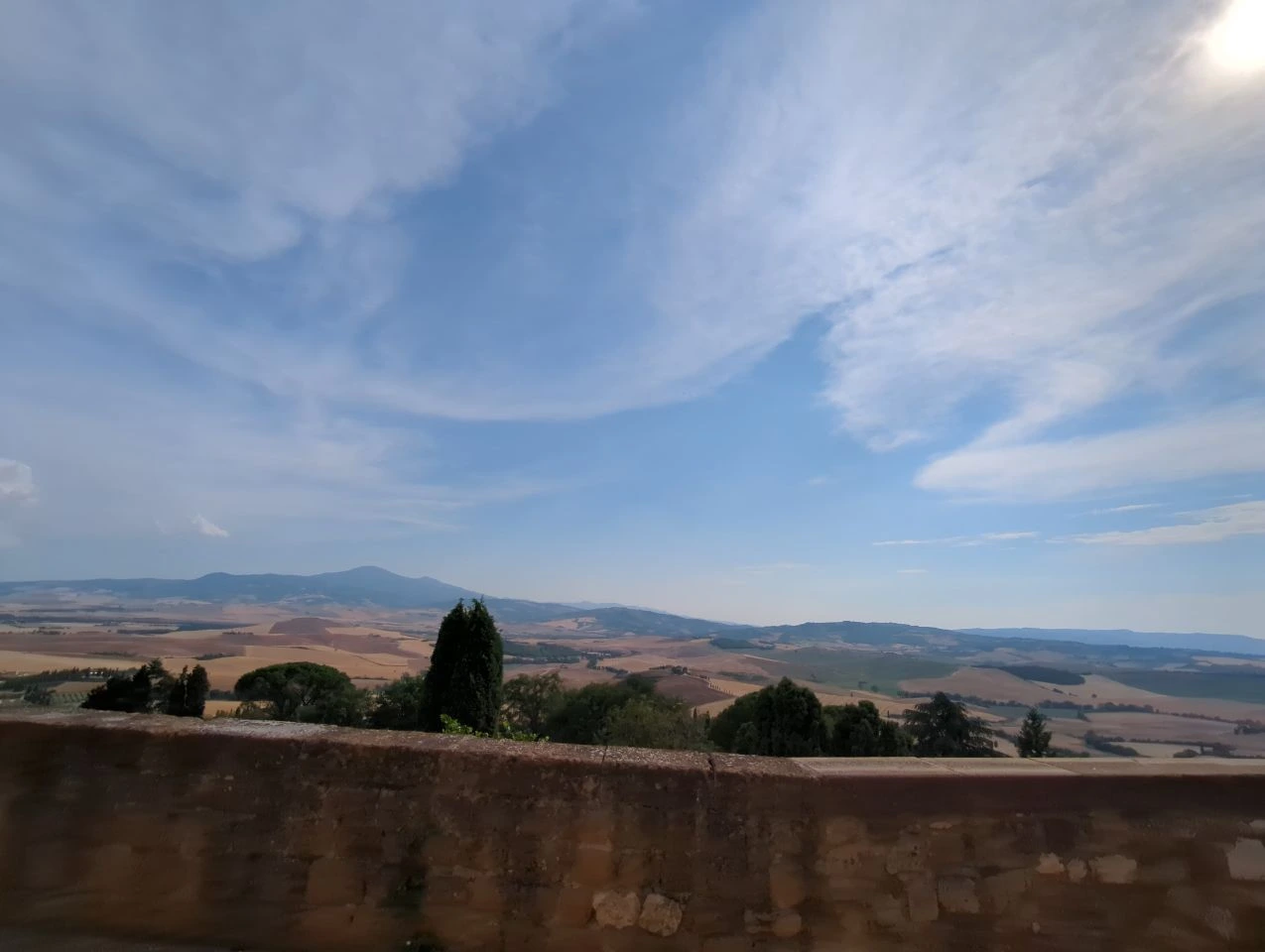
At the village edge, a low wall or belvedere changes the rhythm. You can stop moving and share your attention with the landscape. In open country there is more visual room, so a longer walk or a little distance between you makes sense.
That progression is useful if you're nervous. You don't have to begin with a grand gesture. Start with a compact action, let the conversation take over and widen the movement only when the space widens too.
In a narrow Pienza lane, make the movement smaller
If you're wondering about your hands, give them a temporary job. Hold one another's hand as you walk, link arms, or let one person lightly take the other's forearm while you look at the detail you've chosen. Once your attention moves back to each other, your hands tend to settle without a committee meeting.
The lane also suits a quiet turn. Walk side by side, then let the person nearest the wall stop first. The other notices, turns back and closes the small gap. It creates a beginning, middle and end without asking either of you to arrange every limb.
Keep the pace genuinely yours. If one of you walks faster, don't hide it. A photographer can turn that difference into a playful catch-up rather than asking you to become perfectly synchronised.
In the open hills, create space and come back together
The return is often more useful than a pose. Meet with a hand, shoulder or quiet hello. A kiss isn't required; the change in distance does the work.
Wind can join in without becoming an instruction. If hair or fabric moves, leave it alone for a moment before fixing it. Keep walking, tuck it back once, or let your partner help if that's something you'd normally do. The landscape already has scale and texture. Your movement can stay easy.
Stay on the checked viewpoint, verge or path your photographer chooses. Access, crops and ground conditions change, and working land isn't a prop.
Still portraits can feel like you too
This is where a little precise guidance helps. Your photographer might shift one shoulder towards the light, ask you to leave a fraction more room between your faces or move a hand that has disappeared behind a jacket. That's not a test and it doesn't turn the image into a performance. It is a quick piece of housekeeping.
Keep doing one real thing while you stand still. Finish a sentence. Breathe out slowly. Notice the warmth of a hand. Look at your partner for a moment, then look away when it feels natural. The adjustment belongs to the photograph; the expression can still belong to you.
Change any prompt that doesn't sound like you
Name what you don't want. Nothing is compulsory: you don't have to kiss, laugh, spin or run on request. If one of you prefers slower instructions, say so. Your photographer can choose a quieter action without repeatedly finding the boundary.
If you freeze, return to the setting. Find a doorway, choose a point in the view or start a short walk. You don't have to create a mood on command. You only need a next action that makes sense.
Plan a Tuscany couple session that gives you something easy to do
Tell your Tuscan Hills photographer which settings you love and which kinds of direction sound most like you. We can shape a session with small prompts in Pienza, quiet pauses at a viewpoint and more breathing room in the hills, so you always know what happens next.
Natural couple photos in Tuscany FAQs
Simple answers for a session that feels like the two of you
No. Before the session, share one or two ordinary things you enjoy doing together and anything you want to avoid. That gives your photographer better material than a gallery of poses to copy.
Start at the quieter person's pace. Use short walks, shared attention and prompts that don't require looking at the camera. The more confident partner doesn't need to perform for both of you; they can simply keep the conversation going.
Yes, when it helps. The correction may be as small as bringing one hand out from behind a jacket or letting both arms rest after a walk. Once it is clear in the frame, you can stop thinking about it.
Not at all. A photographer may ask for a brief camera-facing portrait just after a moving sequence, when you're already standing comfortably. You can look up for a few seconds, then return to each other.
Say so. Your photographer can keep the purpose and change the action. If running was meant to create distance, for example, a pause and a slow return can create the same shape more comfortably.


Our Pienza Shoots:
Book your Pienza couple Photographer!
Start Booking
A Romantic Walk Through Pienza’s Stone Streets

Pienza Viewpoints for Couple Photos: Balancing Portraits and Tuscan Scenery

Three Simple Backgrounds That Add Variety to Your Pienza Couple Photos
Pienza Streets and Hills Photoshoot: From Warm Stone to Val d’Orcia Views
Pienza or the Tuscan Countryside? Which Backdrop Fits Your Couple Photoshoot?
What to Wear for a Pienza Couple Photoshoot: Colours, Shoes and Outfits That Move
ENJOY $20 OFF
Your first photoshoot when you become an email subscriber.
Related Articles

A Romantic Walk Through Pienza’s Stone Streets
Pienza’s compact historic centre brings Renaissance architecture, narrow passages, modest doorways and cobbled lanes into one walkable setting. From Corso Rossellino, you can move towards Via del Casello and the romantic side streets, choosing a short sequence

Pienza Viewpoints for Couple Photos: Balancing Portraits and Tuscan Scenery
Two photographs taken along Pienza’s village edge can tell completely different stories. In one, you might appear small against the broad fields and distant hills of Val d’Orcia. In another, you remain the clear focus while the countryside or Pienza’s stone ar

Three Simple Backgrounds That Add Variety to Your Pienza Couple Photos
You don’t need a famous landmark every time you want your Pienza couple photos to feel different. Some of the loveliest backgrounds are much smaller: an opening in the stone that reveals the countryside, seasonal plants spilling into a narrow lane or a church-