
October 8, 2026
Planning a More Accessible Rome Couple Photoshoot: Questions to Ask Before Choosing Your Route
Rome can feel wonderfully cinematic in photographs, with warm stone, sudden views between buildings and fountains catching the morning light. Imagine arriving on the right side of a quiet piazza, taking a moment together and reaching your first photograph without a stressful crossing or hurried transfer.
The most reassuring photoshoot is rarely the one with the longest list of landmarks. It is the one you can picture clearly before you arrive.
That means looking beyond stairs. Consider the whole journey: where you will be dropped off, the crossings and paving along the way, places to pause and where your driver will collect you afterwards.
The locations below are starting points rather than ready-made accessible routes. Their suitability will depend on your wheelchair, cane or other mobility aid, as well as your balance, stamina and personal preferences. Good planning still leaves room for spontaneous photographs. It simply removes avoidable surprises, allowing you to pay more attention to each other than to the next obstacle.
Updated

Table of Contents
First decide what comfortable means for your photoshoot
Before discussing locations, decide how far you want to travel without pausing, which surfaces suit you and how you feel about slopes and crowds. Consider whether you need additional turning space and how close the first photograph should be to the arrival point. If you transfer between a vehicle and your mobility aid, explain how much space and support you need at drop-off.
Two routes can look almost identical on a map but feel completely different during a morning together. The better route is the one that leaves you with enough energy for conversation, natural movement and the photographs you came to create.
It also helps to decide whether you would prefer one visually rich area or several separate locations. A compact area can provide considerable variety when the photographer changes position, lens, background and the direction you face. An archway, café-lined street and fountain might produce wide architectural frames, close portraits, movement and quiet moments together without repeated transfers. Several locations may still suit you, but each transfer introduces another arrival point, crossing and surface to investigate.
Agree the poses, pace and shorter fallback
Explain how long you are comfortable holding a position and how often you want to move. Hands together, a glance towards the street, a shared laugh and a wider architectural composition can all be photographed without repeatedly crossing a square.
Agree how the photographer will offer physical guidance. You may welcome a hand, prefer verbal directions or want your partner to assist. Nobody should assume what kind of help you need or touch you or your mobility aid without asking.
Design a shorter version of the session before you arrive. Choose the photographs that matter most and give the reduced route a satisfying final frame rather than allowing it simply to stop midway through the original plan. If heat, fatigue, crowd pressure or street conditions change, you can switch without having to make hurried creative decisions.
Ask for the route step by step
A customised itinerary is not automatically an accessible one. Swapping one landmark for another does not resolve the journey between them, so ask for the entire route in order rather than a list of photography locations.
You could begin with this message:
> We would like a route that works with a [wheelchair, cane or other mobility aid]. Could you describe the journey from the exact meeting point to the final pick-up, including the crossings, paving, slopes, thresholds and any steps?
Then add the facilities and alternatives you need:
> Please identify suitable places to rest, an accessible toilet and a step-free alternative to every staircase or elevated viewpoint. If any section has not been checked recently, please tell us so that it can be verified or replaced.
Include any transfer requirements and explain what assistance you are comfortable accepting. The route should never rely on somebody lifting you or an occupied wheelchair.
A useful answer does not have to claim complete certainty. If the photographer has not checked a particular crossing, entrance or pavement recently, they should say so. You can then decide whether that section needs fresh verification or should be removed from the plan.
Start with the exact arrival and pick-up points
If you are arriving by car or taxi, establish where the vehicle can legally stop at the planned time. Check the gap between the door and pavement, the kerb height, the surface beside the vehicle and the room available for your mobility aid or transfer. If you require a particular vehicle type, confirm its availability rather than assuming it can be arranged.
Give the finish equal attention. Heat, fatigue and crowds can feel different after the photographs than they did at the beginning. Agree the exact final pick-up point and a second workable pin in case barriers, temporary works or traffic restrictions block the first.
Make sure both points are shared with everyone involved, including the photographer, driver and any companion travelling with you. A driver waiting on the opposite side of a busy road is not a practical pick-up plan, even when the distance looks insignificant on a map.
Check every kerb, crossing and surface transition
For every crossing, ask whether there is a dropped kerb on both sides and whether the usable space is normally clear. Find out whether the crossing has signals, how long you have to cross and whether you will encounter a traffic island or tram tracks. If balance, speed or manoeuvring space matters to you, these details are more useful than being told that a road is quiet.
Look closely at short transitions as well. Within only a few metres, a route might move from broad flagstones to small stone setts, cross a drainage channel and finish on broken paving.
Nominal pavement width is less important than the narrowest space you can actually use. Café tables, queues, scooters, vendors, parked vehicles, crowd barriers and roadworks can reduce a broad pavement to a tight passage. At Rome’s busiest landmarks, those obstructions may also remove the intended photography position. The location does not necessarily have to be abandoned, but the plan should contain another approach or nearby composition.
When nobody can provide a reliable description, request recent photographs or a continuous phone video. Ask for the pavement edge, full usable width, both ends of each crossing, thresholds and slopes that are difficult to judge from a still image. The person recording should move through the route in the correct order rather than filming disconnected attractive sections.
A video cannot prove what conditions will be like on the day, but it can reveal permanent features and clarify where further questions are needed. If a section remains too uncertain for your comfort, replace it before the session.
Separate step-free from smooth, level, short and comfortable
Ask about each quality separately. Is the entire route step-free from the vehicle door to the first photograph? Is the surface suitable for your wheels, cane or balance? Is it level, or does it climb gradually? How long is the rough section? If there is a smoother way around, how much distance does it add?
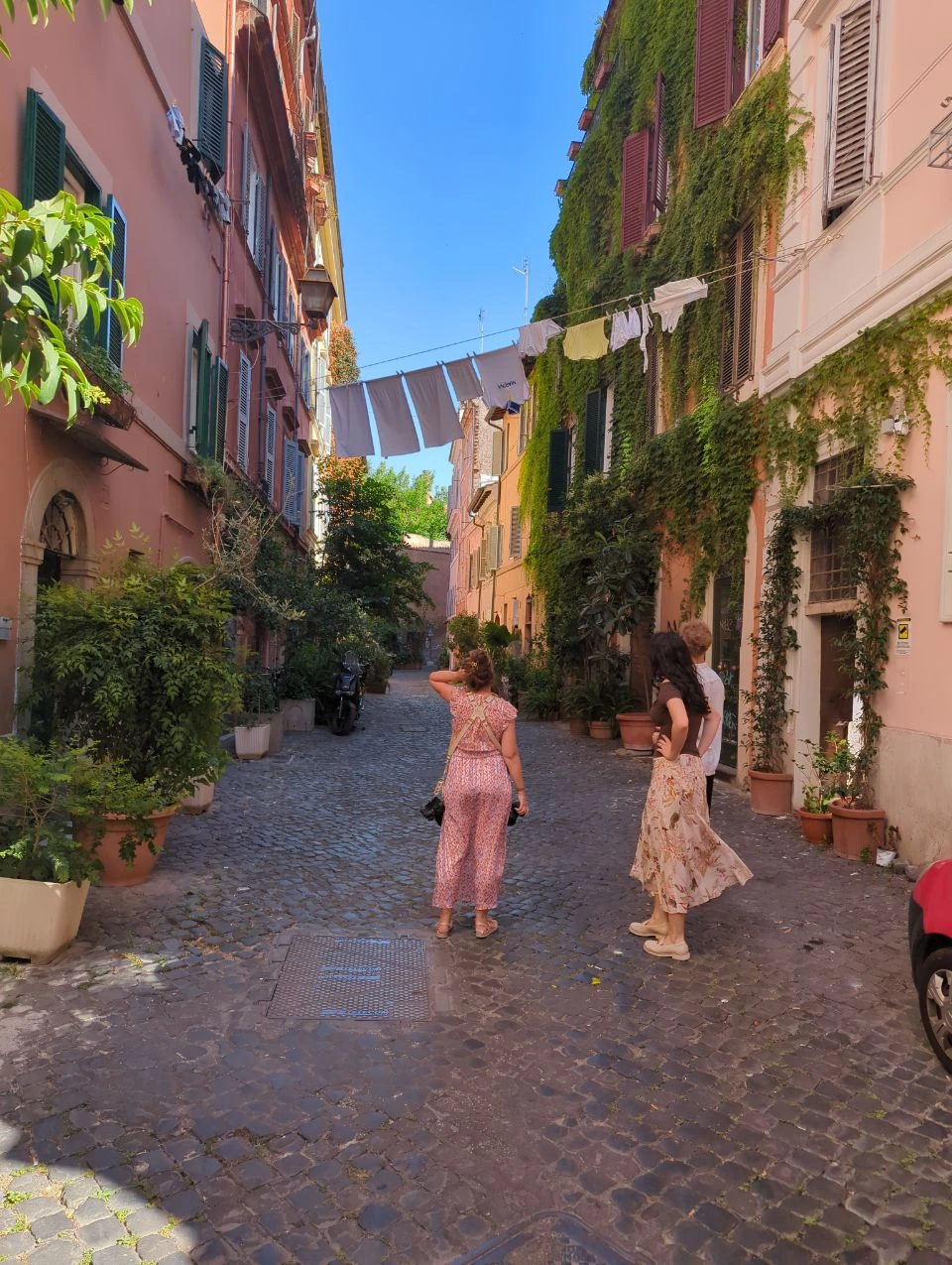
Rome’s stone-paved streets are often celebrated for their atmosphere, but “cobbled” is not a useful access description by itself. Large, fairly even stone setts behave differently from broken stones with wide or deep joints. A short, flat section may feel manageable, while a longer stretch with a sideways slope can create constant vibration or demand considerably more effort.
That effort matters beyond the journey itself. A difficult surface can affect your pace, posture and enjoyment before the camera is even raised. The best route is therefore not merely step-free. It should be comfortable enough for conversation, connection and photographs along the way.
Choose alternatives to stair and hill photographs in advance
If a composition depends on stairs or a climb you would rather avoid, choose an alternative during the planning stage. Ask to see the proposed frame instead of accepting a general assurance that the session can be adapted. A sample photograph or quick phone mock-up can make the alternative easier to assess.
Find out where you will be positioned, where the photographer will stand and which recognisable background will appear. Confirm how you will both reach those positions, since the photographer’s preferred camera angle may involve a different approach from yours.
A street-level composition will not always reproduce the view from a staircase or hill. That does not make it inferior. Warm light, strong Roman architecture and a passing scooter softly out of focus may create a more personal photograph than a famous elevated view reached through an unpleasant approach.
Plan seats, toilets and rests as part of the route
You may not need scheduled rests, or you may prefer brief pauses between photographs. Either is valid. What matters is knowing the longest distance between dependable resting places so you can judge the route yourself.
A pause does not have to feel like dead time. A quiet moment together on a suitable bench, with the photographer working at a respectful distance, can become one of the most natural photographs of the session.
Treat toilets with the same precision. “There are cafés nearby” is not confirmation of a suitable accessible toilet. Identify a particular facility and check its entrance, opening hours and route from the nearest photography stop. If access requires a purchase, key or assistance from staff, establish that in advance.
Turismo Roma’s accessible-Rome information can provide a useful starting point, but it should lead to a specific facility rather than serve as the final answer. The route should also contain a practical alternative if the preferred toilet is unavailable.
Put Rome’s famous photoshoot locations through the same test
Within Villa Borghese, the lake boat should not be assumed suitable. Its photographic appeal does not answer questions about the shore approach, queue or transfer into the boat. An arch walkway also needs a confirmed approach before it becomes part of the plan. Keep either option only if it works for you and adds enough photographic value to justify the effort.
The Orange Garden is another possible viewpoint rather than a ready-made step-free stop. When checked on 3 October 2026, it was free to enter and had seasonal opening hours. Confirm the current times and any temporary closures shortly before your session. A nearby composition using the old wall raised a specific concern about stairs or walking effort, so it should be included only if a separately checked approach reaches the intended angle.
At the Spanish Steps, ask one practical creative question: “Can you show us the exact street-level photograph and the route into it?” A documented 2023 session used the staircase and intermediate levels, so those images should not be presented as proof that a comparable step-free composition exists nearby. A street-level alternative needs its own camera position and may produce a distinctly different photograph.
Trevi Fountain offers one of Rome’s most recognisable backgrounds, but the constrained shooting space makes the precise meeting point and alternative composition especially important. In a documented 2023 session, a couple travelled by taxi from Trevi Fountain to the Colosseum and then continued to a small elevated viewpoint. Anyone considering a similar transfer should confirm lawful stopping places, pavement sides and dropped kerbs at both ends. Around the Colosseum, lower exterior positions may provide dramatic architecture without reproducing the elevated composition. The viewpoint used in that session creates a separate level-change question and should not be treated as part of a straightforward exterior route.
Ponte Sant’Angelo may be worth investigating for its open river light, recognisable architecture and potential for several photographs without repeated vehicle transfers. An earlier start may reduce crowd pressure, but it does not establish that the complete approach suits your requirements.
Do not add the lower Tiber to the route unless the exact change of level and method of access have been confirmed. The information available for this guide did not verify a suitable ramp or lift, so neither should be inferred from photographs taken beside the river.
A quieter Vatican-side street may offer greenery and more breathing room than a major square. However, the available scouting description did not identify a complete verified route. Treat it as a lead for further investigation rather than a confirmed accessible stop.
Recheck the details most likely to change
Ask the photographer for a short message on the evening before the session: all clear, conditions changed or using the fallback. This turns the final check into a simple decision rather than another lengthy planning conversation.
If you plan to use public transport, consult live ATAC information close to the session. General service information cannot guarantee accessible boarding, a working lift or suitable conditions at a particular stop. When any of those details are essential, seek current confirmation for the specific journey and retain another transport option where possible.
Reconfirm the present access and opening arrangements for any toilet, park, vehicle stop, boat or attraction on which the route depends. Prices, operating arrangements, equipment and staff assistance can change, even when an older account describes them confidently.
Sunrise may offer cooler temperatures and fewer people, but it can also mean less frequent transport, unavailable assistance, closed facilities or arrival before a park opens. Judge the start time against the whole route, not simply the expected light and crowd levels.
If a crucial section cannot be verified, activate the shorter route or agreed alternative. The decision should already be clear because the essential photographs and workable final frame were chosen during planning.
Plan your Rome couple photoshoot
Browse Travaya’s photographers in Rome and share your access requirements before booking.
Frequently asked questions
Usually, yes. A modest time buffer allows for careful transfers, temporary obstructions and natural pauses without forcing you to move faster than feels comfortable. It should not be used to add extra landmarks. The purpose is to protect the pace of the agreed route.
Discuss this with the photographer before booking. Explain what the companion will help with, whether they should remain close throughout and whether you would like any photographs with them. The photographer can then plan positions without separating you from support you rely on.
Only with your permission. Agree your boundaries before the session, including whether the photographer may steady, reposition or temporarily hold an aid. If adjustment is needed during a photograph, they should ask first and follow your instructions.
Tripods, camera bags and lighting equipment can occupy useful pavement or turning space. Ask the photographer to keep equipment compact and place bags where they will not narrow the route, create a trip hazard or separate you from your companion.
Use a simple phrase or signal agreed in advance to pause immediately. You should not need to justify pain, fatigue, sensory pressure or concern about a surface. After the pause, choose between continuing from the same area, switching to the shorter route or ending with the planned final photograph.


Our Rome Shoots:
Book your Rome couple Photographer!
Start Booking
Couple Photos in Rome at Midday: Shade-First Routes That Still Look Like Rome

Cloudy Rome Couple Photos: How to Use Soft Light Across the City

How to Choose a Roman Forum Viewpoint for Your Couple Photos

Janiculum Couple Photoshoot: Dome Views, Green Walks and the Fontanone
Pincio Terrace or Piazza del Popolo First? A Couple’s Route from Square to Skyline

Villa Borghese for Couples: Lake First or Skyline First?
ENJOY $20 OFF
Your first photoshoot when you become an email subscriber.
Related Articles

Couple Photos in Rome at Midday: Shade-First Routes That Still Look Like Rome
Rome at midday is bright, busy and gloriously full of life. Stone piazzas glow, shadows sharpen and the city carries on around you at full volume. That does not make every landmark unusable. With a clever route built around real shade, brief hero frames and comfortable transitions, you can enjoy the experience and come home with photographs that feel unmistakably Roman.

Cloudy Rome Couple Photos: How to Use Soft Light Across the City
You pictured Rome in warm evening light: honey-coloured stone, long shadows and a streak of colour behind the skyline. Then the forecast filled with little grey clouds. When you only have a few days in Rome, that can feel like a setback. In practice, it simply changes how your photographer uses the city. Thin cloud, white overcast and heavy storm cover all behave differently. The question is not whether Rome will still look beautiful, but where its stone, streets and shadows will come alive beneath the sky you have.

How to Choose a Roman Forum Viewpoint for Your Couple Photos
Stand above the Roman Forum with Rome spread beneath you, and the choice can seem simple: find the widest view and stand in front of it. Scooters hum below, warm light catches the columns, and the city briefly feels still. Yet the biggest panorama does not always make the strongest photograph. You might want layers of ruins that place you unmistakably in Rome. You might prefer a quieter terrace where your expressions, clothes and body language lead the frame. For a proposal, the deciding factor may be whether you can arrive naturally while your photographer waits unnoticed.