
October 3, 2026
The best views in Santorini, and what each one gives your photos
A tumble of white roofs, a dark rock rising out of blue water, pale cliffs above an almost black shore. Santorini can give you wonderfully different photographs without a single blue dome in every one. The lovely part is choosing which version feels like your holiday. Perhaps you want the village behind you, perhaps the whole island spread below, or perhaps just the two of you against a great sweep of sea.
Updated

Table of Contents
Start with the photograph you'd love to bring home
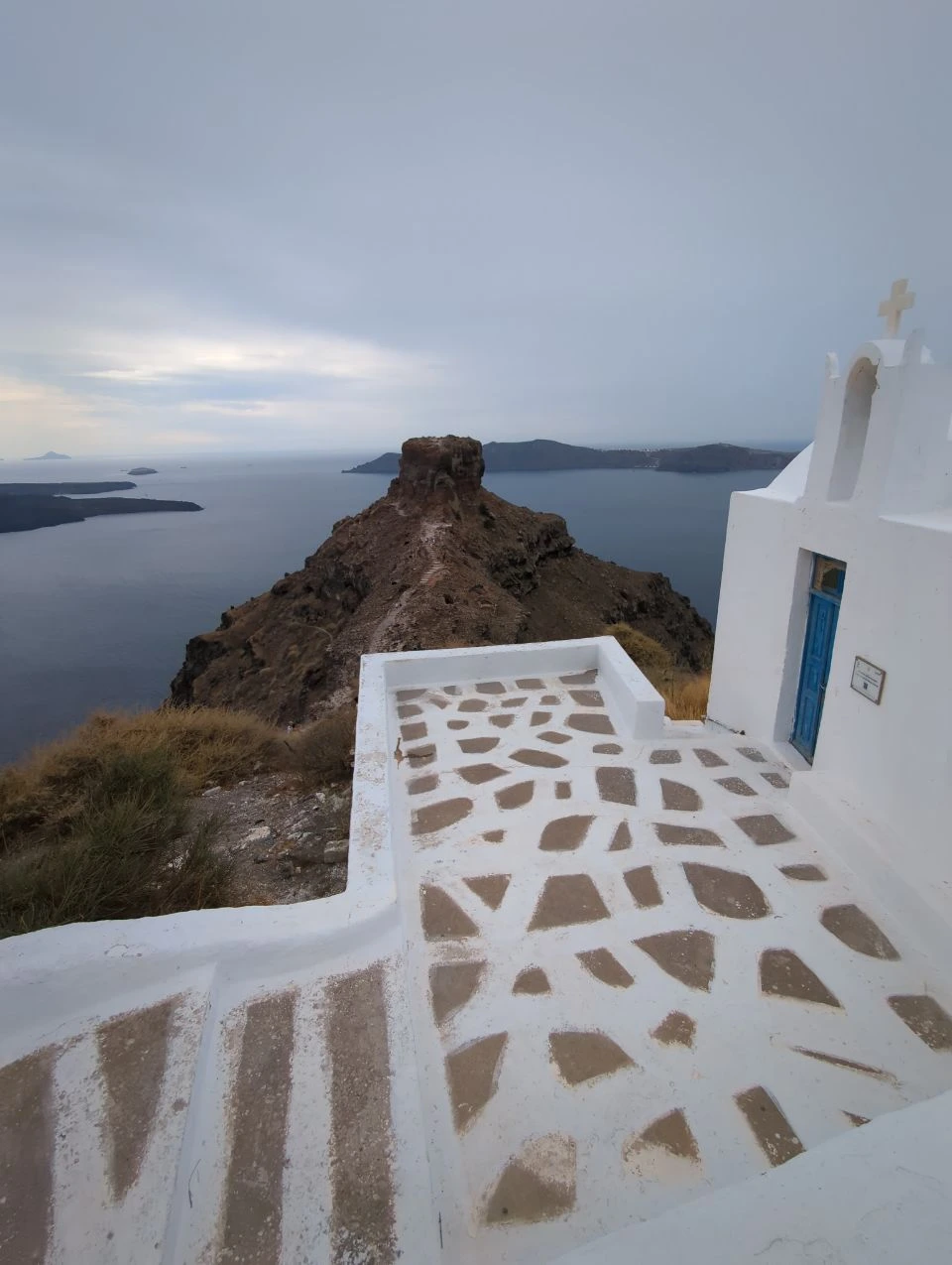
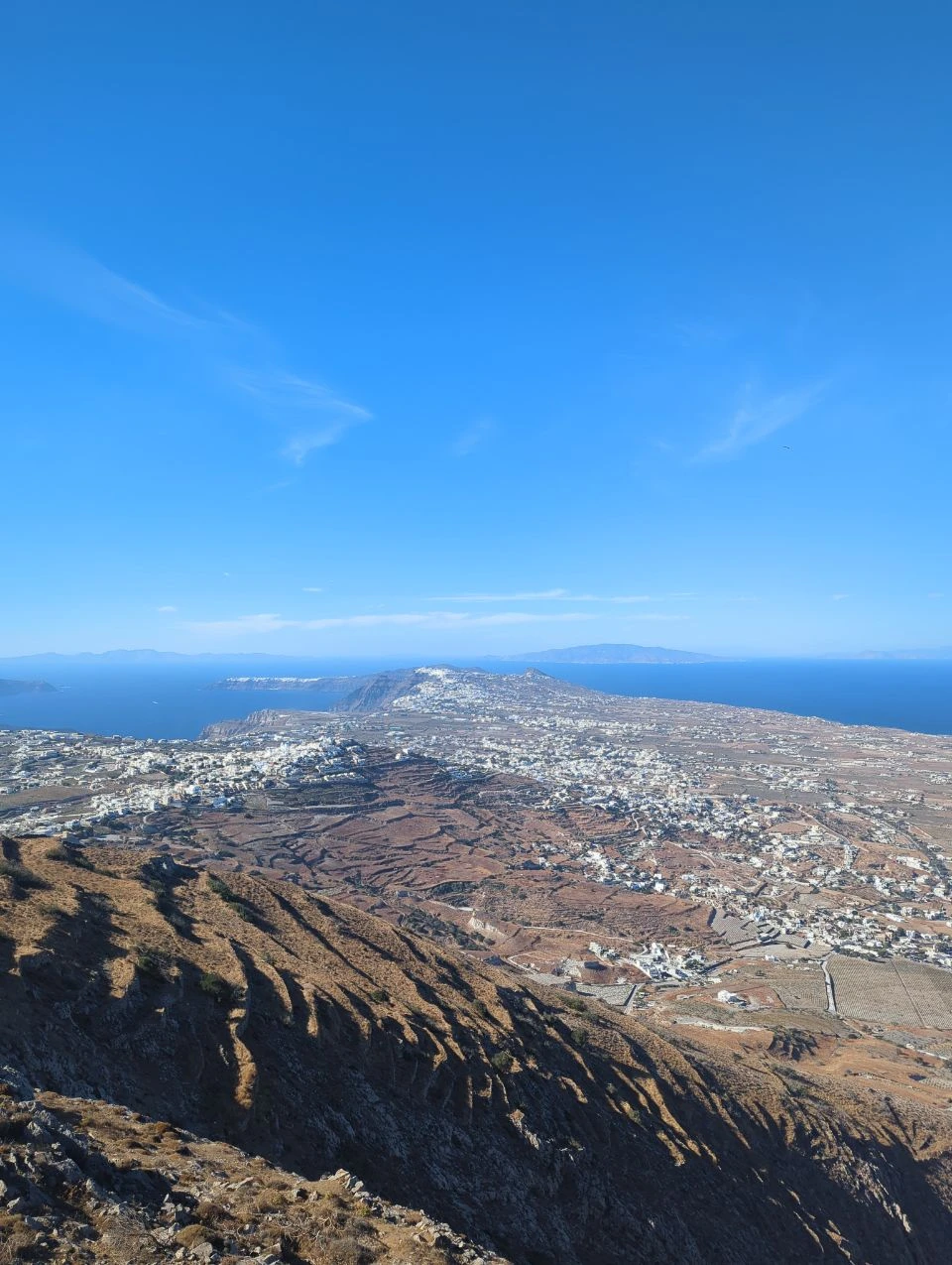
Look at how differently these two photographs feel. In the Skaros view, the dark rock draws you straight in, with a white church beside it and pale paving in front. In the high-island view, there's the pleasure of letting your eye wander across small settlements and patches of land all the way to the sea. One brings a bold landmark close; the other gives you the island stretching out below.
Neither has to do every job. You might love a huge landscape photograph and still want another where you can see each other's faces. Before choosing somewhere, imagine who or what you'd like to notice first. That little decision is much more helpful than working through a list from first place to sixth.
Oia gathers the village into the picture
There are two quite different pleasures here. One is finding a familiar church view and letting its domes fill the picture. The other is looking along the village, so the houses, windmills and cliffside form a much larger scene. The second gives you the feeling of a whole place, with one roof rising behind another, rather than a single landmark to collect.
For a portrait, the view along the village can be particularly appealing. Someone standing closer to the camera can still have Oia clearly behind them, without every building needing to fit. At a tight dome viewpoint, there may be very little suitable space for a person at all. Take the lovely church photograph on its own if that's what the position allows, then look for a comfortable public place for yourselves.
Changing direction is worth a moment, too. A walkway that gives you buildings in one direction may open towards water in the other. You don't have to find a secret terrace to get variety. Keep that curiosity on the public paths; the roofs and little platforms beyond them often belong to homes, churches or accommodation.
If you love pictures full of roofs, colour and little architectural details, Oia gives you plenty to enjoy. You may be sharing the lanes with other visitors even when your photograph looks wonderfully peaceful. For more corners to explore beyond a single dome view, follow the Oia photo walk.
Fira and Firostefani let you look back at the town
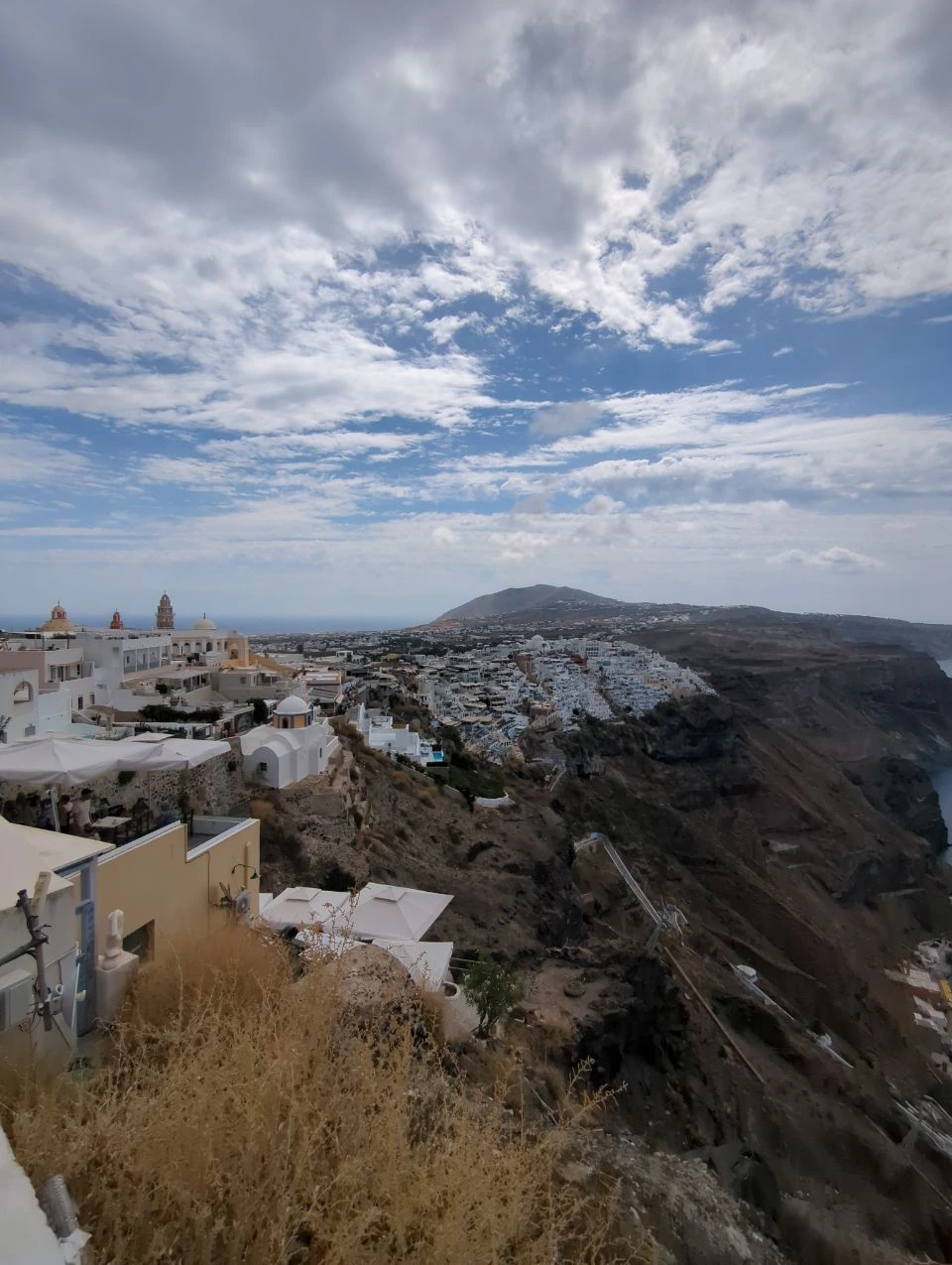
The change is especially satisfying if you've already photographed Oia. Here, you can show the town spilling down the cliff towards the water. Leave some of the dark cliff in the picture. That contrast helps the white buildings stand out and makes their height above the water easier to appreciate.
Firostefani brings another choice. The famous Three Bells of Fira are here, despite the name, and their blue dome and white bell tower make a very recognisable photograph. The view towards the church isn't the only reason to come, though. Looking along the caldera can bring Imerovigli and Skaros into the distance; looking back towards Fira gives the settlement itself a bigger role.
You could come home with a lovely little set from here: the church, the town spread along the cliff, then a closer portrait with a splash of colour or a white wall behind you. Orange-painted stairs and church details give you something smaller to notice between those great sweeps of water.
Other visitors, boats or cruise ships may become part of the background. Decide whether you like that sense of a living island or would prefer a tighter slice of the scene. For the individual stops and the walk between them, use the Fira and Firostefani photo guide.
Imerovigli puts Skaros against all that blue
That can be lovely for photographs of people. A white wall or a small piece of village in the foreground, the rock further away and a broad stretch of water make a scene with room around you. You can keep the landscape generous without filling every corner with architecture. On a day when the water and distant land are clear, the layers can seem to go on and on.
You can also photograph Skaros without making the walk onto it the centre of your outing. You can enjoy the rock from a public spot in the village, or choose to walk out towards it. Once you're on a landmark, you can't see its whole shape behind you in quite the same way. Staying back can be exactly what the photograph needs.
In local photographers' galleries, you'll see both village portraits with Skaros behind them and separate outings towards the rock. If a particularly spacious terrace catches your eye, check where it is before falling for that exact spot. Some belong to booked villas or hotels, so you'll need permission to use them; a church forecourt or roof in a photograph isn't automatically open to you either.
Imerovigli suits you if the dark rock, sea and sense of space are what you keep returning to in your saved photographs. Tell anyone helping plan your outing how much walking and how many steps feel comfortable. A village-side view can spare you the separate rock walk, but it doesn't turn the village into a flat promenade.
Pyrgos brings the roofs closer; Profitis Ilias opens out the island
You don't need to rush straight to the broadest outlook. The layers on the way up, or the ones that appear when you look back downhill, can be the most satisfying part of the picture. They keep the village present as a place with doors, steps and rooftops, rather than reducing it to a distant white patch.
Around the Kasteli, the view can open beyond the roofs to much more of the island. If a café terrace has caught your eye, make it a stop for a drink and ask about taking photographs there. You can also enjoy the setting from public lanes and permitted viewing areas. If it's the little village details you love most, there's more to explore in the Pyrgos, Megalochori and Emporio guide.
Profitis Ilias, the mountain above Pyrgos, is a separate choice. Here, the pleasure is in seeing how the island fits together. Fields, roads and scattered settlements stretch out below, with the sea giving them an edge. The white buildings that seemed enormous when you stood beside them become small parts of a much bigger landscape. Haze and cloud will change how much distant detail you can see, so height alone won't decide which photograph you like best.
If you'd like to add the monastery to your mountain visit, check its current visiting arrangements first. It's home to a living religious community, so enjoy the outlook from exterior areas where access is allowed and leave restricted ground undisturbed. Plan your journey up the mountain separately, too: a visit to Pyrgos leaves you below the summit, so check how you'll get the rest of the way if you're arriving by bus.
At the lighthouse, leave the white village behind
You can let the tower be the main subject, or use a little of the rocky headland to show where it stands. A person in a comfortable position can give the scene a sense of size, but the photograph doesn't need an edge pose to feel dramatic. The open horizon already supplies plenty of that.
Bring shoes you feel steady in for this one: the headland is more exposed than a village lane, with uneven rock and loose material underfoot. You'll enjoy that big sea view much more when you're comfortable standing there. If the wind makes that difficult, choose another suitable setting for your portraits rather than spending the moment trying to settle your clothes and hair.
Plan the last part of the journey as well as the lovely view at the end. The Hellenic Navy's lighthouse information places Akrotiri village five kilometres away, so a bus to Akrotiri won't by itself bring you to the lighthouse. Arrange how you'll cover that last stretch and get back before setting off.
Come for the tower in the landscape and the wide sea view from appropriate public ground. A sunset could be lovely, but the simple contrast between stone, sky and water is worth noticing long before the sun reaches the horizon.
Vlychada trades domes for pale folds and dark sand
The shapes have a story beyond the usual description of a lunar landscape. These are volcanic deposits, with material laid down during the island's Late Bronze Age eruption. Wind and sea have helped carve the forms you see now. That history is visible in the layers and uneven surfaces, without needing to turn a beach visit into a geology lesson.
Looking along the shore brings one ridge in front of another, while a broader view lets the dark sand sit beneath the pale cliff. You might prefer one small stretch to the whole sweep. Light coming across the surface can reveal its relief, giving the photograph more to look at than a flat wall of white.
For portraits, choose a suitable open part of the beach with plenty of distance between you and the fragile cliff faces. Those folds can look beautiful behind you without stepping into their hollows or climbing them. Think about what will feel comfortable on sand and pebbles, too, especially with small children or trailing clothes. It's quite a different afternoon under your feet from a stroll along village paving.
You may also have saved a photograph of Red Beach, but it isn't an extra stop to add here. The Municipality of Thira's published notice prohibits passage and approach because of unstable slopes and rockfalls. Older photographs and marked paths can still appear online, so leave that approach out of your plans.
Vlychada earns its place for its own colours and shapes. Choose it when you'd love a shoreline photograph that adds something the white villages can't, and give yourself time to enjoy the contrast rather than squeezing it between two distant stops.
A little room for the people in your photograph
You can keep a recognisable piece of Santorini in that second picture. Skaros has a clear outline; a few Oia roof curves can suggest the village; pale cliffs above dark sand say something quite different again. Including less of the setting can make it easier to notice both the place and the person.
The space where you stand matters as much as the background. A narrow shared path may be wonderful for looking and less comfortable for pausing as a family. Choose somewhere you're allowed to stop with space for everyone, keep the way clear and take turns if you're photographing one another. A relaxed expression is a much nicer souvenir than the feeling that you had to squeeze into somebody else's exact shot.
Choose a contrast you have time to enjoy
Anna's account of Dyana and Alex's honeymoon session shows how lovely that contrast can be: Imerovigli paired with a beach near Vlychada. Getting between them was part of the planning, with a hire car or hotel shuttle among the arrangements discussed. It's a useful detail to borrow if you're dreaming of both village and shore: plan the ride as well as the photographs.
Another approach is to let the second scene wait. Dreamodd's photographs of Jake and Bella came from an evening around Imerovigli and Skaros, followed by Oia the next morning. You don't need to copy their schedule to borrow the useful idea: two places you love can belong to two separate moments in the holiday.
If you'd love to linger by the sea, start by checking how you'll get back. The current KTEL timetable is the place to check your date, actual stop and return journey. At the time of writing, buses to Vlychada run on a limited daytime schedule, so check your return before planning to stay for sunset. Choose a return that gives you the beach visit you're looking forward to.
Weather can change the picture you'd most enjoy, too. If distant settlements are fading into haze, closer roof curves or a colourful doorway may be more rewarding than another high panorama. Strong wind at an open headland may make a different, suitable location a better place for portraits. If a bright sky has everyone squinting, look for a shady spot where you can comfortably stop for a closer portrait, and keep the wide view as a separate photograph. The Santorini sunrise and sunset guide helps with the light question; the choice here is what you want that light to fall on.
Bring yourselves into the view
If you'd love photographs together in one of these settings, explore Travaya's Santorini photographers. Share your dates, where you're staying and the kind of picture you keep imagining. You can message Travaya on WhatsApp to discuss a location and a comfortable plan. There's no need to make every view part of the same session.
Santorini viewpoint FAQs
You can enjoy the exterior view from suitable public ground without going inside. A visit to the lighthouse site needs special permission from the Hellenic Navy, and entry to the building has to be specifically included, with the keeper or another representative accompanying you. The tower isn't open to visitors, so plan for the lighthouse in the landscape rather than a climb to the top.
It's part of the former D. Nomikos tomato factory, now the Tomato Industrial Museum. The museum tells the story of Santorini's small tomatoes, their processing and the people who worked there. If that sounds like a lovely addition to your beach visit, check its current opening days before going.
No. A phone or ordinary camera can give you plenty to enjoy. Try a horizontal picture for a broad scene and a vertical one when a tower, rock or person is the main subject. You can always make a second photograph of the details you couldn't fit into the first.


How to Propose in London

Couple Photoshoots in London

Best Photography Spots in Lisbon: Choose the Look You Love

Our 12 Favourite Places to Propose on Holiday

What Does a Marriage Proposal Mean, and Why Does It Matter?

Why Do We Propose With a Ring? The Meaning Behind the Tradition
ENJOY $20 OFF
Your first photoshoot when you become an email subscriber.
Related Articles

How to Propose in London
Make the surprise feel like you.

Couple Photoshoots in London
Choose the London setting you love, and we’ll shape one relaxed route around it.

Best Photography Spots in Lisbon: Choose the Look You Love
Choose the Lisbon photo setting that suits you, from Alfama lanes and hilltop views to Bica, Belém, MAAT, the Tagus and yellow trams.