
October 6, 2026
Fisherman's Bastion photo walk: arches, towers and room to explore
A pale stone turret peeks through an arch, the grand stair curls below you, and across the Danube Parliament looks almost small enough to fit in your hand. Fisherman's Bastion has the big Budapest view, certainly. But some of its loveliest photographs happen when you turn away from the river and notice the doorway, balcony or little patch of courtyard beside you.
You can build a wonderfully varied walk around those details. Start with the towers and lower gateways, add the upper terrace if its views appeal, and give Matthias Church a little attention of its own. The pleasure is in having several photographs to look forward to, with enough freedom to follow whichever corner feels good when you arrive.
Updated

Table of Contents
Choose your Fisherman's Bastion photo walk
These scenes sit around the church and Bastion on the Buda side of the city. The Buda Castle palace is elsewhere in the Castle District, so a meeting described only as “at the castle” needs narrowing down. Here, you're concentrating on the church square and the Bastion beside it. You can enjoy that small area properly without building a cross-city itinerary around your camera.
The architecture rewards a closer look. Frigyes Schulek designed the decorative Bastion to complement the neighbouring church, with an extraordinary variety of towers, windows, lamps, fountains and stone benches. That variety is the reason a few changes of position can give your photographs such different backgrounds. Look for the shapes you love as you walk, rather than trying to collect every recognisable corner. The Research Centre for the Humanities' architectural guide explains how those details belong together.
Start with the courtyard towers
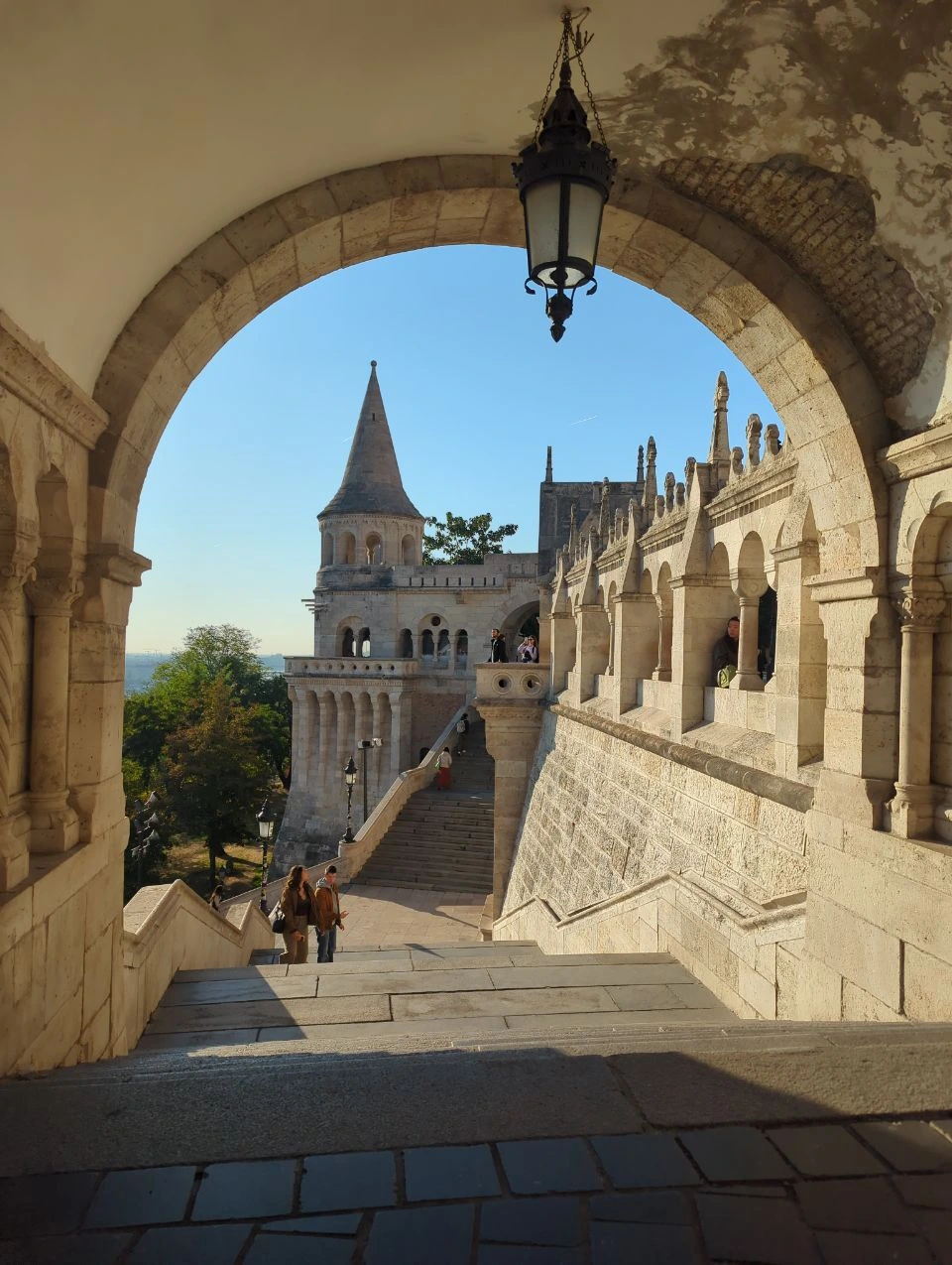
Look first for the short tunnel that frames a turret beyond it. From just outside the opening, you can keep the dark stone surround in the picture and let the brighter tower draw your eye through. Move sideways and the relationship changes: a turret may separate neatly from another tower, or disappear behind the edge of the arch. Those small movements are more useful here than endlessly changing your pose.
Next, try a wider view with the steps and two towers behind you. Let some of the ground remain in the photograph so the stairs have somewhere to lead. If the picture feels busy, move closer for a portrait that keeps just one tower and a little carved stone. Both photographs can feel completely different, even though you've barely walked anywhere.
The fountain, flower-decorated lamps and benches bring a softer pause between the grand views. A close photograph of a detail you noticed together can sit beautifully beside your portraits in a holiday album. Give yourself permission to collect those small memories too. Budapest doesn't have to fill the entire frame every time.
Frame the grand stair through the lower gateways
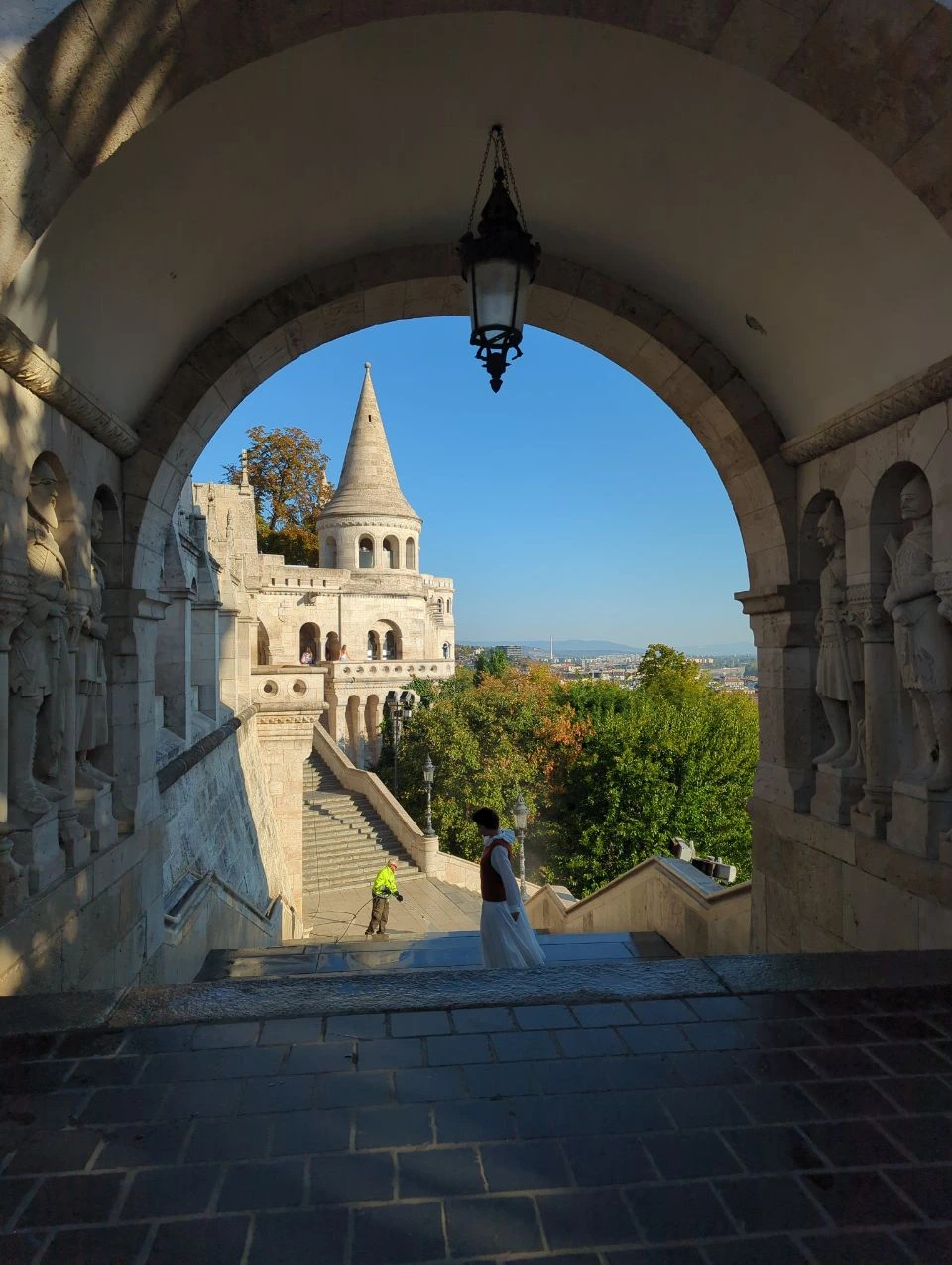
Start by choosing the view from the camera's position. Then have your partner step into the part of the scene where their face is easy to see. Keep the edges of the opening in view if you want the photograph to show the gateway around you; moving closer leaves more room for your expression.
During our visit, photographing from one opening towards the other gave a useful combination of a shaded face and brighter architecture. Treat that as a way of looking for light, rather than a permanent instruction to use the left or right side. The useful question is simple: where can you stand comfortably while the camera sees both you and the stair?
These openings are also people's way through the Bastion. Take your photograph in a gap, keep your bags beside you and let the next visitors pass. If one opening has a queue, look through the other before deciding to wait. You may discover that you prefer its view of the steps.
For a photograph with movement, walk across a level landing and let the stair remain in the background. You get the sense of exploring together without needing to watch the camera while negotiating steps. It's an easy, natural little scene: a few paces, a glance back, and all that wonderful stonework around you.
Find Parliament inside the upper arches
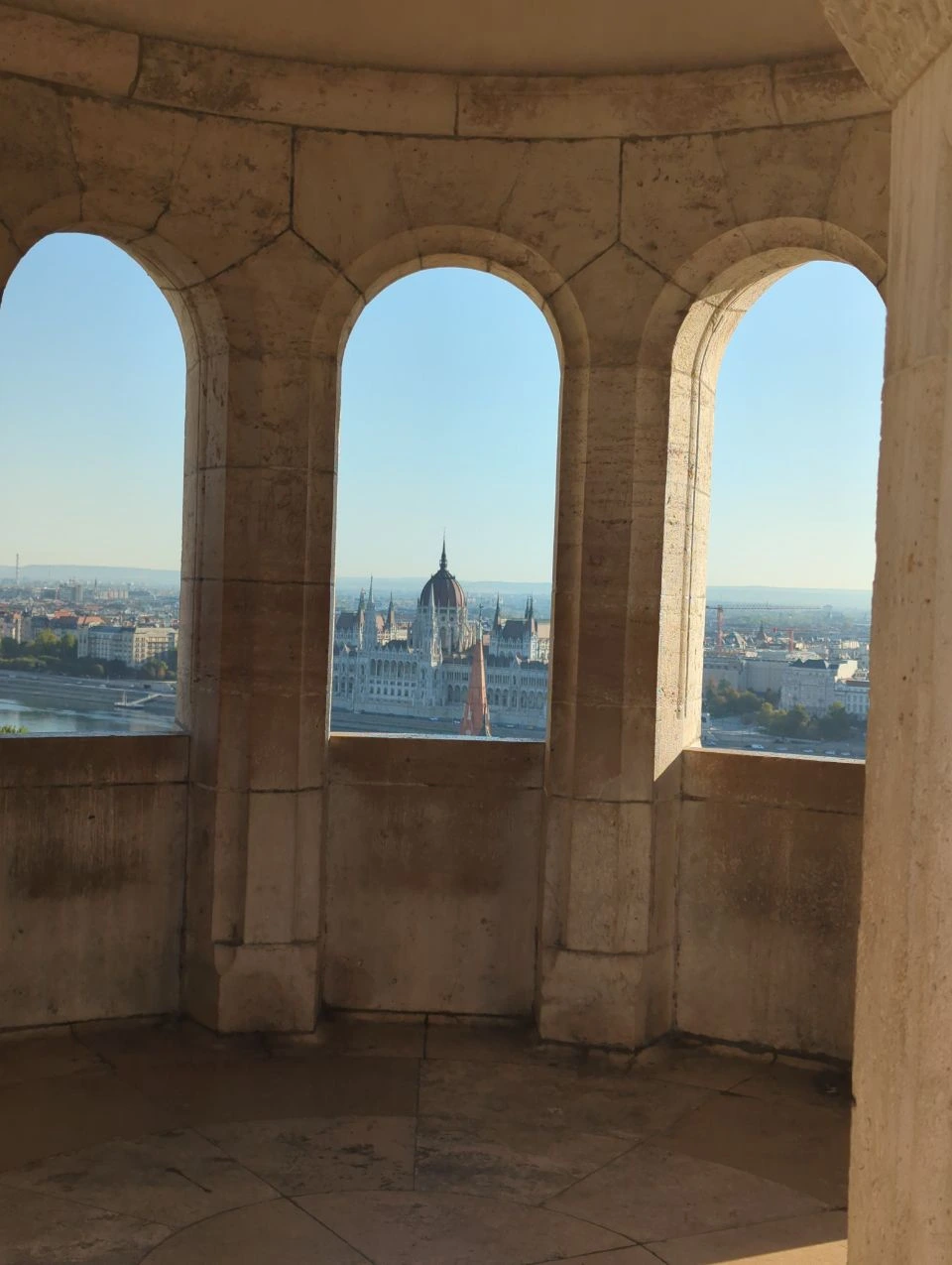
Begin with the view alone. Move until Parliament sits clearly inside the opening rather than partly behind a column. You can then add yourself or your partner while keeping that same line of sight. Standing slightly to one side often leaves more room for the building. A small figure makes the city feel expansive; a closer portrait makes the moment between you more important.
If you're taking your own pictures on a phone, compare the main camera with a modest zoom if your phone has one. A very wide view includes more stonework but can make Parliament a tiny detail. Zooming further may strengthen the skyline while cutting away the arch. Choose the balance you like on the screen, and keep faces away from the stretched-looking outer edges of an ultra-wide photograph.
The bright city and darker opening can also pull the camera in different directions. Tap your face to check how the portrait looks, then check the skyline. If one is losing too much detail, try a position nearer the front of the arch or make two photographs: one portrait and one view. You don't need every frame to do everything.
The lower route still gives you a complete walk when upper access doesn't suit your plans. Admission is a decision about this particular view; it doesn't turn the rest of the Bastion into a waiting room.
Follow the turrets and look across the balconies
Try a photograph looking along the walkway before moving closer for a portrait. The first shows your surroundings; the second can keep just a tower, a sweep of pale wall and your expression. The connecting path belongs to the upper-terrace visit, so use the sections that are actually open when you're there.
The smaller balconies offer another lovely possibility. From a gateway or neighbouring balcony that's open to visitors, your photographer can look across towards you with arches between you. This gives the picture a sense of discovery, almost as if you've just spotted each other across the building. Choose the camera position together first, then walk separately to your places.
Stay on the normal walking surface, inside the parapet, with room for other visitors to use the viewpoint. The stone surround already gives the photograph its drama. You can get that romantic, tucked-away feeling while standing comfortably with both feet on the ground.
Before separating, agree on a simple gesture for “a little left” or “that's the spot”. It saves calling across the balcony and makes the photograph much more relaxed. A quick wave can become a favourite frame in its own right.
Give Matthias Church its own photographs
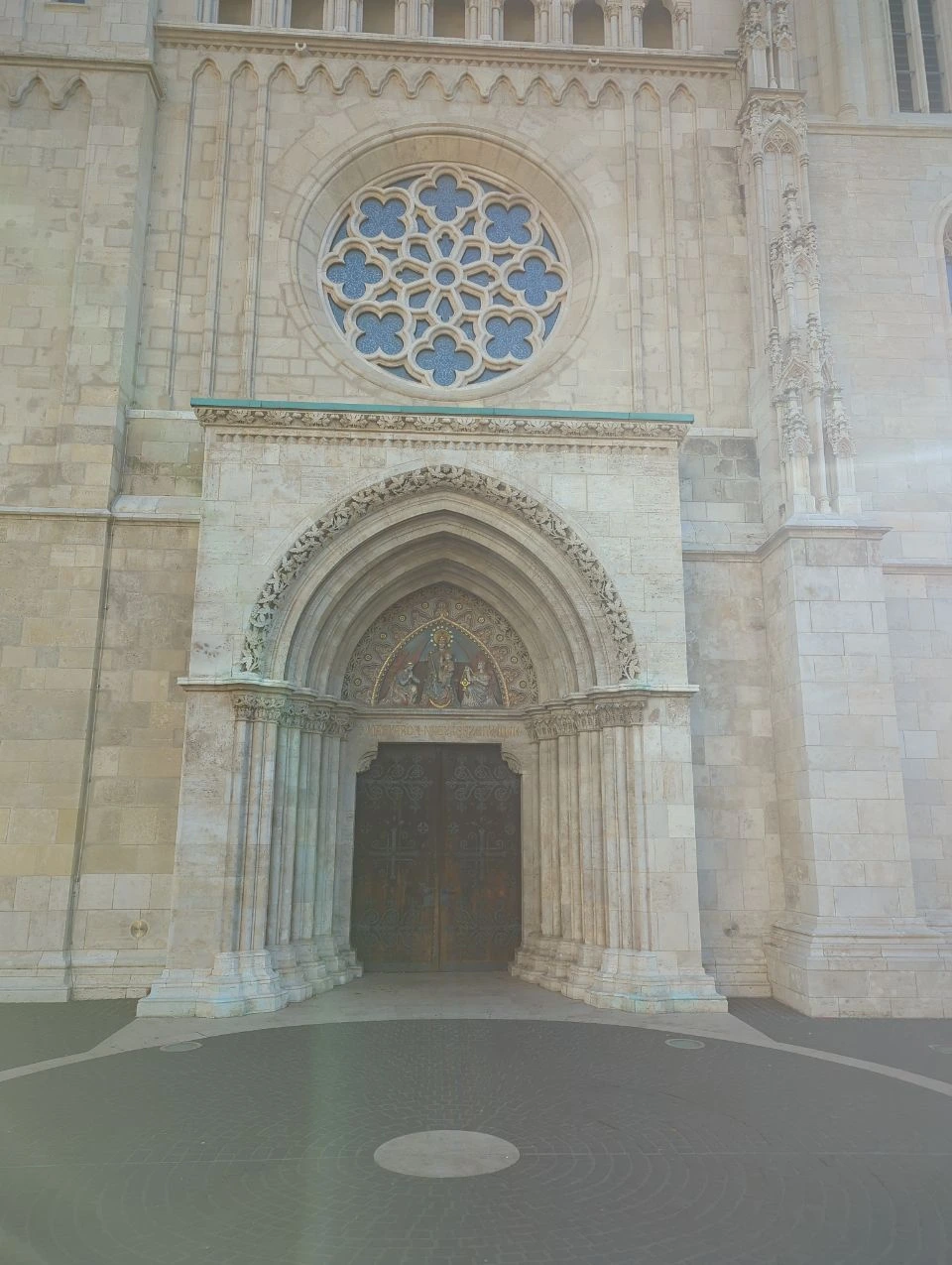
The deeply recessed main portal is especially rewarding. Several layers of carved arches lead in towards the door. From straight ahead, those repeated shapes surround you neatly; from a slight angle, you can see how far the doorway sits back into the stone. Keep enough of the carving above your head to show what makes this entrance special.
The rose window adds a different possibility. With a vertical photograph, you can connect the entrance and window in one view. If including everything makes you too small, give the architecture its own picture and make a closer portrait beside the carved stone. Your album will tell the story more clearly than one crowded image trying to contain it all.
Leave the doorway available for arrivals, and shift to an exterior detail if a service or visitor movement makes the entrance busy. This walk stays outside. A planned photographic visit inside the church needs advance permission and a signed agreement under its visitor rules; an admission ticket alone isn't an arrangement for a shoot.
For a final church view, look back as you leave the square along the street towards Tárnok utca. Around the junction, the church can appear between trees and the edges of the street. Make a walking photograph from the pedestrian space, with the tower behind you. After all those monumental arches, this feels like being out together in Budapest.
Pause beside the king and the column
For your photographs, decide whether you want the whole rider or the smaller details. A wider picture can place the monument among the pale arches, while a closer one brings out a lion or part of the horse's decorated covering. If you're in the photograph, stand far enough from the base for the camera to separate you from it. You won't need to tilt the phone so steeply to include the statue above.
In front of the church, the Holy Trinity Column gives you a different subject: a tall cluster of figures and carved decoration against the square. The present column was inaugurated in 1713 and belongs to Buda's history of plague memorials. You can read that history in the Research Centre's account.
Try including the column and church together to show their setting, then take a detail photograph from ground level. This side of the square felt quieter during our visit, making it a welcome place to linger and look. Choose your standing position around the monument without climbing its base. The changing relationship between column, church and sky is plenty to play with.
Choose the light at Fisherman's Bastion
When you arrive, notice where people are gathering and choose one promising scene. If the river-facing arches are busy, begin with a courtyard portrait or church detail. If a viewpoint opens up while you're nearby, enjoy it then. You can spend the morning making photographs rather than repeatedly checking whether one particular frame has become available.
In bright sunshine, compare a position just inside an opening with one fully out in the light. The shaded position can be more comfortable for your eyes, while the sunlit stone behind you keeps the picture bright. Look for even light across your face: a narrow band of sunshine crossing one eye usually makes a portrait harder than moving half a step sideways.
On an overcast day, the softer difference between light and shade can make close portraits easier. Bring out the carved doorway, pale towers and dark openings; the architecture still supplies plenty of shape. If haze makes Parliament faint, give more space to the nearby stonework and choose the skyline photograph later if visibility improves.
After rain, take a moment to check the stair surfaces before choosing a walking photograph. A still portrait on a comfortable landing can be just as atmospheric. Let the actual conditions decide the movement, and you'll have more attention left for each other and the view.
Arrive at the church square and keep the walk flexible
Bus 16 links Deák Ferenc tér in Pest with Széll Kálmán tér in Buda through the Castle District. Use Szentháromság tér as your destination in BKK's journey planner, checking the actual departure for your date and starting address. That matters particularly for an early meeting, when your preferred journey may differ from a daytime sightseeing route.
The funicular connects Clark Ádám tér with Szent György tér by the palace, leaving a walk through the district to reach the Bastion. For visits from 5 to 16 October 2026, BKK has announced that it's closed for maintenance. Outside that closure, its normal posted start is 08:00 and it uses its own tickets. Check the current funicular information before including the ride in your plans.
For an unhurried visit, we'd set aside roughly an hour for the courtyard, a lower-gateway photograph and the church exterior. Allow more if you want the upper lookout, several portraits or time simply to enjoy the view. That's a suggested allowance, not a timed circuit: queues and how much you enjoy each spot will shape the walk.
Keep the first part simple. Arrive at the square, choose the nearby scene that looks inviting, then work towards your priority photograph. Finish with the church and street view if that takes you naturally towards your next stop. When you've got the photographs you love, you can put the camera away and decide where breakfast or a coffee fits into the rest of your day.
Make room for the photographs you actually want
For more ideas for the two of you, see how a couple photoshoot at Fisherman’s Bastion uses arches, stairs and movement through the same setting.
For a solo visit, you can make a lovely set from architectural details, the river view and a portrait taken by a companion or photographer. Keep any camera support where it's permitted and where it leaves the route clear. The Budapest photographer page is where we keep the city's session details.
Clothes with a clear shape read well against all that carved stone. If you love pale colours, try a portrait against a darker opening so your outfit has an outline. A stronger colour stands out naturally against the pale walls. There's no need to dress as though you're attending a royal event, although the towers may give you ideas.
Choose shoes you can walk in across paving and steps, and bring a layer you like being photographed in if the morning feels cool. Keeping what you carry small helps when you're moving through an arch or changing places across a balcony. Then your attention can stay on the view, your partner and that little moment before you both start laughing.
Make your Budapest morning yours
FAQs
Everything you need to know about our service
The operator's 2026 notice lists a standard adult ticket at 1,700 HUF and a reduced ticket at 850 HUF for eligible visitors. Its paid season runs from 2 January to 23 December. Listed hours are 09:00–19:00 in January–May and from 1 October to 23 December, and 09:00–21:00 in June–September. Check the [operator's current notice](https://budavarikapu.hu/halaszbastya2026/) for eligibility and changes. It doesn't establish a promise of free entry before 09:00, even if you've read that advice elsewhere.
Yes, by choosing positions around the square and checking your intended approach in advance. Starting at hilltop level can reduce the climb from the river, but it doesn't make every gateway, stair or upper viewpoint suitable. Share your actual mobility needs when arranging a session, including whether uneven paving is difficult. Ask for a route built around the places you can comfortably use rather than assuming the full circuit will work.
A short version can work well: begin with one courtyard photograph while your child is interested, then use a nearby detail such as a turret window or fountain as something to notice together. Keep an adult close around stairs and viewpoints. A buggy changes which levels are convenient, so choose a few reachable positions and leave time for a break. You can finish with a happy child and a small set of photographs without visiting every corner.
Yes, it can provide a beautiful public setting, but it doesn't offer privacy simply because you arrive early. Plan the exact standing place, where your photographer will be and how you'll reach it together before the moment. If you want decoration, reserved space or anything that changes how an area is used, have the relevant permission confirmed first. A quiet-looking photograph and an exclusively booked location are different arrangements.


How to Propose in London

Couple Photoshoots in London

Best Photography Spots in Lisbon: Choose the Look You Love

Our 12 Favourite Places to Propose on Holiday

What Does a Marriage Proposal Mean, and Why Does It Matter?

Why Do We Propose With a Ring? The Meaning Behind the Tradition
ENJOY $20 OFF
Your first photoshoot when you become an email subscriber.
Related Articles

How to Propose in London
Make the surprise feel like you.

Couple Photoshoots in London
Choose the London setting you love, and we’ll shape one relaxed route around it.

Best Photography Spots in Lisbon: Choose the Look You Love
Choose the Lisbon photo setting that suits you, from Alfama lanes and hilltop views to Bica, Belém, MAAT, the Tagus and yellow trams.