
October 8, 2026
Budapest After Sunset: Romantic Couple Photos with City Lights
The Danube is still holding the last colour of the sky when Budapest begins to sparkle. Parliament sharpens into view across the water, bridge ironwork frames the skyline, and warm lamps glow along façades and steps as you wander between them.
An evening session is much more than a daytime route taken later. Some corners become quieter, others buzz with passing trams and evening crowds, and reflections ripple through the city lights on the river. Do you picture yourselves beneath a sweeping skyline, framed by the bold structure of a bridge or tucked together under warm street lamps?
Choose the mood that feels most like you, and the decisions about timing, clothing and locations become much easier.
Updated

Table of Contents
Why Budapest Changes After Sunset
From one bank, the Danube might fill the foreground, Chain Bridge cross the middle of the view and the buildings of Buda rise beyond it. Move closer and everything changes. Ironwork, stone, steps and individual lamps become more prominent, allowing the city to frame your smaller gestures instead of dominating every photograph.
That variety makes Budapest especially lovely for an evening couple session. You can begin with generous views that clearly establish where you are, then wander into a tighter architectural setting without losing the character of the city. Sometimes just a few streets are enough to shift the atmosphere from grand and cinematic to cosy and personal.
The river creates useful visual separation too. An illuminated building across the water can remain clear behind you rather than competing with nearby details, while the darker foreground adds depth. Closer to the centre, façades, columns and pools of lamplight create layered scenes in which you feel part of Budapest, not simply like observers standing outside it.
Start Before Full Darkness
Early in the session, faces can feel softly connected to the wider scene. As twilight deepens, city lights begin to glow while blue, pink or muted gold lingers above the skyline. Buildings remain recognisable, but lamps and windows start adding atmosphere. Later, the sky darkens and Budapest’s brightest façades create a moodier, more concentrated setting.
Your best starting point depends on which part of that transition excites you most. Begin earlier if you want more colour in the sky and a softer balance between people and architecture. Start closer to sunset if you love the moment when the lights become prominent but the skyline remains clearly defined. A predominantly nocturnal session can begin later, although that leaves less room for variety if a building is not illuminated as expected.
There is no universal starting time because sunset shifts considerably throughout the year. Check the date-specific sunset time shortly before your session, then work backwards according to how much daylight, twilight and darkness you would like. Your photographer can turn that preference into a realistic meeting time.
Choose Your Evening Mood: Panorama, Structure or Street Lights
For an unmistakably Budapest backdrop, a riverside panorama gives the photographs room to breathe. The Danube becomes part of the composition, buildings settle into a broad skyline and bridges may connect the two sides of the frame. You will often appear smaller against the surroundings, giving the images a calm, cinematic quality.
Imagine reaching the riverbank just as Parliament’s lights become brighter than the remaining sky, then pausing together while the city stretches behind you. A gentle walk along the embankment brings movement into the photographs without losing the grandeur of the view. Even something tiny, such as leaning into each other at the water’s edge, can feel significant against such a generous skyline.
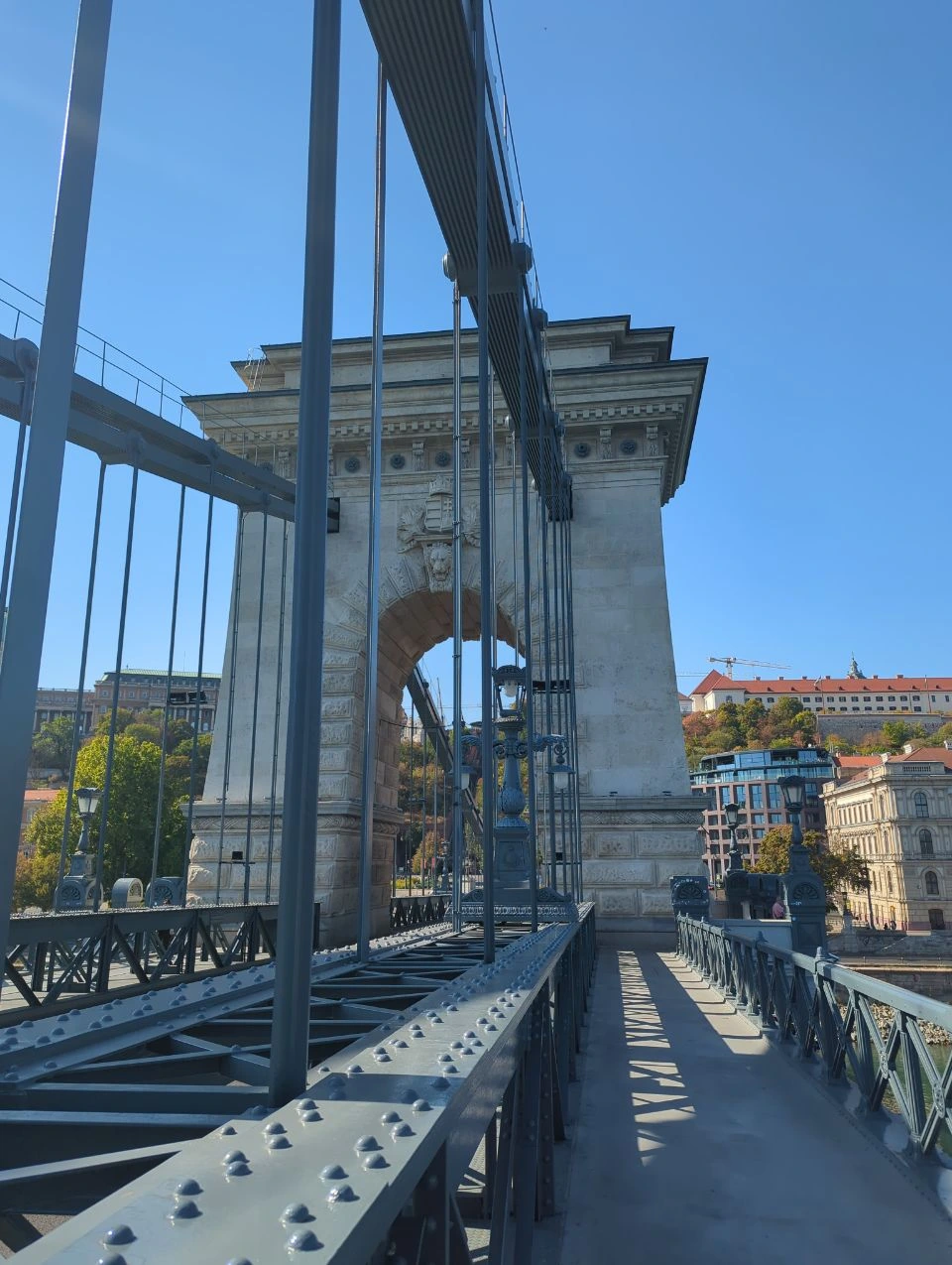
If you prefer something bolder and more urban, let Budapest’s bridges do the framing. Chain Bridge offers substantial ironwork, repeating lines and glimpses of water through its structure. Liberty Bridge has its own personality, with green decorative metalwork and striking diagonal lines.
Both are lively public spaces, and that movement is part of their charm. Footsteps, passing traffic and flashes of water between the ironwork make the scene feel wonderfully alive. On a breezy bridge approach, even a coat lifting slightly as you walk can add energy. The strong lines draw attention through the frame, while stone and metal make a pleasing contrast with softer movement between you.
For a more intimate evening mood, the streets around St Stephen’s Basilica bring the focus closer. The scene can shift from a broad square and monumental façade to smaller neighbouring lanes within a short walk. The Opera exterior offers another compact architectural setting, with columns, entrance details and traditional-looking lamps.
Here, a hand at the waist, a shared look beneath a lamp or one person gently drawing the other closer can become the heart of the photograph while Budapest carries on around you. Doorways, corners and pools of light create a sense of intimacy in a public setting. The result can feel less like a formal city portrait and more like a lovely evening you happened to spend together.
Parliament After Dark: Close Detail or the Whole Façade?
Stay close and the building feels enormous. Its ornament, stonework and vertical scale become dominant, while the surrounding square, gardens and riverside allow for broader architectural compositions. Walking beneath the building can feel more immersive than standing squarely in front of it, particularly when the perspective lets its height rise through the frame.
The trade-off is that including the complete façade from nearby usually requires an extremely wide photograph. Temporary barriers may also limit positions around the square, so your photographer might need to adapt the exact viewpoint on the day. If close architectural detail is the priority, flexibility will matter more than recreating one particular image.
From the opposite bank, the distance allows the full riverside façade to sit behind you in one sweeping view. The Danube creates clear separation between the darker foreground and the illuminated building. Standing close together beside the water while Parliament glows across the river gives you an unmistakable Budapest photograph without making you compete with the architecture.
Distance changes the emotional tone as well. Close views emphasise scale, ornament and the feeling of being surrounded by the landmark. The opposite bank feels more contemplative, as though you are enjoying the view together.
For a shorter session, choose the interpretation that matters most and stay on the appropriate side of the river. Crossing simply to photograph Parliament twice can eat into the loveliest twilight, and there are far more enjoyable ways to spend that time.
Compare the Parliament viewpoints for couples if you are still choosing between architectural detail and the full riverside façade.
Treat Reflections as a Possibility, Not a Promise
On a calm evening, a reflection may be clearly recognisable. On another, the same light might stretch into broken ribbons or tremble across the surface as a boat passes. Those lively streaks can be every bit as atmospheric as a neat reflection, especially when the composition already works through the shape of Parliament, the riverbank and the evening sky.
The direction and intensity of the available light matter too. A reflection that looks bright to your eye may appear differently in a photograph once the exposure is balanced between the illuminated building and the people in the foreground. Your photographer may change the angle or shift your position slightly to make the most of whatever the water is doing.
Think of reflected light as an extra layer rather than the foundation of the photograph. Wet paving after rain can also catch lamps or passing light, but that is another happy opportunity rather than something you can schedule. An evening does not need perfect reflections to feel romantic. Texture, movement and broken colour often suit the Danube beautifully.
What to Wear for Budapest City Lights
That does not mean you both need to wear pale or bright colours. Deep green, navy, charcoal and burgundy can all look gorgeous after sunset when they are balanced with a lighter layer, visible texture or some contrast between your outfits. The aim is simply to stop your clothes, bodies and surroundings from becoming one dark shape.
Coordinate rather than matching exactly. A related colour palette and a similar level of formality usually look more natural than identical clothing. If one person wears a strong pattern or statement piece, a quieter choice for the other can keep everything feeling balanced.
It is worth thinking about how your clothes move too. You should be able to walk, turn and stand close without constantly readjusting. Layers help as the temperature changes and can add subtle variety during the session. A coat that opens naturally as you walk may create lovely movement, while anything that makes you hunch or brace your shoulders will quickly become uncomfortable.
The riverside can feel cooler and breezier than Budapest’s sheltered streets. Clothing that seems perfectly suitable for the forecast may feel less cosy when you pause near the water, so keep an extra layer nearby even if it does not appear in every photograph.
Choose shoes that can cope with stone surfaces, bridge approaches and uneven paving. If your favourite pair is mainly for the photographs, bring something practical for walking between locations. Your feet will thank you, and relaxed feet tend to produce much more relaxed faces.
How to Move Naturally After Dark
You might walk side by side, slow down and turn towards each other, chat while staying close or pause beneath a lamp for a quieter frame. One person can move half a step ahead and glance back, or you can stop together as though deciding where to wander next. These prompts are small enough to leave space for your real reactions.
If something feels awkward and makes you laugh, brilliant. That unplanned reaction may become the photograph you love most. Looking natural does not mean receiving no direction at all. It means the direction gives you room to respond instead of asking you to hold an unfamiliar position and manufacture an expression.
As the light fades, your photographer may ask you to slow a movement slightly so a touch, turn or laugh remains visible. Alternating gentle movement with short pauses gives the final set both energy and closeness. A still portrait can also feel far more relaxed after you have walked into position than when you are placed there immediately.
Budapest itself can help. Bridge lines provide a natural direction to follow, a riverside railing offers an easy place to pause, and a lamp or doorway gives you somewhere to settle without the choice feeling random.
Keep all movement within pedestrian areas, watch for cyclists and transport, and never walk backwards near the river’s edge. Comfort and awareness matter more than completing a prompt perfectly. If a spot feels cramped or distracting, shifting a short distance is usually much more effective than forcing the photograph.
Two Compact Ways to Plan the Evening
Chain Bridge and the adjacent Pest riverbank make a natural pairing when you want both bold structure and open riverside views. The bridge walkway can feel compressed when it is busy, while the nearby embankment gives your photographer more room to change distance and angle without a lengthy transfer. If pedestrian traffic becomes heavy, you can move to the bank earlier and still keep the mood you planned.
St Stephen’s Basilica and its neighbouring streets offer another wonderfully walkable combination. The square provides scale and architectural presence, while the surrounding lanes bring the photographs closer and more intimate. Short distances make it easier to respond to crowds, available light or temporary access changes without losing a large part of the session to travel.
The Opera can work as an alternative architectural anchor when its location fits the rest of your evening. On performance nights, activity around the entrance may affect where your photographer can stand, so let the surrounding streets remain part of the plan rather than treating them as a last-minute fallback.
What to Check Before Your Session
It is also sensible to look for major events, performances, temporary works and public-transport changes around the area you plan to visit. If an important photograph depends on a particular terrace, set of steps or position near a landmark, check the latest access information. Barriers do not necessarily prevent lovely photographs, but they can change the strongest viewpoint.
Architectural lighting may vary because of seasonal schedules, special events or day-to-day operations. Treat one specific illuminated façade as a preference, not the condition on which the entire session depends. A strong evening plan includes nearby alternatives that work with architecture, street lamps or the remaining colour in the sky.
Finally, remember that a place which feels quiet in the morning may be wonderfully lively after sunset. Budapest remains a working city, and its bridges, riverbanks and squares can stay active well into the evening. That energy can add life to your photographs, while thoughtful timing and careful angles stop it from taking over every frame.
Plan Your Budapest Couple Session With Travaya
Fancy turning those glowing river views, bridge lights and cosy evening streets into photographs that feel like you? Explore Travaya’s photographers in Budapest and share whether you are dreaming of sweeping panoramas, bold bridge structure or warm, intimate streets after sunset.
Budapest After-Sunset Photo Session FAQs
Choose the Parliament side for architectural detail and dramatic scale, or the opposite bank for the complete illuminated façade. For a short session, prioritise one interpretation rather than spending valuable twilight crossing the river.
The photographs can still use the river’s texture, moving trails of light and the separation it creates between you and the skyline. A mirror-like reflection is a lovely bonus, not a requirement.
Yes, provided the locations form a realistic route. A connected pairing usually preserves far more time for photographs than travelling between several distant landmarks.
Your photographer can adjust the angle, move to a nearby viewpoint or reverse the order of the route. Decide which overall mood matters most, so a change of exact position does not change the purpose of the session.


Our Budapest Shoots:
Book your Budapest couple Photographer!
Start Booking
A Couple Photoshoot at Fisherman’s Bastion: How the Session Unfolds

The Best Budapest Streets for Natural Couple Photos

How to Prepare for a Couple Photoshoot in Budapest

A Romantic Couple Photoshoot at Buda Castle: A Gentle Palace Walk for Two

Photos with the Hungarian Parliament: which side should couples choose?

A Fairytale Couple Photoshoot at Vajdahunyad Castle
ENJOY $20 OFF
Your first photoshoot when you become an email subscriber.
Related Articles

A Couple Photoshoot at Fisherman’s Bastion: How the Session Unfolds
A couple photoshoot at Fisherman’s Bastion can give you loads of variety without needing an elaborate plan. Its pale stone arches, stairways, towers and open terraces create natural opportunities to walk, pause and enjoy each other’s company, with Budapest ready to sweep into the background whenever you want a wider view. You do not need to arrive knowing how to pose. The architecture gives you something to move through and respond to, while your photographer can offer simple prompts as the session unfolds. The result is a connected gallery filled with close portraits, playful moments and expansive city scenes, rather than a string of stiff poses.

The Best Budapest Streets for Natural Couple Photos
You turn a corner, the buildings open slightly and a familiar Budapest landmark appears between the façades. One of you notices it first; the other follows their gaze without breaking stride. The landmark places you in the city without taking over the photograph. You are still walking, talking and looking at each other rather than queuing for a formal pose in front of a monument. That is one of the loveliest ways to photograph a couple in Budapest. A leafy path below the Castle District feels very different from the grand approach to St Stephen’s Basilica, yet both give you space to move and respond naturally. The question is not which backdrop looks most impressive, but where you are most likely to loosen up and enjoy the walk.

How to Prepare for a Couple Photoshoot in Budapest
Budapest can feel completely different from one street to the next. You might walk hand in hand beneath the pale arches of Fisherman’s Bastion, hear a tram rattling beside the Danube, then warm your hands around coffee on a neighbourhood boulevard that feels far removed from the main sights. That variety is exciting, although choosing where to go can feel harder than it needs to. Begin by deciding how you want the photographs to feel, then choose a setting that supports that atmosphere. A little planning goes a long way. The light, crowds, hills, cobbled streets and walking distances can all shape how comfortable you feel. Once those details are working for you, the session becomes less about collecting landmarks and more about enjoying Budapest together.