
October 8, 2026
Photos with the Hungarian Parliament: which side should couples choose?
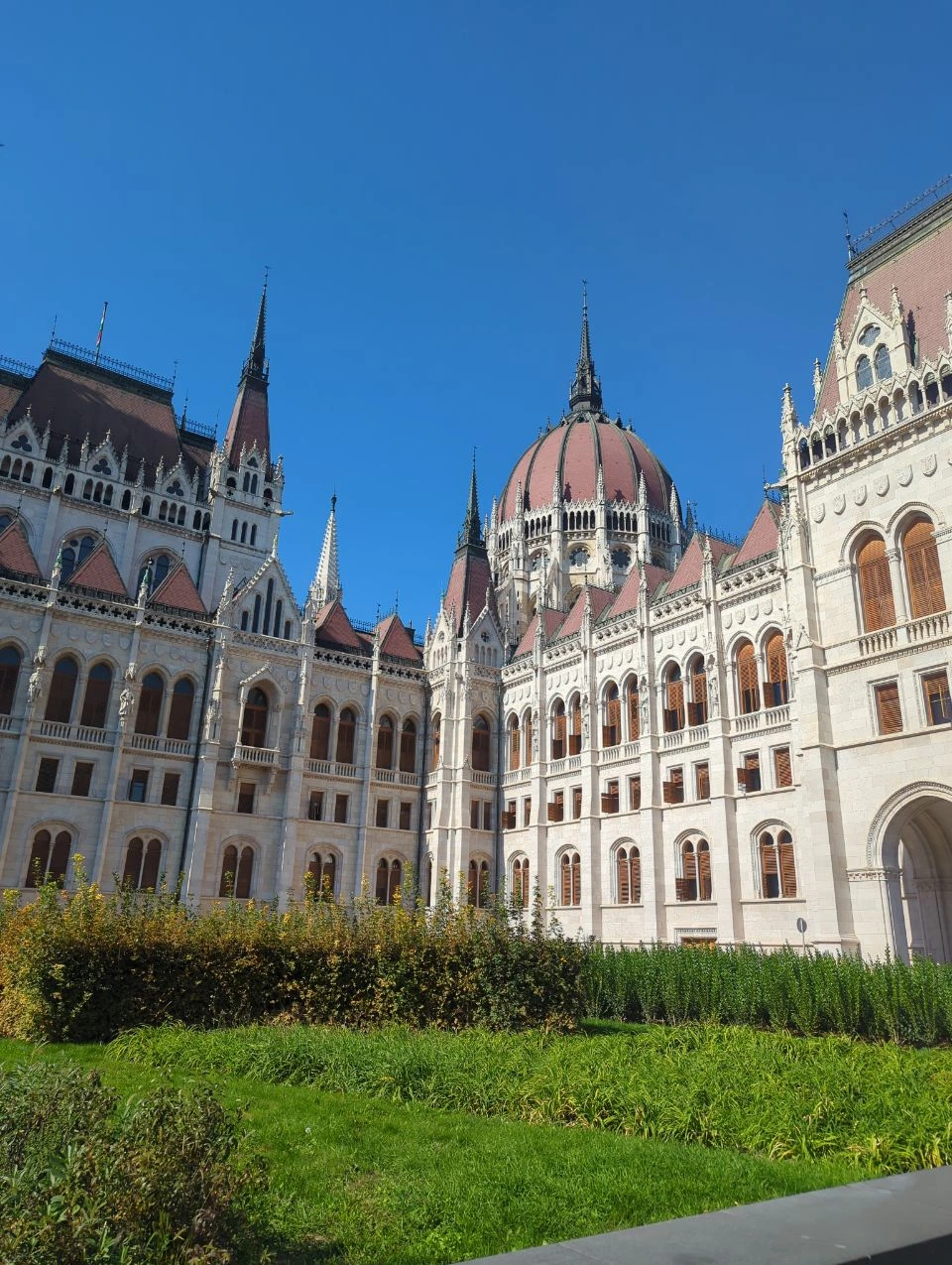
Picture two photographs from the same Budapest trip. In the first, you are close enough to see each other’s expressions clearly while carved stone, tall windows, planting and the dome place you beside the Hungarian Parliament. In the second, you appear smaller beside the Danube, but the complete building stretches across the background and Budapest is recognisable at once.
Neither photograph is the lesser choice. They simply give visual importance to different things. Staying beside Parliament produces a more intimate, couple-led result shaped by architectural details. Creating distance across the river gives the landmark, water and skyline a larger role. Fisherman’s Bastion offers a third treatment, using its own stonework to frame Parliament in the distance.
The useful question is therefore not simply, “Pest or Buda?” It is, “What relationship do we want between ourselves and Parliament?” Once that is clear, choosing a viewpoint becomes much easier.
Updated

Table of Contents
Which side is better for photos with the Hungarian Parliament?
Choose a separated viewpoint across the Danube if the building must be shown as a complete and immediately recognisable landmark. The river supplies the physical distance needed for Parliament to read as one coherent shape. The trade-off is that the photograph becomes more place-led, with more attention given to the façade, water, sky and surrounding skyline.
An elevated Buda viewpoint offers a slightly different answer. At Fisherman’s Bastion, for example, the couple can occupy the foreground while an arch or terrace introduces another architectural layer and Parliament appears beyond it. That is not the same result as an open riverbank panorama, even though both are taken from the Buda side.
Neither bank wins universally. A simple way to decide is to ask what should catch your eye first in the finished image. If the answer is your expressions and connection, begin near the building. If it is Parliament in its complete riverside setting, begin farther away. If you want the photograph to feel carefully framed by several pieces of Budapest architecture, consider an elevated viewpoint.
Beside Parliament: intimacy, architectural scale and one honest limitation
Near the square-facing architecture, repeated windows, towers, broad steps and carved stone create a strong sense of scale. Only part of the building may be visible, yet it can still feel unmistakably grand. This is a good setting for portraits in which your faces, hands and movement matter more than a complete architectural record. Parliament becomes the environment around you rather than a distant object behind you.
Moving towards raised planting produces a gentler variation. Greenery or flowers can sit low in the foreground while smaller towers and the dome rise above them. That layering helps break up the hard lines of the stone and can add colour without asking you to stand inside landscaped areas. It also lets a photographer keep you relatively large while preserving a clear Parliament reference.
The same principle worked during a documented circuit around the building on 30 September 2026. Security boundaries prevented close access to some ornate entrances, but flowers outside the restricted area still provided useful foreground interest from the public side. That layout was specific to the visit, not a permanent guide to where barriers or planting will be. Its value is the broader lesson: a setback does not necessarily spoil the photograph if the composition can use what remains accessible.
A seated portrait can make the setting feel quieter. A bench, trees and a partial view of the dome create a different mood from standing against monumental stonework. Instead of presenting yourselves formally to the camera, you can sit close, talk or look out towards the city. The result feels more like a pause during a Budapest morning than a posed monument photograph.
Street movement adds another option. From an appropriate public path, a passing tram may appear with Parliament and introduce a lively, everyday city detail. It cannot be scheduled like a studio prop, so the photograph should work even if no suitable tram arrives. Tracks and crossings also need to remain completely clear. The interest comes from safely observing the city in motion, not from moving into an active transport corridor.
Walking photographs are especially useful near such an imposing building. A slow stroll, a turn towards one another or a brief stop beneath the windows keeps the couple at the centre while the architecture supplies rhythm and scale. These small actions also make it easier to respond to other people using the square, rather than waiting for a large public space to become empty.
Light can differ from one side of the building to another. On one sunny late-morning visit, a garden-side angle gave gentler portrait light than the brighter façade. That is a dated observation rather than a rule for every month or weather pattern, but it shows why a flexible circuit is useful. Moving a modest distance may improve the light on your faces or separate you more cleanly from the stonework.
The honest limitation is physical distance. Immediately beside the riverside façade, there may not be enough room to include its full length comfortably. The exact result depends on the chosen position and equipment, so it would be too absolute to call a complete view impossible. However, if seeing Parliament as one clean, complete landmark is essential, a viewpoint across the Danube gives that photograph a much stronger chance.
Across the Danube: when the complete Parliament view matters most
This wider treatment changes the balance of the image. You may occupy less space, while Parliament and the river become more prominent. That can feel grand and spacious, particularly if you want a portrait that places your trip within a recognisable cityscape. It is less suited to showing tiny expressions or close physical details, but it can still feel personal through body language, movement and the way you stand together within the scene.
The river is important here for more than atmosphere. It creates the space that the near side lacks. It may also contribute colour, texture or reflections, although those details depend on weather, water conditions and available light. The underlying composition should remain appealing on a grey morning or when the water reflects very little.
Not every separated viewpoint produces the same result. A lower public position may place more water in front of Parliament. A promenade can create a cleaner balance between people, river and façade. Higher ground can bring walls, terraces or arches into the foreground, making the photograph feel more layered.
There is also no single guaranteed point that will be clearest on every date. Boats, vegetation, temporary structures, events and security arrangements can affect the view. The sensible plan is to choose the desired visual relationship first, then confirm the precise standing point after assessing current conditions.
If full-building recognition is your non-negotiable priority, protect it early in the plan. Do not make it dependent on a very specific reflection, illuminated façade or colourful sky. Those elements can be lovely additions, but the strength of the photograph should come from the couple, the river and Parliament’s complete form.
Open riverbank, Fisherman’s Bastion or Margaret Bridge?
The amount of river and sky can then be adjusted through position and framing. A closer portrait may retain enough of the dome and façade to identify the setting while keeping expressions readable. A wider version can place you more modestly within the panorama. Both belong to the same open-riverbank family, but they tell slightly different stories about your place within the city.
Fisherman’s Bastion creates a more structured image. A couple can stand in the foreground, pale stone or an arch can surround them, and Parliament can appear on the far side of the Danube. These three layers make the scene feel enclosed and theatrical. Parliament remains recognisable, but it shares attention with the Bastion’s architecture.
That distinction matters. Choosing Fisherman’s Bastion is not simply choosing a higher camera position for the same riverbank photograph. Its openings and terraces become active parts of the composition. It suits couples who like the idea of one Budapest landmark framing another, while an open bank is more appropriate when Parliament should stand without a competing architectural foreground.
Margaret Bridge provides a broader river narrative. Parliament can still be significant, but the wider surroundings and the sweep of the Danube take on more importance. This works when you want to show the scale of the river and city rather than isolate the façade as tightly as possible.
A low exposed shore was observed near the bridge area on 2 October 2026, but that observation is not a recommendation to use it. Safe access, legality and reliability at different river levels were not established. The supportable option is the broader view from an appropriate public area, subject to conditions on the day.
Think of the three treatments as different visual intentions. The open riverbank is clear and panoramic. Fisherman’s Bastion is layered and architectural. Margaret Bridge is broader and more river-led. Choosing among them is more useful than asking which one is simply the prettiest.
What light, crowds, planting and security can change
A strong plan keeps the visual relationship intact when those extras disappear. If a specific bench is unavailable, a standing or walking portrait can retain the same quiet mood. If flowers are sparse, trees or the texture of the architecture may provide depth. If a tram does not arrive at a useful moment, the public path still supports a lively Parliament portrait without it.
Early sessions can bring softer light and sometimes less pressure from other visitors. They do not guarantee an empty location. Documented experiences include both calmer early conditions and substantial sunrise crowds at popular Buda viewpoints. Choose an early start because the light and pace suit you, while remaining prepared to share public spaces.
Crowds also have different effects depending on the composition. Near Parliament, people moving through paths or square edges may call for a tighter frame, a short wait or a change of direction. From across the Danube, the distance to the building preserves much of the panorama, although activity close to the couple still matters. At Fisherman’s Bastion, changing to another suitable opening may be more productive than waiting indefinitely for one famous arch.
Weather can alter both mood and priorities. Bright sun may make one façade feel harsh while a garden-side position is gentler. Cloud can soften faces and stonework but reduce the chance of bright reflections. Wind can affect hair, clothing and comfort beside the river. None of those conditions automatically makes one bank unusable, but they may change which composition should be photographed first.
Illumination should remain an atmospheric possibility rather than a promise. Parliament can look striking after daylight fades, yet the available information does not confirm a fixed exterior lighting schedule. Blue-hour colour is equally dependent on weather and timing. If an evening photograph matters deeply, current operating conditions are worth checking shortly before the session.
Security boundaries and event arrangements can move. The barriers observed around parts of Parliament on 30 September 2026 limited proximity to ornate entrances, while accessible flowers outside the boundary still supported attractive foregrounds. A future layout may differ. Current signs, barriers and staff instructions always take precedence over a planned camera position.
The practical rule is reassuringly simple: protect the central idea and stay flexible about its ingredients. A close portrait does not require one exact bench, and a panorama does not require mirror-like water. When the basic composition is strong, seasonal planting, a passing tram, warm light or an unexpectedly quiet arch becomes a bonus rather than a condition for success.
Can you photograph both sides in one session?
A compact session often benefits from committing to one main environment. Near Parliament, there is already enough variety for formal architecture, planting, walking photographs, seated moments and street movement. From one suitable Buda position, it may be possible to create both a recognisable panorama and more personal portraits without repeatedly changing districts.
Including both sides becomes more realistic when the session is planned as two clear chapters. One chapter can focus on close architectural immersion, while the other secures the distant landmark view. This is a planning inference based on the geography, not a promise that a particular duration will always be sufficient. The workable route depends on the exact viewpoints, transport, current access and pace of the session.
The order should follow the must-have photograph and the conditions expected that day. If the skyline view is the priority, it may deserve the most favourable available light. If close expressions matter more, it can be wiser to begin where there is room to settle into the session before considering a panorama.
Avoid turning the route into a hunt for every possible feature. A bench, tram, complete façade, river reflection, bridge view and Bastion arch can quickly become a stressful checklist. Fewer well-chosen compositions leave more space for natural interaction and sensible adjustments when Budapest does something unexpected.
Use the Budapest couple photoshoot duration guide to judge whether a second area adds enough variety to justify the transfer.
Which Parliament photograph should be non-negotiable?
Express that preference in one ordinary sentence. For example: “We want to look close and connected, with Parliament surrounding us.” Alternatively: “We want the whole building to be unmistakable across the river.” If an architectural frame matters most, you might say: “We want an arch around us with Parliament clearly visible beyond.”
That sentence gives the session a hierarchy. The essential photograph can receive the strongest available combination of time, light and access, while the secondary idea stays flexible. You are not choosing the only view you may photograph. You are deciding which result should be protected first.
Ready to plan your Budapest couple photos?
If you would like help turning that priority into a relaxed route, explore Travaya’s Budapest photographers and plan the session around the photograph you most want to keep.
FAQs about couple photos with the Hungarian Parliament
Possibly, depending on the exact position and equipment, but close range makes the full riverside elevation difficult to include comfortably. If a clean view of the whole building is essential, create more distance and photograph from across the Danube. Stay near Parliament when larger portraits and architectural detail matter more.
No. An open opposite-bank view prioritises the façade, river and skyline. Fisherman’s Bastion adds elevation and foreground architecture, allowing an arch or terrace to frame the couple with Parliament beyond. It produces a more layered image rather than an unobstructed panorama.
Potentially, but the river crossing needs to be treated as part of the itinerary. Travel reduces the time available at each viewpoint, and light, crowds or access may change between stops. There is no reliable universal minimum duration, so the route should be built around the one photograph you most want.
It can sometimes feel calmer and may offer softer light, but sunrise does not guarantee empty surroundings. Popular Buda viewpoints can attract substantial early crowds. Choose the timing for its likely light and atmosphere, then keep an alternative position available if the preferred viewpoint is busy.
The available official information does not establish current rules for commercial photography, tripods or controlled areas. Check the latest arrangements shortly before the session. Use public paths, respect signs and barriers, keep transport corridors clear and follow instructions from staff or security personnel.


Our Budapest Shoots:
Book your Budapest couple Photographer!
Start Booking
A Couple Photoshoot at Fisherman’s Bastion: How the Session Unfolds

The Best Budapest Streets for Natural Couple Photos

How to Prepare for a Couple Photoshoot in Budapest

A Romantic Couple Photoshoot at Buda Castle: A Gentle Palace Walk for Two

A Fairytale Couple Photoshoot at Vajdahunyad Castle

A Relaxed Couple Photoshoot on Margaret Island, Budapest
ENJOY $20 OFF
Your first photoshoot when you become an email subscriber.
Related Articles

A Couple Photoshoot at Fisherman’s Bastion: How the Session Unfolds
A couple photoshoot at Fisherman’s Bastion can give you loads of variety without needing an elaborate plan. Its pale stone arches, stairways, towers and open terraces create natural opportunities to walk, pause and enjoy each other’s company, with Budapest ready to sweep into the background whenever you want a wider view. You do not need to arrive knowing how to pose. The architecture gives you something to move through and respond to, while your photographer can offer simple prompts as the session unfolds. The result is a connected gallery filled with close portraits, playful moments and expansive city scenes, rather than a string of stiff poses.

The Best Budapest Streets for Natural Couple Photos
You turn a corner, the buildings open slightly and a familiar Budapest landmark appears between the façades. One of you notices it first; the other follows their gaze without breaking stride. The landmark places you in the city without taking over the photograph. You are still walking, talking and looking at each other rather than queuing for a formal pose in front of a monument. That is one of the loveliest ways to photograph a couple in Budapest. A leafy path below the Castle District feels very different from the grand approach to St Stephen’s Basilica, yet both give you space to move and respond naturally. The question is not which backdrop looks most impressive, but where you are most likely to loosen up and enjoy the walk.

How to Prepare for a Couple Photoshoot in Budapest
Budapest can feel completely different from one street to the next. You might walk hand in hand beneath the pale arches of Fisherman’s Bastion, hear a tram rattling beside the Danube, then warm your hands around coffee on a neighbourhood boulevard that feels far removed from the main sights. That variety is exciting, although choosing where to go can feel harder than it needs to. Begin by deciding how you want the photographs to feel, then choose a setting that supports that atmosphere. A little planning goes a long way. The light, crowds, hills, cobbled streets and walking distances can all shape how comfortable you feel. Once those details are working for you, the session becomes less about collecting landmarks and more about enjoying Budapest together.