
October 8, 2026
The Best Budapest Streets for Natural Couple Photos
You turn a corner, the buildings open slightly and a familiar Budapest landmark appears between the façades. One of you notices it first; the other follows their gaze without breaking stride. The landmark places you in the city without taking over the photograph. You are still walking, talking and looking at each other rather than queuing for a formal pose in front of a monument.
That is one of the loveliest ways to photograph a couple in Budapest. A leafy path below the Castle District feels very different from the grand approach to St Stephen’s Basilica, yet both give you space to move and respond naturally. The question is not which backdrop looks most impressive, but where you are most likely to loosen up and enjoy the walk.
Updated

Table of Contents
Choose a street mood, not a landmark checklist
For a monumental mood, look for a broad street where a dome, tower or imposing façade draws your eye through the scene. For something softer, think of walking beneath trees, brushing shoulders on a narrow path or stopping halfway up a set of worn stone steps. Columns, carved details and graceful façades create a more elegant look, while shopfronts, ordinary corners and everyday pavement life give photographs a local feel.
Each setting creates a different balance between Budapest’s grandeur and your connection as a couple. Broad streets give the city scale, although they also bring more pedestrians and open space. Narrower streets pull the architecture closer and feel more intimate, but their light can be less predictable. Trees add movement and depth, while changing foliage can alter both the colour and visibility of a view.
There is no single correct Budapest look. A dramatic building at the end of a street can feel romantic and cinematic. A quiet pavement beside a café can feel warmer and more personal. Decide whether you want the city to announce itself immediately or reveal itself gradually as you walk.
Castle District streets: let Matthias Church appear as you walk
That gradual reveal works beautifully for couple photographs. You can move through the street together rather than taking up a fixed position beneath the church. A wider photograph might show the building beyond you. The next might catch your joined hands or the moment one of you says something that makes the other look away laughing.
Nearby steps create a different rhythm. Trees and foliage can form layers around you, while the rise and turn of a staircase add depth. One person reaches a landing first, turns back and waits; the other closes the final few steps. The action has a natural beginning and end, without requiring an elaborate pose.
Changes in level can also produce variety within a small area. From one position, a wall or tree might conceal much of the district. A little farther along, the view can open to a roofline, tower or section of the city below. This makes the Castle District useful when you want several visual moods without repeatedly travelling between unrelated locations.
Some of the green paths and steps below Castle Hill are best treated as inspiration rather than fixed meeting points because their precise locations were not confirmed. Plan around a known street or landmark first, then use quieter paths if they suit the route on the day.
Late September and early October observations found green foliage and dappled light, but tree cover, colour and visibility between buildings change through the year. A view that feels enclosed in late summer may become much more open once the leaves have fallen.
Around St Stephen’s Basilica: cinematic or intimate?
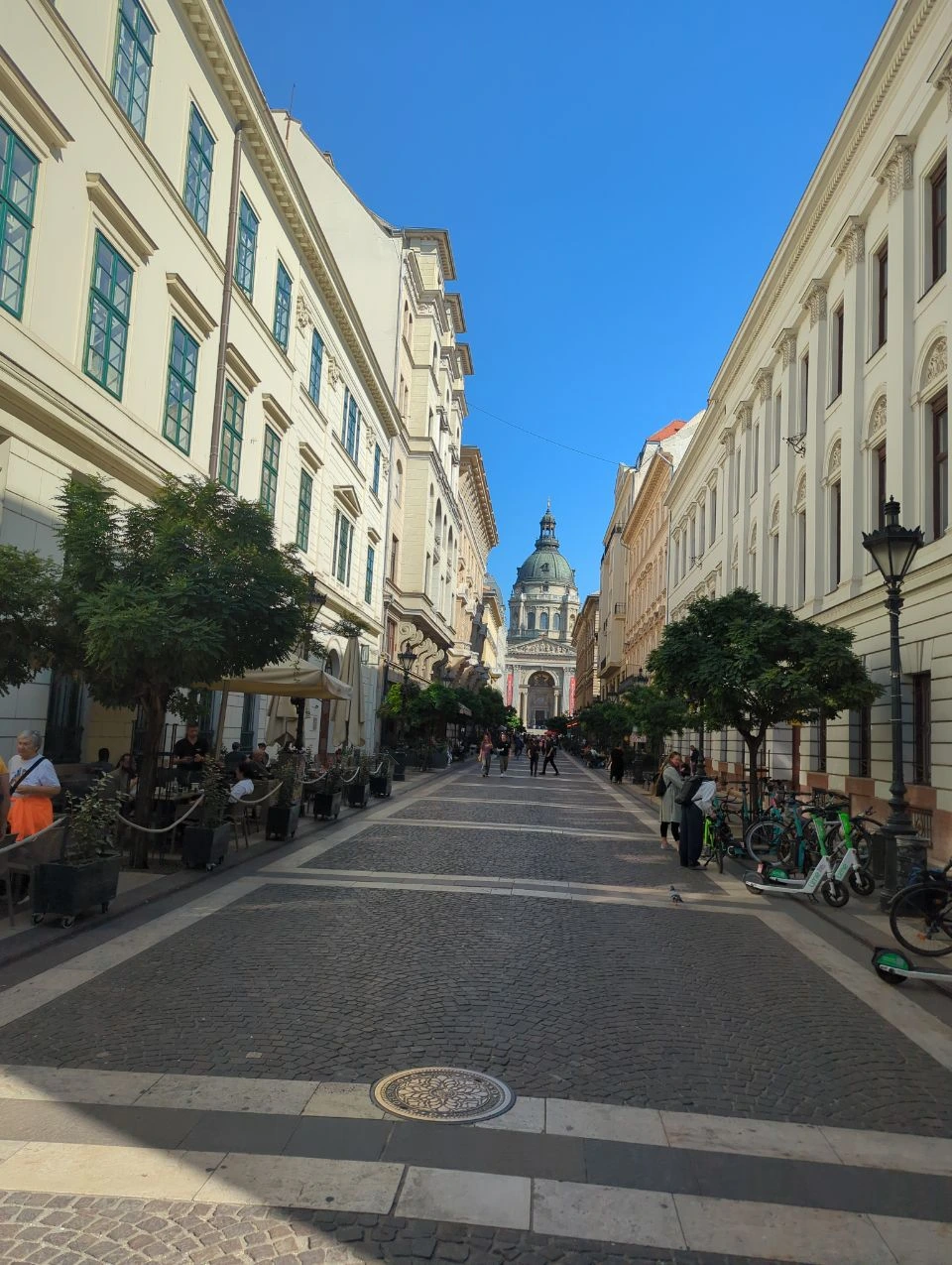
From a broad approach, the surrounding buildings form a strong corridor towards the Basilica. The dome becomes the destination of the frame while the street gives the scene scale. As it grows larger behind you, one person can glance back while the other keeps walking. You get a clear sense of Budapest without having to stop squarely in front of the main entrance.
The broader approach is often the livelier option. During a late-September lunchtime visit, plenty of people were moving through it. Pedestrians can add energy and context, but clear gaps may disappear quickly. This setting suits couples who enjoy the feeling of being in the middle of the city and do not need every background to be empty.
A few streets away, the mood can soften almost immediately. During the same visit, a narrower Basilica-side perspective had fewer pedestrians, with trees breaking up the surrounding stonework. The building remained visible but became part of a closer street scene rather than its sole focus. Strong backlight made that angle more challenging, and the precise street was not confirmed, so it is better understood as a type of perspective than a guaranteed quiet location.
The direction of the street matters here. On the main approach, the architecture naturally leads towards the dome. From a side street, façades, trees and changing light may become just as prominent as the Basilica itself. The first option gives you a strong establishing photograph; the second can make the area feel more private even when you remain close to the centre.
If you choose this part of Budapest, allow time to respond to what the street is doing. A momentary opening between pedestrians may suit a wide photograph. When the pavement fills again, a closer composition can concentrate on expressions, hands and movement without pretending the city around you has vanished.
The Opera area: elegant variety within a short stop
Walk along the façade first, allowing the building to establish the setting without standing rigidly at its centre. Then pause on the steps while one of you adjusts the other’s coat, hair or sleeve. That small action gives the photograph a point of connection while the columns and carved surfaces add structure around you.
Decorative lamps are particularly useful when the camera moves closer. Beneath them, the Opera can remain recognisable even in a tighter photograph of you leaning in to talk. This makes it possible to move from a broad city view to something polished and intimate without repeatedly relocating.
The steps and entrances create clear lines, but they are also working parts of the building. During one late-September afternoon visit, the exterior was relatively quiet. Performances, tours and arriving guests can quickly change that atmosphere, however, so entrances must remain clear for visitors and staff.
Historic metro stations nearby could add tiled walls, old-style benches and period detail if an underground element suits the day. They are best considered an optional addition rather than something on which the route depends.
Around Dohány Street: notice the towers within the neighbourhood
Ordinary buildings and pavement activity remain in the foreground, so the synagogue appears as part of its neighbourhood rather than as an isolated backdrop. A few steps can change the towers from the main feature to a small, recognisable detail above your shoulders. This gives a photographer several compositions without asking you to remain in one position.
The surrounding streets are particularly effective when you prefer layered city photographs. A tower may sit above a roofline, between façades or beyond moving traffic. The result feels grounded in the neighbourhood, with the landmark discovered through the street rather than separated from it.
This guide refers to photographs taken from the surrounding public streets, not inside the synagogue, its memorial areas or other managed spaces. It is an active religious and commemorative setting, so entrances and security points should remain clear. Worshippers, visitors and security staff should never be treated as background characters in a photograph.
Bartók Béla Boulevard: let the shoot become an afternoon out
Budapest’s official tourism guide highlights the stretch between Kosztolányi Dezső Square and Szent Gellért Square. Its restaurants, cafés, bars and galleries create a different atmosphere from the ceremonial centre. Instead of moving towards a palace or dome, you walk through a neighbourhood shaped by changing façades, signs, doorways and daily activity.
One of you slows at a gallery window; the other walks two steps ahead, notices and doubles back. You pass a café terrace, pause beside an interesting frontage or continue talking as the background changes around you. These modest interactions often produce the most personal photographs.
The images can follow the pace of the walk. Wider frames include the boulevard’s architecture and movement. Closer ones happen when a window, textured wall or doorway gives you a natural place to pause. A busy frontage can add warmth and context, while a visually cluttered section can simply be left behind.
Bartók Béla Boulevard is particularly useful if you feel self-conscious when attention is focused entirely on the camera. The surroundings give you things to notice and respond to, from window displays to changing architecture. There is no need to manufacture constant interaction because the neighbourhood provides its own small interruptions.
Choose this area when neighbourhood character matters more than immediate landmark recognition. It will not produce the same instantly identifiable skyline as the Castle District or Basilica, but it offers greater continuity and a more everyday picture of Budapest.
This is an active urban boulevard, so traffic, businesses, pavement conditions and footfall can vary. Its main advantage is that it supports a longer, continuous walk rather than a series of brief landmark stops.
Great Market Hall and Párisi Udvar: brief flashes of Budapest
At Great Market Hall, the patterned roof and exterior towers provide an immediate burst of colour and shape. If a yellow tram crosses while you walk, it can bring a sudden streak of movement to the scene. Treat that as a happy accident rather than something worth waiting for.
The Hall is most useful when it already fits the route. Its roofline establishes the setting quickly, while surrounding transport and pedestrian movement give photographs a lively urban quality. That same activity makes it difficult to linger without interrupting the pace of the walk or getting in the way of passengers.
The strongest photograph may not require the whole building. A section of patterned roof, a tower above the street or a glimpse of the façade behind a passing tram can be enough to identify the location while preserving the sense of movement.
Párisi Udvar offers a more ornate change of scene. Its façade reads most clearly from across the street, where more of the building can enter the picture at once. Traffic, buses and waiting passengers may partially obscure it, so safe positioning and ordinary street use take priority over a perfectly clear view.
Both places suit couples who enjoy a lively city backdrop and are comfortable allowing movement, traffic and chance to influence the photograph. They are less suitable if your priority is a consistently quiet setting.
How to build a natural, compact Budapest photo walk
The contrast should change the mood without sending you unnecessarily across the city. Trees or steps can soften a monumental route, while the Opera can add a polished architectural note. A market roof or ornate façade may provide a quick burst of colour and detail if it already lies along the way.
Think about how each part of the walk will feel, not only how it will look. Beginning somewhere busy may make the first few minutes feel exposed if you need time to relax. Starting on a quieter street can give you room to settle before moving towards a more recognisable landmark. Other couples may prefer to begin with the grandest view while their energy is high, then finish with a slower neighbourhood walk.
The order should also reflect the type of photographs you value most. If the landmark is essential, give it enough time rather than squeezing it between several secondary stops. If natural interaction matters more, protect the continuous walking section and treat architectural highlights as optional additions.
Avoid planning too many cross-city combinations without checking current transport, temporary works and the precise places you intend to use. A route that looks efficient on a map can feel fragmented once travel, crossings and waiting time enter the day.
Timing, light, access and respectful photography
Tours, religious services, performances, roadworks, commuting patterns and weather can all alter a street. Build flexibility into the route rather than depending on one predetermined frame. If an area no longer offers the conditions you expected, a nearby street or a different direction of view may preserve the mood without forcing the original plan.
Light behaves differently across Budapest’s streets. Broad approaches can provide a clearer view of the sky but may expose you to stronger, less forgiving light. Narrow streets can offer shade while also creating sharp changes between bright and dark areas. Trees soften some scenes, although dense foliage may conceal the architecture you hoped to include.
Seasonal change matters most in the greener parts of the Castle District and on tree-lined side streets. Leaves can add softness, colour and layers, but they can also block a tower or roof that is visible at another time of year. If a particular view is important, recent local knowledge is more useful than assuming an older photograph can be recreated exactly.
Keep public streets unobstructed and distinguish a light, mobile couple session from a production involving tripods, substantial lighting or extended use of pavement space. Interiors, religious grounds, transport property and managed attractions may have separate photography rules. Check current guidance before making any such space essential to the plan.
Respect for ordinary city life improves the session as much as it protects other people. Leave entrances open, do not occupy narrow steps for long periods and avoid drawing strangers into the composition without consideration. A good street photograph can include the energy of Budapest without treating the city as a private set.
Plan your Budapest couple shoot
Explore Travaya’s photographers in Budapest and plan a street walk shaped around the way you naturally spend time together.
Frequently asked questions
Choose Buda if you are drawn to slopes, steps, greenery and historic views that reveal themselves gradually. Choose Pest if you prefer grand façades, busier streets, neighbourhood activity and architectural variety within a flatter urban setting. A compact session is usually stronger when it explores one side well rather than using valuable time to cross the city repeatedly.
Choose a route with continuous movement and things to notice along the way. Walking, looking at architecture, pausing at a window or climbing a short set of steps gives you a shared activity. You do not need to perform constant romance or hold a fixed pose for every photograph.
Yes. Budapest offers façades, broad streets, café areas and landmark views that do not depend on staircases. If steps, steep gradients, cobbles or long walking distances may be difficult, make that part of the route discussion from the beginning. The Castle District requires particular care because changes in level are part of its character.
Prioritise a flexible area with several usable streets close together. Strong sun may favour a shaded side street, while changing cloud can make a broad architectural view easier to photograph. In rain, avoid assuming that an interior will be available unless access has been confirmed. A shorter exterior route with nearby pauses is safer than depending on an unverified indoor location.
No. Pedestrians, traffic and café activity can make photographs feel alive and rooted in the city. What matters is whether the amount of activity suits the mood you want. If you prefer a calmer result, choose narrower streets or a neighbourhood walk and remain flexible about the precise background.


Our Budapest Shoots:
Book your Budapest couple Photographer!
Start Booking
A Couple Photoshoot at Fisherman’s Bastion: How the Session Unfolds

How to Prepare for a Couple Photoshoot in Budapest

A Romantic Couple Photoshoot at Buda Castle: A Gentle Palace Walk for Two

Photos with the Hungarian Parliament: which side should couples choose?

A Fairytale Couple Photoshoot at Vajdahunyad Castle

A Relaxed Couple Photoshoot on Margaret Island, Budapest
ENJOY $20 OFF
Your first photoshoot when you become an email subscriber.
Related Articles

A Couple Photoshoot at Fisherman’s Bastion: How the Session Unfolds
A couple photoshoot at Fisherman’s Bastion can give you loads of variety without needing an elaborate plan. Its pale stone arches, stairways, towers and open terraces create natural opportunities to walk, pause and enjoy each other’s company, with Budapest ready to sweep into the background whenever you want a wider view. You do not need to arrive knowing how to pose. The architecture gives you something to move through and respond to, while your photographer can offer simple prompts as the session unfolds. The result is a connected gallery filled with close portraits, playful moments and expansive city scenes, rather than a string of stiff poses.

How to Prepare for a Couple Photoshoot in Budapest
Budapest can feel completely different from one street to the next. You might walk hand in hand beneath the pale arches of Fisherman’s Bastion, hear a tram rattling beside the Danube, then warm your hands around coffee on a neighbourhood boulevard that feels far removed from the main sights. That variety is exciting, although choosing where to go can feel harder than it needs to. Begin by deciding how you want the photographs to feel, then choose a setting that supports that atmosphere. A little planning goes a long way. The light, crowds, hills, cobbled streets and walking distances can all shape how comfortable you feel. Once those details are working for you, the session becomes less about collecting landmarks and more about enjoying Budapest together.

A Romantic Couple Photoshoot at Buda Castle: A Gentle Palace Walk for Two
You begin beneath pale stone arches, close enough to spot the carved details and watch the light shifting around the gateway. There is nothing to perform and no grand entrance to perfect. The architecture brings all the drama you need, leaving you free to settle in, stay close and enjoy being there together. A Buda Castle couple photoshoot can feel wonderfully unlike a production. Think of it as a shared palace walk through gateways, along stairs and terraces, and towards Matthias Fountain. This experience stays around the palace exterior, so it is separate from Fisherman’s Bastion and the other Castle Hill attractions. Within one connected setting, you can create grand architectural portraits, affectionate close-ups and sweeping Budapest views without spending half the session travelling across the city.