
October 8, 2026
When a Rome Photo Spot Is Busy or Closed: How to Find a Better Backup
You arrive with the picture already glowing in your imagination. Water sparkling behind you at Trevi, the Colosseum filling the frame, Rome opening beneath the pines of the Aventine. Then the real city intervenes. The fountain edge is packed, a gate is shut, a barrier cuts through the composition or the light has turned hard and overhead.
It is disappointing, especially when you have only one morning or evening for your session. You might glance at the crowd, then at each other, wondering whether the photograph you planned is still possible. But the photograph is not lost. It simply needs to become something different.
The best response is rarely a frantic dash towards another famous landmark. It is a calm decision about what is no longer working and what could work instead. A close portrait might become a walking photograph. A dramatic close-up might become a wider view. A panorama might become a beautifully framed glimpse of the city.
Updated

Table of Contents
A good backup should feel different
A better backup creates a visible change in the finished photograph. Instead of producing a compromised version of the original idea, it gives the gallery another quality, such as intimacy, movement, scale, depth or controlled light.
That difference matters. A photograph beneath grand architecture can be followed by a quiet portrait in a shaded doorway, then by a laughing walk through a lively street. These contrasts make the gallery feel more varied while helping you use the conditions Rome actually provides.
The alternative does not always need to be another location. Moving a few metres, changing height or replacing a still pose with movement may be enough. The aim is not to collect as many landmarks as possible, but to leave with photographs that feel confident and complete.
When Trevi is crowded, stop waiting for an empty fountain
An early start can improve your options, but it cannot control them. One local observation found Trevi already busy at around 06:45. You may reach the piazza before seven and hear voices and raised phones around the basin before you have even found your intended position. Dawn is a strategy, not a reservation.
If the fountain edge is already dense, decide whether the original photograph still has a realistic chance of working. A still portrait beside the water needs space, a reasonably clear background and a few uninterrupted moments. When visitors are continually arriving, leaving and lifting phones, it becomes difficult to settle into the photograph.
Movement can reduce that dependence on a perfectly clear background. You might walk through a broader architectural composition, with one partner glancing back as the other catches up. A wider frame can include the scale and energy of the piazza, while a closer view can draw attention to expressions, water details or reflected light. The fountain remains part of the atmosphere without having to occupy every available centimetre behind you.
This does not mean pretending the crowd is invisible. A photographer can use foreground figures at the edge of a composition, wait for a brief opening or frame tightly enough that the busiest areas disappear. The important question is whether those adjustments create a strong photograph quickly. If they do not, the session should continue elsewhere.
Be cautious about supposedly secret lanes and hidden corners near Trevi. A place described as quiet online may be busy, poorly lit, blocked or unsuitable by the time you arrive. It is better to respond to the street in front of you than to depend on a promised viewpoint that may never materialise.
If it is time to move on, compare these alternatives to Trevi for couple photos.
At the Spanish Steps, change the angle or the light
The Steps become more interesting when you stop treating them as one enormous staircase. You can meet halfway on a landing, turn towards each other from different levels or walk across the scene rather than posing directly in front of it. A side line can create depth, while an off-centre composition allows the architecture to rise behind you without requiring control of the entire staircase.
This approach also changes how the Steps feel. A centred photograph emphasises symmetry and grandeur. Different levels introduce a sense of interaction, with one person approaching, pausing or looking back towards the other. A side angle may reveal balustrades, façades and smaller architectural details that disappear in the standard frontal view.
During one couple’s session in 2023, an illuminated doorway provided the first useful frame before daylight. The warmer pool of light held the couple close as one partner turned back towards the other. It created a contained, intimate photograph before the session moved into the more open surroundings of the Steps.
A doorway, shaded edge or side-lit patch should only be used where access allows and without blocking an entrance. When the space is suitable, controlled light can produce a quieter and more personal image than the grand view you first imagined.
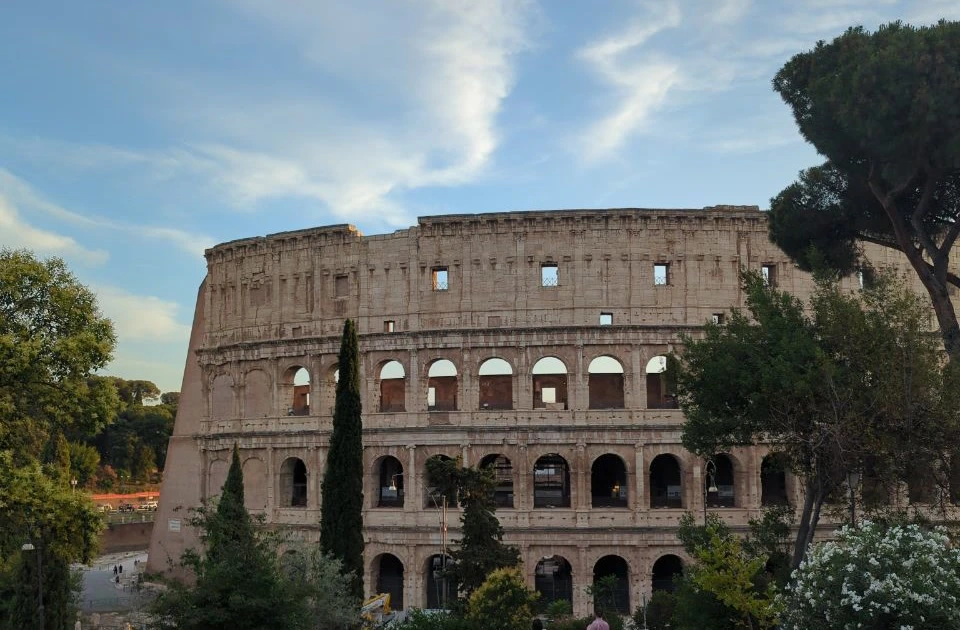
At the Colosseum, change height before changing landmarks
The Colosseum does not need to dominate every centimetre of the frame to feel powerful. From a raised or more distant viewpoint, it can anchor a composition containing rooftops, ruins and a broad sweep of sky. Its stone texture may appear less prominent, but the photograph gains depth and shows how the monument sits within the wider city.
In one 2023 session, the photographer began from a small raised position overlooking the Colosseum before moving closer. Other local observations have found useful views from behind the monument, beside the Forum and along its side approaches. These are creative possibilities rather than fixed route recommendations, because barriers, pedestrian flows and access can change.
A side approach can introduce movement and reveal the curve of the structure gradually. Softer evening conditions may create a richer balance between warm stone and sky. If there is a breeze, movement in a dress, jacket or loose hair can add energy to the frame. The result will depend on the season, weather, orientation and available space, so these effects should be treated as opportunities rather than promises.
Changing height can also solve a question of proportion. At close range, the monument may overwhelm the couple or be difficult to fit comfortably into the frame. From farther away, the photographer can choose a more deliberate balance between people, architecture and sky. The Colosseum remains unmistakable, but the photograph becomes about Rome’s scale rather than physical proximity alone.
If the Orange Garden is closed, replace width with framing
A more interesting response is to show Rome in a completely different way. Instead of spreading the city across the frame, contain it within an architectural detail.
The Knights of Malta keyhole on the Aventine is the obvious example. Through the small opening, the distant dome of St Peter’s appears in miniature, creating a concentrated reveal rather than a broad skyline. That tight framing can give the photograph a sense of discovery that the Orange Garden panorama would not provide.
The keyhole is not an automatic substitute. A queue may make it impractical, and the surrounding space may not give the photographer enough room to work. If either problem affects the composition, there is little value in exchanging one prolonged wait for another.
The same visual principle can guide the next photograph elsewhere in the accessible Aventine area. An arch, gate or gap between buildings can hold a brighter fragment of Rome beyond a darker foreground. The couple might remain close to the camera while the city appears as a carefully placed layer behind them. Instead of imitating the lost panorama, the photograph becomes more intimate and graphic.
Planning information checked on 3 October 2026 listed the Orange Garden as open from 07:00 to 18:00 from October to February, until 20:00 in March and September, and until 21:00 from April to August. Entrance was free. These are useful planning hours, but not a guarantee that the garden will be accessible on a particular day.
When the lower Tiber is unsuitable, move up
High water, poor footing, barriers, closure or event controls should end the lower-level plan immediately. Do not cross a boundary or descend simply because the photograph looked possible on another day. River conditions can change quickly, so the area must be assessed in person.
The natural fallback is upward. From a legally accessible bridge or street-level position, the photographer can decide whether the skyline, bridge structure or passing street life provides the strongest Roman cue. The low river perspective is replaced by height, open sky and the movement of the city.
Upper-level details can support that transition. Lamps may create a repeating line through the frame, while parapets can provide structure without hiding the view. Passing pedestrians and traffic can make the photograph feel lively, particularly when they remain secondary to the couple.
Street level can also preserve some of the intended geographical context. A bridge, dome or stretch of river may still be visible, but from an angle that does not depend on reaching the embankment. The finished photograph will feel different from the original plan, yet it can remain clearly connected to the Tiber and its place within Rome.
Use the two-minute Rome fallback test
1. Identify what is no longer working. Decide whether the problem is access, safety, light, the angle or a lack of room. Naming the actual obstruction prevents random changes that preserve the same weakness.
2. Change one main variable. Adjust the viewpoint, light or amount of movement. One clear change makes it easier to judge whether the alternative is genuinely stronger.
3. Check the new composition. Look for flattering light, enough room to work comfortably and at least one detail that still feels unmistakably Roman.
4. Choose one simple action. Walk, pause together, look back or step into the new light. A clear action helps the photograph begin without a long sequence of instructions.
Waiting is sensible when the disruption is obviously brief. A delivery vehicle may move, staff may reopen a passage or a group of visitors may pass. If the same problem affects more than one attempt, however, waiting begins to consume time without improving the result. The light changes, the remainder of the session becomes rushed and frustration can begin to show.
The two-minute test protects both the photographs and your mood. It creates a natural point at which everyone stops hoping that the original conditions will return and starts working with the conditions available.
Check live access separately from photography conditions
For the Colosseum archaeological area, consult the Parco archeologico del Colosseo. Turismo Roma provides official visitor information, while Roma Capitale is the appropriate municipal source for local notices. If a change of location depends on a bus, tram or Metro connection, ATAC provides current public-transport information.
Historical observations and earlier sessions are still useful. They can indicate which viewpoints have worked, where crowds often gather and which alternatives might produce a different visual effect. They cannot predict present conditions or override a closure.
This distinction is especially important when a location is technically open but photographically unhelpful. An accessible viewpoint may still have harsh light, temporary barriers or too little room to work safely. Equally, a busy site may remain worthwhile if a usable side angle or brief opening produces the intended photograph.
A genuine backup therefore passes two checks. It must be legally and safely accessible, and it must work as a photograph at that moment. Passing only the first test is not enough.
Plan a Rome session that can change gracefully
Before the session, decide which one or two photographs matter most to you. Tell your photographer what draws you to them, whether it is water and reflected light, monumental scale, a skyline or a sense of movement through the streets.
It is more useful to describe that feeling than to insist on an exact pose copied from another session. The same mood may be achievable from a different viewpoint, in another kind of light or through a completely different composition.
Agree in advance on the sign that it is time to move on. That might be a safety concern, a closure or simply two unsuccessful attempts under unchanged conditions. A shared limit prevents uncertainty at the location and gives your photographer permission to protect the rest of the session.
It also helps to distinguish priorities from preferences. If one landmark is essential, the route can allow more flexibility around the remaining photographs. If variety matters more than any individual setting, the photographer can respond more freely to light, access and street activity.
The hoped-for photograph should remain the starting point, not a demand that the city must meet.
Choose someone who can prepare for the original idea and recognise a stronger alternative when conditions change by exploring Travaya’s photographers in Rome.
Frequently asked questions
Explain which visual qualities matter most to you, not only which landmarks you want. Mention whether you prefer wide city views, intimate portraits, movement, architecture or softer light. You should also share any mobility requirements or time constraints that could affect alternative viewpoints and walking distances.
Comfortable footwear is useful when a session may involve cobbled streets, slopes, bridges or a longer walk between viewpoints. If particular shoes are important to the finished look, carry them and change for the photographs rather than wearing them throughout the route.
The photographer may need to change the visual plan rather than keep changing landmarks. Sheltered architecture, covered passages, doorways and reflected light can produce a more coherent gallery than travelling across Rome in search of identical conditions elsewhere. Safety and official restrictions should determine whether the outdoor route continues.
Yes. Tell the photographer before the session about steps, uneven ground, steep approaches or walking distances that may be difficult. Backups should then be chosen for realistic access as well as photographic value, rather than improvised after reaching an unsuitable route.
No. You only need to communicate your priorities and understand how the decision to pivot will be made. Your photographer can prepare suitable options, check current conditions and choose the one that best fits the available light, access and remaining time.


Our Rome Shoots:
Book your Rome couple Photographer!
Start Booking
Couple Photos in Rome at Midday: Shade-First Routes That Still Look Like Rome

Cloudy Rome Couple Photos: How to Use Soft Light Across the City

How to Choose a Roman Forum Viewpoint for Your Couple Photos

Janiculum Couple Photoshoot: Dome Views, Green Walks and the Fontanone
Pincio Terrace or Piazza del Popolo First? A Couple’s Route from Square to Skyline

Villa Borghese for Couples: Lake First or Skyline First?
ENJOY $20 OFF
Your first photoshoot when you become an email subscriber.
Related Articles

Couple Photos in Rome at Midday: Shade-First Routes That Still Look Like Rome
Rome at midday is bright, busy and gloriously full of life. Stone piazzas glow, shadows sharpen and the city carries on around you at full volume. That does not make every landmark unusable. With a clever route built around real shade, brief hero frames and comfortable transitions, you can enjoy the experience and come home with photographs that feel unmistakably Roman.

Cloudy Rome Couple Photos: How to Use Soft Light Across the City
You pictured Rome in warm evening light: honey-coloured stone, long shadows and a streak of colour behind the skyline. Then the forecast filled with little grey clouds. When you only have a few days in Rome, that can feel like a setback. In practice, it simply changes how your photographer uses the city. Thin cloud, white overcast and heavy storm cover all behave differently. The question is not whether Rome will still look beautiful, but where its stone, streets and shadows will come alive beneath the sky you have.

How to Choose a Roman Forum Viewpoint for Your Couple Photos
Stand above the Roman Forum with Rome spread beneath you, and the choice can seem simple: find the widest view and stand in front of it. Scooters hum below, warm light catches the columns, and the city briefly feels still. Yet the biggest panorama does not always make the strongest photograph. You might want layers of ruins that place you unmistakably in Rome. You might prefer a quieter terrace where your expressions, clothes and body language lead the frame. For a proposal, the deciding factor may be whether you can arrive naturally while your photographer waits unnoticed.