
October 8, 2026
Sunrise or sunset: when should you plan your couple photoshoot in Budapest?
Budapest feels completely different at the two edges of the day. In the morning, pale light reaches the stonework of Castle Hill as the city begins to stir. You might walk beneath a Fisherman’s Bastion arch while the streets below are still waking. By evening, attention shifts towards the Danube, changing skies and the movement of boats, trams and people through the city.
Both can look wonderful. The better question is not which time is more beautiful, but which Budapest photograph you would be most disappointed to miss.
Updated

Table of Contents
Sunrise or sunset in Budapest? Start with the photograph you want
If you picture yourselves beside the Danube with the complete Parliament building stretching across the background, sunset into early evening is usually the more natural fit. You can begin while there is still detail in the sky and stay as the river darkens and the city lights become more visible.
These photographs tell different stories. A close portrait beneath a carved arch, a wide Castle Hill panorama and a complete view of Parliament cannot all be planned around one universal golden-hour rule. The viewpoint matters as much as the time.
Think about how you want the session to feel as well as how you want it to look. Morning lends itself to intimacy, gentler streets and a quieter visual palette. Evening brings movement, changing city light and a more cinematic atmosphere. One feels soft and still; the other places you within Budapest as the city gathers energy.
What sunrise gives you, and what it cannot promise
Morning is particularly effective when architecture is central to the composition. Light-coloured façades, elevated terraces and stone details respond beautifully to low, directional light. Long shadows can also give a photographer useful ways to add depth without relying on a dramatic sky.
What sunrise cannot promise is a deserted landmark. Budapest’s most recognisable viewpoints attract photographers, visitors and tour groups precisely because they are so appealing early in the day. The atmosphere may be calmer than it is later, but a famous location can still be busy.
There is also more to a morning session than the first minute after the sun appears. The light continues to change, and a position that feels crowded or awkward at first may become easier a little later. A good sunrise plan therefore allows the photographer to adjust the order of the photographs instead of treating one precise moment as the only opportunity.
Choose sunrise because you love its light, colour and pace. If the surroundings happen to be quieter too, consider that an advantage rather than a guarantee.
Fisherman’s Bastion or Buda Castle: choose the frame you love
If that layered arch view is the photograph you care about most, the Bastion is worth prioritising. Local shoots demonstrate how well its pale stone responds to warm morning light, particularly when the sun creates definition around the arches, staircases and balustrades.
An early start does not mean every opening will be free. Conditions observed in autumn 2026 varied sharply. On 30 September, there was a queue at a popular opening between roughly 08:00 and 08:30. At sunrise on 1 October, an observation estimated that around 200 people were already at the Bastion.
On that second morning, photography became easier about 30 to 40 minutes later, while long shadows and backlight were still attractive. Conditions will differ from one date to another, but this shows why it can be better to work with the changing scene than to abandon the location after a busy first impression.
The session does not depend on securing one particular opening. You might begin on the stairs or beside a balustrade, then move beneath the preferred arch when a brief gap appears. A neighbouring arch can produce a slightly different Parliament frame, while small changes in position, lens choice or camera height can reduce distractions without pretending that the public space is empty.
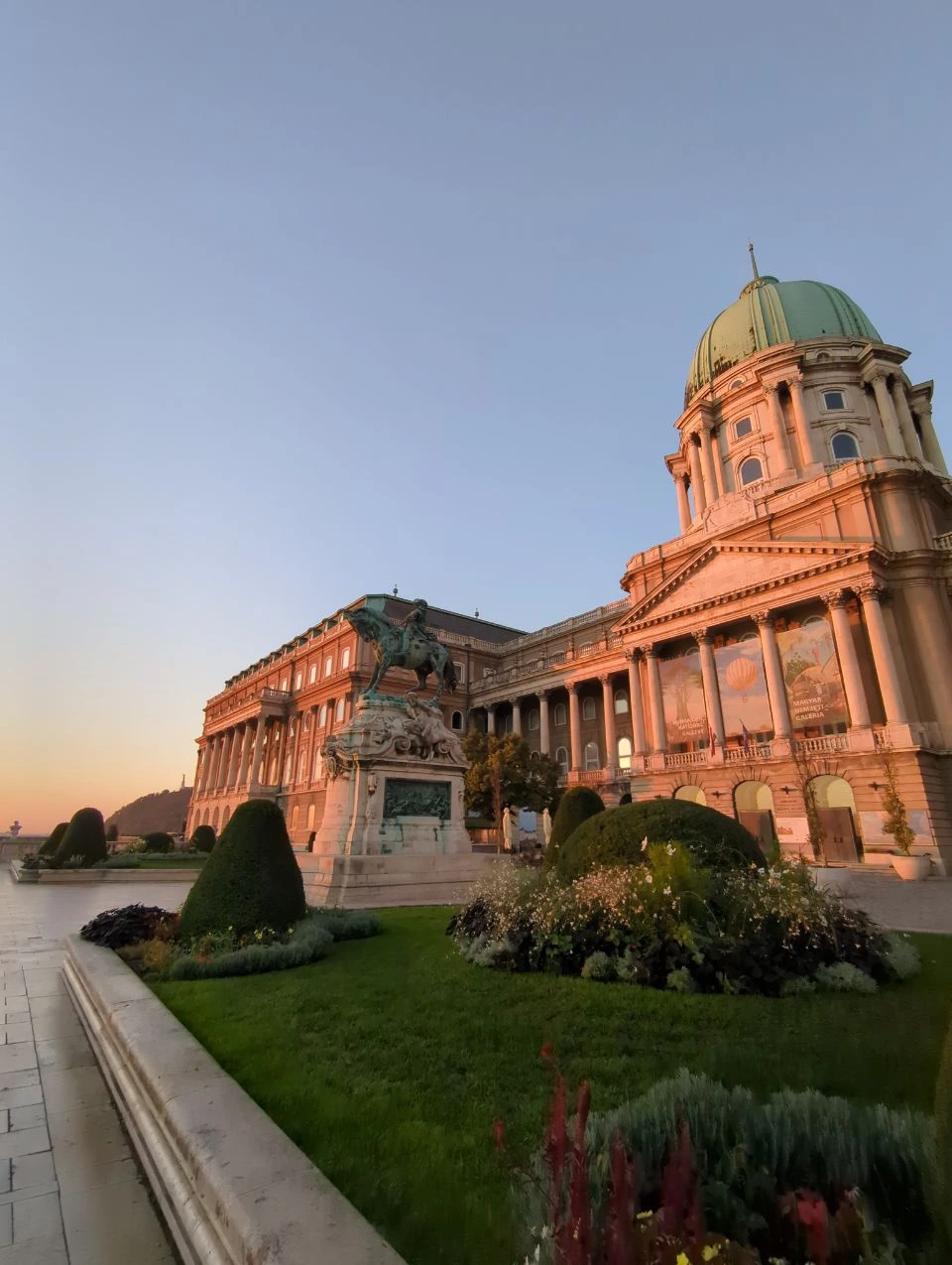
Buda Castle is the stronger choice if you want more room to walk, pause and create several different photographs without waiting for one famous spot. Its terraces can hold the river, bridges, church towers and Parliament within broad city views. The photographer has more freedom to adapt if people, barriers or difficult light affect the original composition.
On 2 October 2026, the palace terraces were exceptionally calm following a much busier sunrise at Fisherman’s Bastion. A lower terrace also opened up a wide panorama across the city. It will not be identical every morning, but the additional space usually offers more ways to respond to the conditions.
Choose Fisherman’s Bastion if its arches and layered Parliament view are central to what you love. Choose Buda Castle if you prefer open panoramas, walking photographs and greater variety. If both matter, decide which one deserves most of your time and treat the other as a flexible addition.
St Stephen’s Basilica: when a morning in Pest fits better
The square, columns, pale façade and long approaches create an immediate sense of place. Walking towards the Basilica shows the scale of the building, while turning into a nearby street allows for closer photographs with architectural detail still present around you.
Local photographers have shared engagement and pre-wedding sessions made here in the early morning. Warm light and quieter surroundings worked beautifully in those examples, although the square will naturally feel different from one day to the next.
The Basilica particularly suits couples who want to feel immersed in Budapest rather than positioned above it. The photographs can move between symmetry, movement and small interactions without depending on a distant panorama. A few steps may be enough to change from a formal architectural portrait to something more personal and spontaneous.
It can also be a more convenient beginning if an early climb, hilltop transfer or series of stairs feels demanding. You still receive a recognisable Budapest setting, but the visual story becomes urban and architectural rather than panoramic.
Light changes quickly around a large building. One side of the square may become bright while another remains in shade, and the surrounding streets can create pockets of soft, flattering light. Your photographer can follow those conditions rather than depending on one exact position.
Choose the Basilica when you want Budapest to wake around you, with the city’s scale and street-level character forming part of the photographs.
Sunset and early evening at Parliament: choose the viewpoint first
On the Pest side, the square and nearby paths place you close to Parliament. The building towers behind you, allowing the photographer to emphasise columns, windows, stone ornament and the sheer scale of the façade. This creates dramatic architectural portraits, but the limited distance makes it difficult to fit the complete building comfortably into the frame.
On 30 September 2026, strong daytime sun proved more challenging than the number of people around Parliament. Barriers affected parts of the doors and steps, while a garden-edge position provided gentler light for faces. When direct sun or temporary restrictions interrupt a planned symmetrical view, closer compositions and a different camera direction can still make the architecture feel impressive.
The Pest-side riverbank offers another interpretation. Here, you gain proximity to the water while Parliament rises prominently beside you. Its riverside position and ornament remain clear, although you are still too close for the grand, complete façade seen in Budapest panoramas.
For that complete view, you need to photograph from the opposite bank. The distance across the Danube allows the whole building to sit within the frame, with the river in front and, when conditions cooperate, reflections below. This is not an angle reached by taking a few steps around Parliament. It is a separate location that must be included deliberately in the route.
A flexible window from late daylight into evening works particularly well from this side of the river. You can begin with detail in the sky, continue through softer twilight and finish as the illuminated façade becomes more prominent. Landmark lights do not have a sufficiently reliable switch-on minute for the entire session to depend on it, so allow time for the transition rather than arriving for one predicted instant.
If you want to continue beyond twilight, our guide to Budapest couple photos after sunset explains how to build an evening route.
Gellért Hill or Liberty Bridge: choose a different mood
On 1 October 2026, a leafy Gellért Hill lookout with circular benches allowed a session to begin with relaxed seated portraits before moving towards the view. Greenery softened the city setting and made the sequence feel more intimate, although the same place may naturally be busier on another day.
A nearby lookout with pale paving produced a cleaner urban panorama. From the stairs, the couple could be framed above the railing with the Danube and city opening behind them. This works well if you prefer a clear skyline and strong architectural lines without asking one landmark to dominate every photograph.
A hilltop setting also provides a natural change of pace. Rather than moving constantly, you can pause, sit together and allow the city to form a distant background. It can suit couples who want their gallery to feel less formal or less centred on famous architecture.
Liberty Bridge offers a sharper mood. Its green metalwork creates diagonals, repeating shapes and strong perspective, while the river and city remain visible around you. Walking within that structure can make the photographs feel energetic and modern.
The bridge is an active transport crossing, so pedestrians and vehicles remain part of the setting. Safe positions and the movement around you will influence which compositions are possible.
Neither location has one universally superior time of day. The more useful choice is between the quieter feeling of a hilltop lookout and the energy of a city crossing. Your photographer can then assess the direction of the light, the level of activity and the safest available positions.
One side of the Danube or both?
Castle Hill includes slopes, stairs and pauses between useful compositions. Formal clothing, footwear, photography equipment and the time required to move through busy areas can all affect how much ground you cover. A distance that looks short on a map may take longer when you are stopping regularly for photographs.
Crossing the Danube requires additional planning. Moving between Parliament’s near-side architecture and its opposite-bank panorama changes the entire viewpoint, so traffic, walking pace and the chosen bridge or transport option all matter. An experienced Budapest photographer can judge whether the crossing adds enough value for the time available.
Pest can provide useful variety without a river crossing. Around St Stephen’s Basilica, you can move between the broad square, close stone details and surrounding streets. Near Parliament, the square, garden edge and riverbank offer several moods, even though they cannot reproduce the distant opposite-bank perspective.
A longer session may allow you to begin with close Parliament details, cross the river and finish with the wider view. For a shorter session, staying within one cluster gives you more time for natural movement, varied compositions and brief pauses when a useful viewpoint is occupied.
If you want both Buda and Pest, choose one must-have photograph on each side and allow everything else to remain optional. That gives the route a clear purpose while preserving room to respond to traffic, light and the way the session unfolds.
Keep the plan flexible and check current local information
Budapest’s major landmarks are shared public spaces. Other visitors, commuters and city activity are part of the experience. A photographer can often use that movement to create a stronger sense of place, rather than waiting indefinitely for the surroundings to resemble an empty reference photograph.
Flexibility also matters because access can change. Opening hours, maintenance work, public events, transport arrangements and photography rules may differ from those encountered during an earlier visit. Check current official information shortly before the session and agree on one nearby alternative.
Weather should be treated in the same practical way. A cloudy forecast does not automatically mean poor photographs, but rain, strong wind or slippery surfaces may affect exposed terraces, bridges and hilltop routes. Discuss the decision point with your photographer in advance so you know whether the plan will continue, move to more sheltered surroundings or be rescheduled.
The aim is not to remove every uncertainty. It is to make sure that one crowded viewpoint, temporary barrier or change in light cannot undermine the whole experience.
Plan your Budapest couple photoshoot
Tell Travaya which photograph matters most to you and how much time you have. We will help you shape a suitable route, pace and nearby alternative around that priority.
FAQs about Budapest couple photoshoots
Choose clothes that allow you to walk comfortably and feel like yourselves. Coordinated colours generally photograph more naturally than identical outfits. Bring a discreet extra layer for cool mornings or evenings, particularly if the route includes an exposed terrace or riverbank.
Comfortable shoes with reliable grip are the practical choice for cobbles, slopes and stairs. If you want dressier footwear in the photographs, carry it and change near the main location rather than wearing it throughout the route.
A light meal and some water can make an early start much more comfortable, especially if the session involves climbing or extended walking. Allow enough preparation time so that breakfast, travel and last-minute delays do not make the morning feel hurried.
Yes, but changing takes time and suitable private facilities may not be available beside every landmark. For a shorter session, one adaptable outfit is usually simpler. If two looks matter to you, discuss where the change could happen and include it in the route timing.
Agree on the weather decision process before the day. Light rain may still allow atmospheric photographs with suitable clothing or an umbrella, while heavy rain, strong wind or unsafe surfaces may require a sheltered alternative or a new date. The appropriate choice depends on the route and your photographer’s rescheduling terms.
Save a small number of photographs that clearly show the viewpoint or mood you love, then share any mobility concerns, footwear limitations or timing restrictions. This gives the photographer useful direction without turning the session into a rigid shot list.


Our Budapest Shoots:
Book your Budapest couple Photographer!
Start Booking
A Couple Photoshoot at Fisherman’s Bastion: How the Session Unfolds

The Best Budapest Streets for Natural Couple Photos

How to Prepare for a Couple Photoshoot in Budapest

A Romantic Couple Photoshoot at Buda Castle: A Gentle Palace Walk for Two

Photos with the Hungarian Parliament: which side should couples choose?

A Fairytale Couple Photoshoot at Vajdahunyad Castle
ENJOY $20 OFF
Your first photoshoot when you become an email subscriber.
Related Articles

A Couple Photoshoot at Fisherman’s Bastion: How the Session Unfolds
A couple photoshoot at Fisherman’s Bastion can give you loads of variety without needing an elaborate plan. Its pale stone arches, stairways, towers and open terraces create natural opportunities to walk, pause and enjoy each other’s company, with Budapest ready to sweep into the background whenever you want a wider view. You do not need to arrive knowing how to pose. The architecture gives you something to move through and respond to, while your photographer can offer simple prompts as the session unfolds. The result is a connected gallery filled with close portraits, playful moments and expansive city scenes, rather than a string of stiff poses.

The Best Budapest Streets for Natural Couple Photos
You turn a corner, the buildings open slightly and a familiar Budapest landmark appears between the façades. One of you notices it first; the other follows their gaze without breaking stride. The landmark places you in the city without taking over the photograph. You are still walking, talking and looking at each other rather than queuing for a formal pose in front of a monument. That is one of the loveliest ways to photograph a couple in Budapest. A leafy path below the Castle District feels very different from the grand approach to St Stephen’s Basilica, yet both give you space to move and respond naturally. The question is not which backdrop looks most impressive, but where you are most likely to loosen up and enjoy the walk.

How to Prepare for a Couple Photoshoot in Budapest
Budapest can feel completely different from one street to the next. You might walk hand in hand beneath the pale arches of Fisherman’s Bastion, hear a tram rattling beside the Danube, then warm your hands around coffee on a neighbourhood boulevard that feels far removed from the main sights. That variety is exciting, although choosing where to go can feel harder than it needs to. Begin by deciding how you want the photographs to feel, then choose a setting that supports that atmosphere. A little planning goes a long way. The light, crowds, hills, cobbled streets and walking distances can all shape how comfortable you feel. Once those details are working for you, the session becomes less about collecting landmarks and more about enjoying Budapest together.