
October 10, 2026
Budapest Viewpoints for Photography: Compare the Skyline, Foreground and Feel
Budapest has no shortage of elevated views, but the highest point will not necessarily produce the photograph you love most. Each viewpoint changes how the skyline, foreground and people fit together. This guide compares the city’s main options so you can find a setting that suits the photographs you want to create.
Updated

Table of Contents
Choose the Photograph Before You Choose the Viewpoint
Foreground is especially important when people will appear in the photographs. Arches, stairs, walls, planting and changes in height can give a photographer more ways to build a composition. They can also help a couple move naturally instead of relying on the distant skyline in every image.
Each location carries a different mood. Fisherman’s Bastion feels ornate, intimate and unmistakably Budapest. Buda Castle lends itself to a visual story across its historic grounds. Gellért Hill ranges from sheltered greenery to expansive city panoramas. The Museum of Ethnography roof offers a lighter, more contemporary setting away from Castle Hill.
With limited time, one viewpoint with several useful compositions is usually more valuable than chasing multiple distant panoramas. You do not need a universal winner. You need the combination of skyline, setting, mood and effort that works for you.
Fisherman’s Bastion Frames Budapest; Gellért Hill Reveals Its Shape
At Fisherman’s Bastion, Parliament can appear across the river through an arch, between stone columns or beyond a terrace edge. The pale walls and decorative towers hold the composition together, helping you remain prominent while a major landmark establishes the setting.
Its compact layout is one of its greatest strengths. Arched corridors, steps, terraces and recognisable towers sit relatively close together, so a photographer can move from an architectural portrait to a river view without changing to a completely different location.
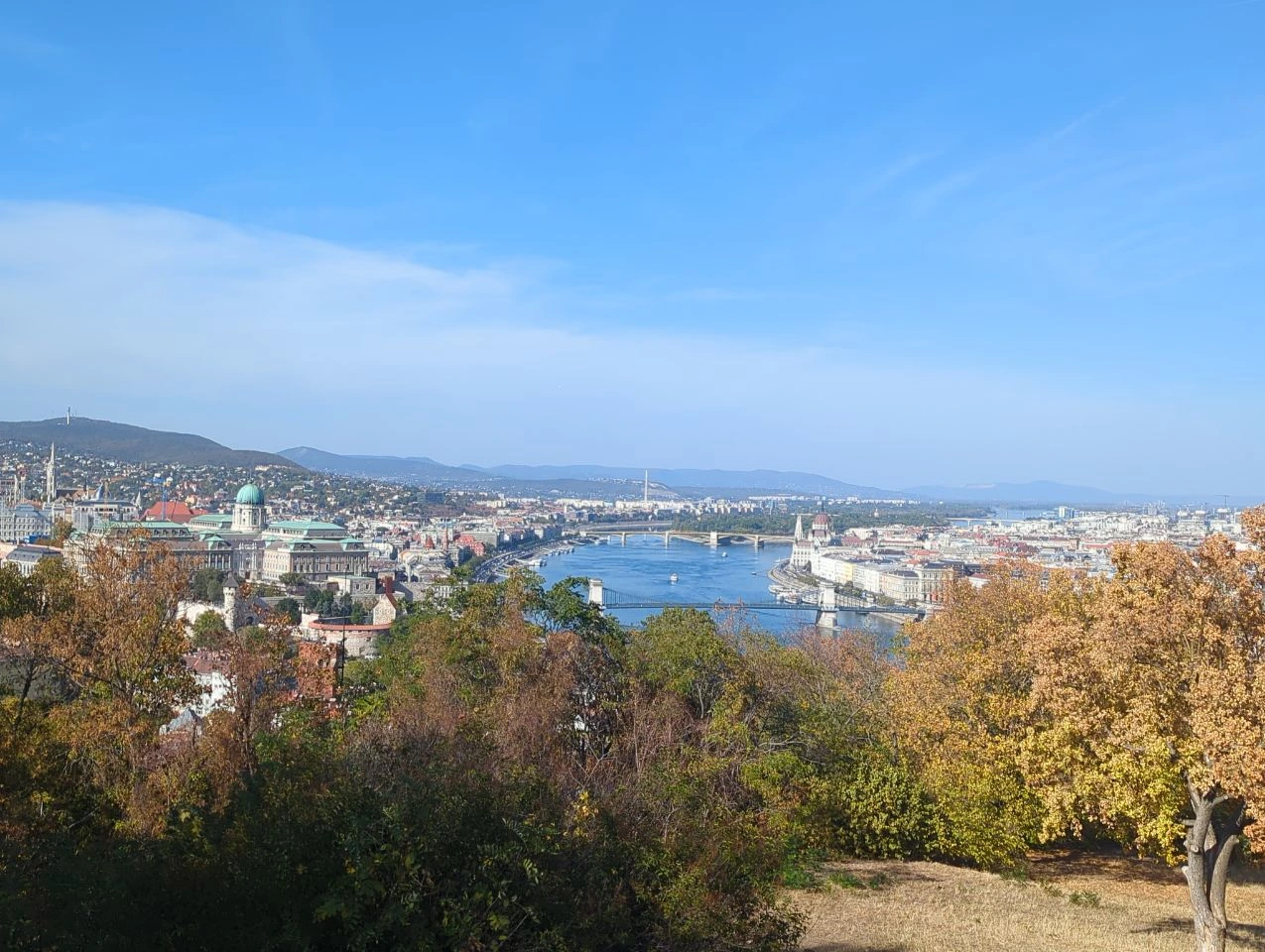
Gellért Hill places more emphasis on geography. From its broader positions, you can see the Danube running through the city, bridges connecting Buda and Pest, landmarks rising at different points and hills continuing beyond the centre. The image becomes less about one famous building and more about Budapest as a whole.
The choice also affects your scale within the frame. At Fisherman’s Bastion, you can remain the clear subject while the architecture and skyline establish the location. In a wide Gellért panorama, you may become a smaller part of a much larger cityscape. That can feel dramatic and expansive, but it will not suit everyone.
Fisherman’s Bastion or Buda Castle: Instant Icon or Room to Move?
Fisherman’s Bastion is particularly effective when you want one or two signature photographs. Its architecture provides ready-made frames and clear positions for the people being photographed, creating layered images that could only convincingly belong to Budapest.
Buda Castle supports a broader visual story rather than a collection built around one landmark. Its terraces, palace walls, courtyards and stairs allow you to walk, pause and change direction while the photographer moves between wider city views and more enclosed compositions. From some lower terraces, bridges, Parliament and church towers can share the background while leaving plenty of room for people in the foreground.
Buda Castle was quiet around sunrise during a visit on 2 October 2026, although crowd levels naturally vary with the season, weather, events and the particular terrace you choose. Its size may still provide alternatives if one area feels busy.
The distinction matters for proposals. Fisherman’s Bastion works well for a reveal built around one recognisable setting. Buda Castle gives a photographer more room to follow the approach, capture the reaction and continue into portraits without keeping the couple in one fixed composition.
Gellért Hill Is More Than One Photograph
During a visit on 1 October 2026, one lookout had circular seating and vegetation that made it feel softer and more sheltered than the exposed viewpoints nearby. The greenery connected people to the foreground and worked particularly well for relaxed portraits. This was only a snapshot of the location on that date. Seating may move, planting changes with the season and other visitors can affect how private the lookout feels.
A separate pale-paved lookout created cleaner, more urban lines. Its paving, railing and nearby stairs gave the composition a graphic quality. The stairs also allowed the photographer to stand somewhat higher than the people being photographed, bringing more of the city into view beyond the railing. This can improve the balance between the subject and skyline, although it will not guarantee a completely unobstructed view.
The broad panorama near the Citadella changes the scale again. The Danube, bridges, major landmarks and distant hills can share one wide composition. Parliament may be visible, but it will not necessarily dominate.
These viewpoints are not all beside one another or part of a confirmed photography route. The supplied position for the broad panorama is imprecise, and the observed lookouts have not been reliably matched to every free or ticketed Citadella zone. Confirm the exact position and current route before building one of these views into a timed session.
Why Foreground Can Matter More Than the Skyline
Architectural elements can frame the people in a photograph or reveal the city gradually behind them. Planting produces a softer setting, while paving, railings and strong lines create a cleaner urban feel. These details also help a photographer create variety without asking you to repeat similar poses against the same view.
Foreground becomes particularly important during a proposal. The exact position needs to provide a discreet approach, enough room for the reaction and a safe place from which the photographer can work. Those details should be planned for the chosen viewpoint rather than improvised in a narrow, crowded or exposed space.
A good viewpoint does not merely show Budapest behind you. It gives you a natural place within the scene.
The Museum Roof Offers a Different Budapest
The building rises in two curved wings, giving a photographer several ways to balance people against the architecture and surrounding landscape. More than 7,000 square metres of planting spread across the roof, softening its dramatic lines.
When checked on 10 October 2026, the public exterior portions were described as free, accessible from outside and open around the clock. It is still sensible to recheck before visiting, as maintenance, events or difficult weather can affect access.
The surrounding view is centred on City Park and Heroes’ Square rather than the Danube. The House of Music and Museum of Fine Arts can also form part of the wider setting. Parliament is listed among the distant landmarks that may be visible in suitable conditions, but this is not the right location if a prominent Parliament backdrop is essential.
The museum warns that steps and planted surfaces may become slippery. Visitors may also be asked to leave the roof during lightning. If you are planning to use a drone, tripod or lighting, check the museum’s photography rules first. Ordinary public access does not necessarily cover specialist equipment or an organised commercial production.
When Weather Changes the Best Choice
Haze does not automatically spoil a session. It changes what needs to carry the photographs. Fisherman’s Bastion can remain effective because its architectural foreground keeps the composition clear even when Parliament or the far bank becomes less distinct. A documented winter engagement session used fog to create softer architectural portraits there, although the density, colour and timing of fog cannot be predicted.
Buda Castle and the Museum of Ethnography roof also retain nearby structure when the horizon weakens. This gives a photographer something to work with even if the wider city view loses definition.
Wind and exposure matter too. A mild breeze at street level can feel much stronger on an open hill or roof. Heavy rain and unsafe surfaces are not creative challenges to push through. They are reasons to change the location, shorten the session or move somewhere safer.
Compare Budapest Viewpoints for Photography at a Glance
- For Parliament framed by architecture: choose Fisherman’s Bastion. It creates a recognisable Budapest composition, subject to current terrace access and ticket conditions.
- For varied environmental portraits: choose Buda Castle. It supports several compositions within one district, provided you confirm the route to your preferred camera positions.
- For a green portrait foreground: choose a leafy Gellért lookout. The softer setting depends on seasonal planting, seating and current access.
- For a clean urban panorama: choose a pale-paved Gellért lookout. Its strong lines work well, but check the steps, crowds and possible obstructions.
- For contemporary design and greenery: choose the Museum of Ethnography roof. Its modern architecture and planting are distinctive, with weather and surface restrictions to consider.
Fisherman’s Bastion and Buda Castle are the clearest historic pairing because they are in the same district. The exact connecting route and access to your preferred positions should still be checked.
Check the Effort and Access Before Committing
Some Citadella views could be reached without an exhibition ticket, while others could not. The inner park, wall-side viewpoints, panoramic promenade and Liberty Statue were listed as free during their applicable opening hours. Roof Garden 360 and the Round Bastion Terrace required admission to the Bastion of Liberty exhibition.
These categories do not confirm which arrangement applies to every observed camera position. Check the precise viewpoint instead of relying on the general name Gellért Hill or Citadella.
Bus 27 can reduce part of the climb, but official guidance still gives an approximate 500-metre walk from Búsuló Juhász. That does not mean every lookout has step-free access. Slopes, stairs, temporary diversions and the final approach all matter when mobility or comfort is a concern.
The Museum of Ethnography roof includes slopes and steps. General exterior access should not be confused with confirmed step-free access to every useful photographic position.
Fisherman’s Bastion and Buda Castle also contain several levels. Routes to specific camera positions have not been confirmed as step-free. If you need to minimise stairs, agree on the precise composition and approach with your photographer before committing.
Effort is not merely a transport detail. A demanding climb can affect clothing, comfort, timing and how relaxed you look on arrival. It can also make a discreet proposal approach more difficult. Build recovery time into a hilltop plan, and do not schedule the key moment immediately after the hardest part of the journey.
Opening times, tickets, maintenance work, construction routes and temporary closures can change. Recheck them shortly before your visit, particularly when one terrace or lookout is essential to the photographs you want.
Viewpoints to Check Before You Visit
When operating, the 57-metre tower involves 153 steps and admits a stated maximum of 30 people. Those figures suggest a substantial climb, but the available first-party visit on 2 October 2026 covered only the exterior and nearby theatre area. As the tower was closed during the visit, its views and current interior access could not be assessed.
St Stephen’s Basilica is not ready to join the panorama shortlist either. Its surrounding streets are well supported as portrait settings, but the available information does not establish current dome access, lift availability, remaining stairs, photography conditions or which landmarks appear prominently from the top.
Leaving these locations off the shortlist is not a judgement on their potential. It simply avoids building a time-sensitive plan around access or sightlines that still need checking.
Plan Your Budapest Photography Session
A local photographer can translate your visual priority into a realistic location and sequence while accounting for current access, walking effort, available space and the best light.
Explore Travaya’s Budapest photographers to find someone whose style suits the photographs you have in mind.
FAQs
Fisherman’s Bastion is usually the strongest choice. Selected Buda Castle and Buda-bank positions can also work, but Parliament’s apparent size will depend on the exact position, visibility and composition.
Yes, provided the selected lookout offers enough foreground and allows people to remain at the intended scale within the composition. Confirm the precise camera position in advance rather than choosing only by the general area name.
Prioritise a location with strong nearby structure instead of depending on a distant panorama. Fog can create a beautiful atmosphere, but no particular effect or level of visibility can be guaranteed.
The Museum of Ethnography roof is the best fit for that combination. Check current access and weather conditions before visiting.


Our Budapest Shoots:
Book your Budapest Photographer!
Start Booking
The Best Photo Spots in Budapest: Choose Your View, Light and Atmosphere

Buda Castle District Photo Spots: A Walk Through Terraces, Gateways and Gardens

Budapest Tram and Metro Photography: How to Frame Viewpoints, Movement and Station Design
A Couple Photoshoot at Fisherman’s Bastion: How the Session Unfolds

The Best Budapest Streets for Natural Couple Photos

How to Prepare for a Couple Photoshoot in Budapest
ENJOY $20 OFF
Your first photoshoot when you become an email subscriber.
Related Articles

The Best Photo Spots in Budapest: Choose Your View, Light and Atmosphere
Budapest gives you grand river views, pale stone terraces, green iron bridges, Austro-Hungarian architecture and quiet parkland. You do not need to fit all of them into one photoshoot. In this guide, we will compare the best photo spots in Budapest, explain how to combine them and show you what to check before finalising your plans.

Buda Castle District Photo Spots: A Walk Through Terraces, Gateways and Gardens
Budapest’s Castle District may look grand at first, but it offers far more than distant skylines and formal portraits. Within the same wider area, you can move from quiet streets and detailed stonework to arches, palace terraces, sculpture and planted gardens. In this guide, we’ll show you how to build a varied photo walk while adapting to the weather and whatever is accessible on the day.

Budapest Tram and Metro Photography: How to Frame Viewpoints, Movement and Station Design
Budapest gives you three distinct ways to photograph its public transport. You can frame a tram beneath Parliament or within the green ironwork of Liberty Bridge, slow down for the historic details of M1, or use M4’s deep spaces and repeating structures to create a more architectural image. There’s a particular satisfaction in preparing the composition, then watching a tram arrive at exactly the right moment. You don’t need to cover the whole network to produce a varied set of photographs. In this guide, you’ll learn how to choose the right visual approach, photograph movement safely from public areas and recognise when a simple personal photograph may be becoming a planned production.